
History
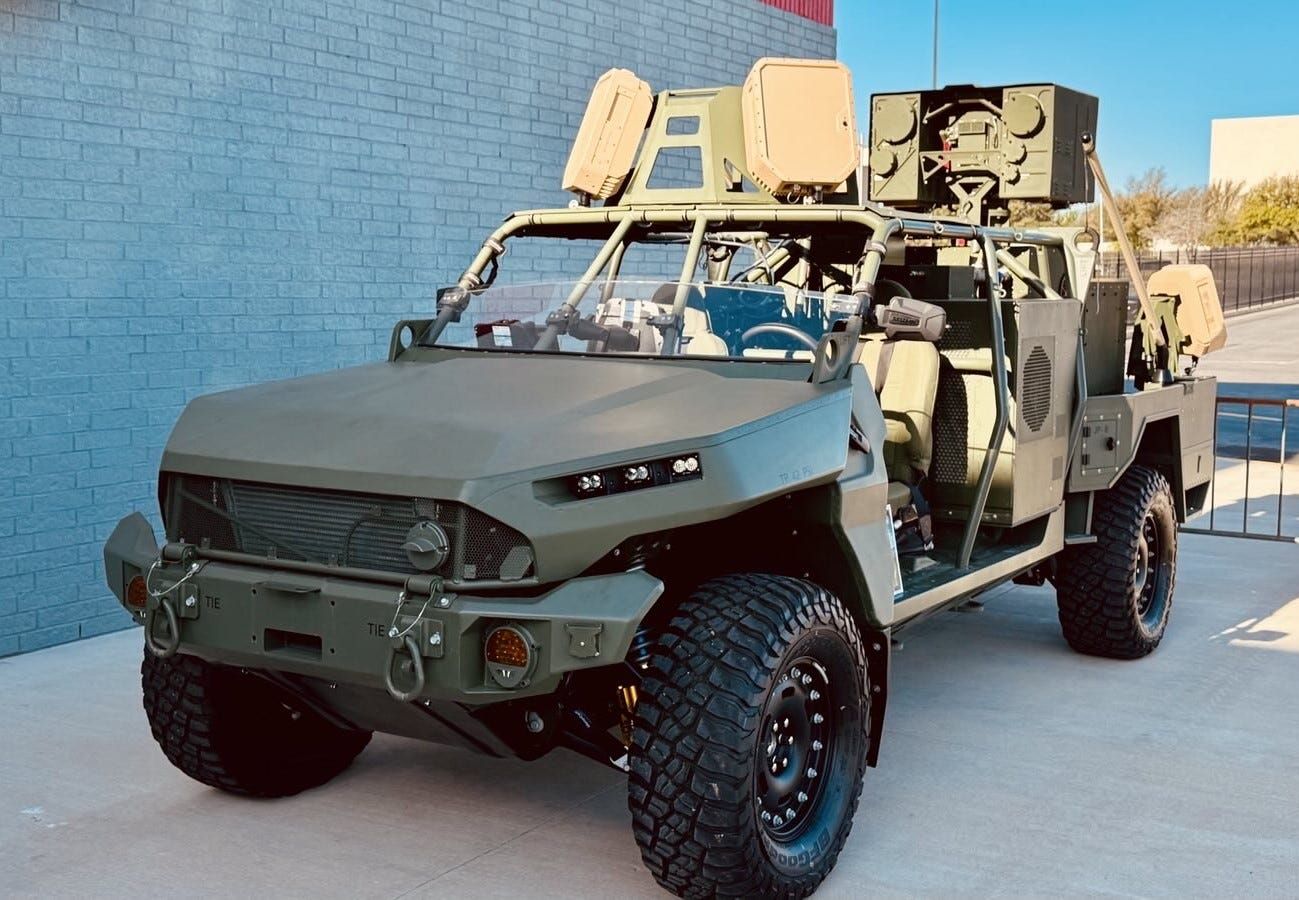
AMP-HEL, the Army Multi-Purpose High Energy Laser, is a U.S. Army mobile directed-energy system developed to provide a hard-kill counter-unmanned aircraft capability. The first prototype increment combines AeroVironment's 20 kW-class LOCUST laser weapon system with the General Motors Defense Infantry Squad Vehicle.
The vehicle-mounted configuration is intended to give maneuvering forces a counter-UAS weapon that can move with deployed units instead of remaining tied to a fixed defensive position. The Army has identified Group 1 and Group 2 unmanned aircraft systems as targets for the 20 kW-class prototype.
The program remained in prototype assessment during the documented 2026 testing period. The September 2026 Fort Bliss activity evaluated the system in an operationally relevant training environment, but does not by itself establish routine operational fielding.
Development and prototype delivery
AeroVironment delivered the first two AMP-HEL mobile counter-UAS prototype systems to the U.S. Army Rapid Capabilities and Critical Technologies Office in September 2025. These systems formed the first increment of the AMP-HEL prototyping effort and used LOCUST laser weapon systems integrated on General Motors Defense Infantry Squad Vehicles.
The prototypes were integrated at AeroVironment's directed-energy manufacturing facility in Albuquerque, New Mexico. They then underwent government acceptance testing at Yuma Proving Ground in Arizona, where the evaluation covered performance, mobility, safety, and lethality. Army personnel subsequently conducted new-equipment training at Fort Sill, Oklahoma.
In September 2025, AeroVironment also described a second AMP-HEL increment planned around two Joint Light Tactical Vehicles equipped with 20 kW-class LOCUST laser weapon systems, radar, and command-and-control equipment. This represented a broader configuration than the first ISV-mounted increment.
Fort Bliss assessment
On September 16, 2026, U.S. Army soldiers assigned to the 1st Armored Division and Joint Task Force-Southern Border prepared an ISV-mounted AMP-HEL for assessment during an exercise at Fort Bliss, Texas. The activity was conducted in support of Operation Ardent Vanguard and placed the system in a training environment connected with missions along the U.S. southern border.
The assessment examined the laser's capabilities, mobility, and integration with other systems supporting counter-drone operations. It also gave soldiers an opportunity to evaluate how the vehicle-mounted weapon could be repositioned and employed as part of a layered defensive network.
Operational employment of the ISV-mounted AMP-HEL on the border is not established by the documented September 2026 Army assessment. The confirmed Fort Bliss activity was an exercise and evaluation rather than evidence of routine operational fielding.
Design
The first AMP-HEL increment integrates AeroVironment's LOCUST laser weapon system on the General Motors Defense Infantry Squad Vehicle. This arrangement places a 20 kW-class directed-energy weapon on a lightweight and highly mobile tactical vehicle.
The system is intended for counter-unmanned aircraft missions. Its laser provides a hard-kill option against Group 1 and Group 2 unmanned aircraft systems, allowing the weapon to physically disable or destroy a target rather than relying only on electronic disruption.
The ISV-mounted architecture emphasizes mobility and integration with maneuvering forces. The Fort Bliss assessment specifically examined how soldiers could reposition the system and use it alongside other capabilities supporting counter-UAS operations.
Laser weapon system
The weapon subsystem is the AeroVironment LOCUST laser weapon system in a 20 kW-class configuration. The available program information identifies performance, safety, mobility, lethality, precision tracking, and targeting as important elements of the prototype evaluation and development process.
Vehicle integration
The first increment uses the General Motors Defense Infantry Squad Vehicle as its carrier. Integrating the laser on the ISV is intended to provide an expeditionary counter-UAS capability that can accompany forces and be repositioned as operational requirements change.
Program status
AMP-HEL was undergoing soldier-level assessment during the documented September 2026 Fort Bliss exercise. The first two ISV-mounted prototypes had already completed integration, government acceptance testing, and Army new-equipment training following their delivery in 2025.
The program is part of the U.S. Army's effort to develop mobile directed-energy defenses against drones and other airborne threats. Soldier feedback from prototype activities is intended to support further refinement of the system.
Variants
- AMP-HEL first increment: Two prototype systems using 20 kW-class AeroVironment LOCUST laser weapon systems integrated on General Motors Defense Infantry Squad Vehicles. The prototypes were delivered to the U.S. Army in September 2025.
- AMP-HEL second increment: A configuration described in 2025 around two Joint Light Tactical Vehicles carrying 20 kW-class LOCUST laser weapon systems together with radar and command-and-control equipment.
Specifications (AMP-HEL first increment)
General characteristics
- Type: Mobile high-energy laser counter-unmanned aircraft system.
- Laser weapon: AeroVironment LOCUST Laser Weapon System.
- Laser class: 20 kW-class.
- Carrier vehicle: General Motors Defense Infantry Squad Vehicle.
- Primary mission: Mobile counter-UAS defense.
- Target classes: Group 1 and Group 2 unmanned aircraft systems.
- Engagement method: Directed-energy hard kill.
 Argentina
 Armenia
 Australia
 Austria
 Austria-Hungary
 Belgium
 Brazil
 United Kingdom
 Brunei
 Bulgaria
 Canada
 Chile
Chile China
China Colonial America
 Colombia
 Confederate States
 Croatia
 Czech
Czech Denmark
 Egypt
Egypt Finland
 France
 Georgia
 Germany
 German Imperial
 Greece
 Holland
 Hungary
 India
India Indonesia
 Iran
Iran Iraq
Iraq Ireland
 Israel
 Italy
Italy Japan
Japan Japan (1940)
 Jordan
 Kingdom of Italy
 Malaysia
 Mexico
 Myanmar
 Nazi Germany
 Netherlands
 New Zealand
 North Korea
 Norway
 Pakistan
 Peru
Peru Philippines
 Poland
 Portugal
 Prussia
 Romania
 Russia
 Saudi Arabia
 Serbia
 Singapore
 Slovakia
 Slovenia
 South Africa
 South Korea
 Soviet Union
 Spain
Spain Sweden
 Switzerland
 Syria
Syria Taiwan
 Thailand
 Turkey
 UAE
UAE Ukraine
 Vietnam
 Yugoslavia