
History
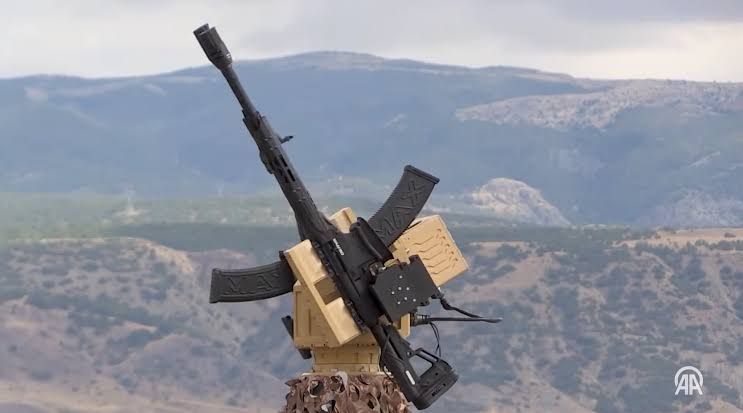
Turaç developed the Dron Kalkanı, also rendered as Drone Kalkanı or Drone Shield, as a close-range counter-UAV turret for protecting military vehicles, facilities, and other platforms from FPV and small drones.
The system was designed for the final stage of an incoming drone attack, when reaction time is limited. Its combination of passive sensing, automatic target processing, and twin 12-gauge shotguns is intended to provide a hard-kill option against drones that reach the defended platform despite other protective measures.
A prototype existed and underwent live testing in 2026, including installation on a pickup-type vehicle and engagement of a small multirotor drone. Turaç planned operational readiness and serial-production capability before the end of 2026.
Development
The development program combined equipment from several Turkish participants. Turaç led the Dron Kalkanı project and supplied Sterling anti-drone ammunition. Derya Arms supplied the 12-gauge shotguns. Lasersan provided electro-optical and acoustic sensing elements together with the robotic turret, while Urban Savunma handled mechanical and vehicle integration. Istanbul Technical University's Aerospace Research Centre contributed to algorithm development.
The design requirement emphasized immediate reaction to fast, low-flying FPV drones. The weapons remain loaded and ready on the remotely controlled turret so that the mount can slew toward a detected target and fire during the short terminal engagement window.
The system was also intended to counter fiber-optic-controlled FPV drones. Such aircraft do not depend on a conventional radio-frequency command link and therefore cannot be stopped solely by disrupting that link with conventional radio-frequency jamming.
Turaç planned to present Dron Kalkanı at MÜSİAD EXPO 2026 in Istanbul on 23–26 September 2026. The company stated that the system was expected to reach operational readiness and serial-production capability before the end of the year.
Design
Dron Kalkanı is built around a remotely operated pan-and-tilt turret carrying two semi-automatic Derya MAX 12-gauge shotguns. The arrangement allows both weapons to fire simultaneously, creating a dense pattern of projectiles across the flight path of an approaching drone.
Sensors and fire control
The turret uses visual tracking supported by electro-optical and acoustic sensors. Image-processing and acoustic-sensor algorithms perform target detection, classification, tracking, and firing-solution calculations. The system can detect and track targets at approximately 600–800 m.
The passive sensor arrangement was selected partly to reduce electrical demand and overall turret weight. The module can operate from a platform's standard onboard electrical system without requiring an additional generator.
Armament and ammunition
The turret carries two Derya MAX semi-automatic 12-gauge shotguns. The Derya MAX, also identified as the MK-12, is a gas-operated smoothbore weapon based on an AR-15-style layout and uses detachable magazines.
Dron Kalkanı uses Sterling anti-drone ammunition developed by Turaç to create a wider projectile pattern against small aerial targets. At an engagement distance of about 150 m, the two shotguns can fire together to place a dense projectile cloud in the target's path.
Platform integration
The compact turret is designed for installation on multiple types of platforms. Supported integration concepts include wheeled and tracked armored vehicles, unmanned ground vehicles, naval platforms, and fixed-site defensive positions. Prototype testing also demonstrated installation on a pickup-type vehicle.
Program status
As of September 2026, Dron Kalkanı was represented by a physical prototype that had been used in live testing against a small multirotor drone. The system had not yet been described as a fielded production system. Turaç targeted operational readiness and serial production before the end of 2026.
Specifications (Dron Kalkanı prototype)
General characteristics
- Type: Close-range counter-UAV remote weapon turret
- Developer: Turaç
- Country of development: Turkey
- Turret configuration: Remotely operated pan-and-tilt mount
- Intended targets: FPV drones and other small unmanned aerial vehicles
- Supported platforms: Wheeled and tracked armored vehicles, unmanned ground vehicles, naval platforms, and fixed installations
- Power: Standard platform onboard electrical supply without a dedicated additional generator
Sensors and engagement
- Sensors: Electro-optical and acoustic sensors with visual tracking
- Target processing: Automated detection, classification, tracking, and firing-solution calculation
- Detection and tracking distance: Approximately 600–800 m
- Hard-kill engagement distance: Approximately 150 m
Armament
- Weapons: Two Derya MAX semi-automatic 12-gauge shotguns
- Fire method: Simultaneous fire from both shotguns for a dense projectile pattern
- Ammunition: Turaç Sterling anti-drone 12-gauge ammunition
 Argentina
 Armenia
 Australia
 Austria
 Austria-Hungary
 Belgium
 Brazil
 United Kingdom
 United States
 Brunei
 Bulgaria
 Canada
 Chile
Chile China
China Colonial America
 Colombia
 Confederate States
 Croatia
 Czech
Czech Denmark
 Egypt
Egypt Finland
 France
 Georgia
 Germany
 German Imperial
 Greece
 Holland
 Hungary
 India
India Indonesia
 Iran
Iran Iraq
Iraq Ireland
 Israel
 Italy
Italy Japan
Japan Japan (1940)
 Jordan
 Kingdom of Italy
 Malaysia
 Mexico
 Myanmar
 Nazi Germany
 Netherlands
 New Zealand
 North Korea
 Norway
 Pakistan
 Peru
Peru Philippines
 Poland
 Portugal
 Prussia
 Romania
 Russia
 Saudi Arabia
 Serbia
 Singapore
 Slovakia
 Slovenia
 South Africa
 South Korea
 Soviet Union
 Spain
Spain Sweden
 Switzerland
 Syria
Syria Taiwan
 Thailand
 UAE
UAE Ukraine
 Vietnam
 Yugoslavia