
History
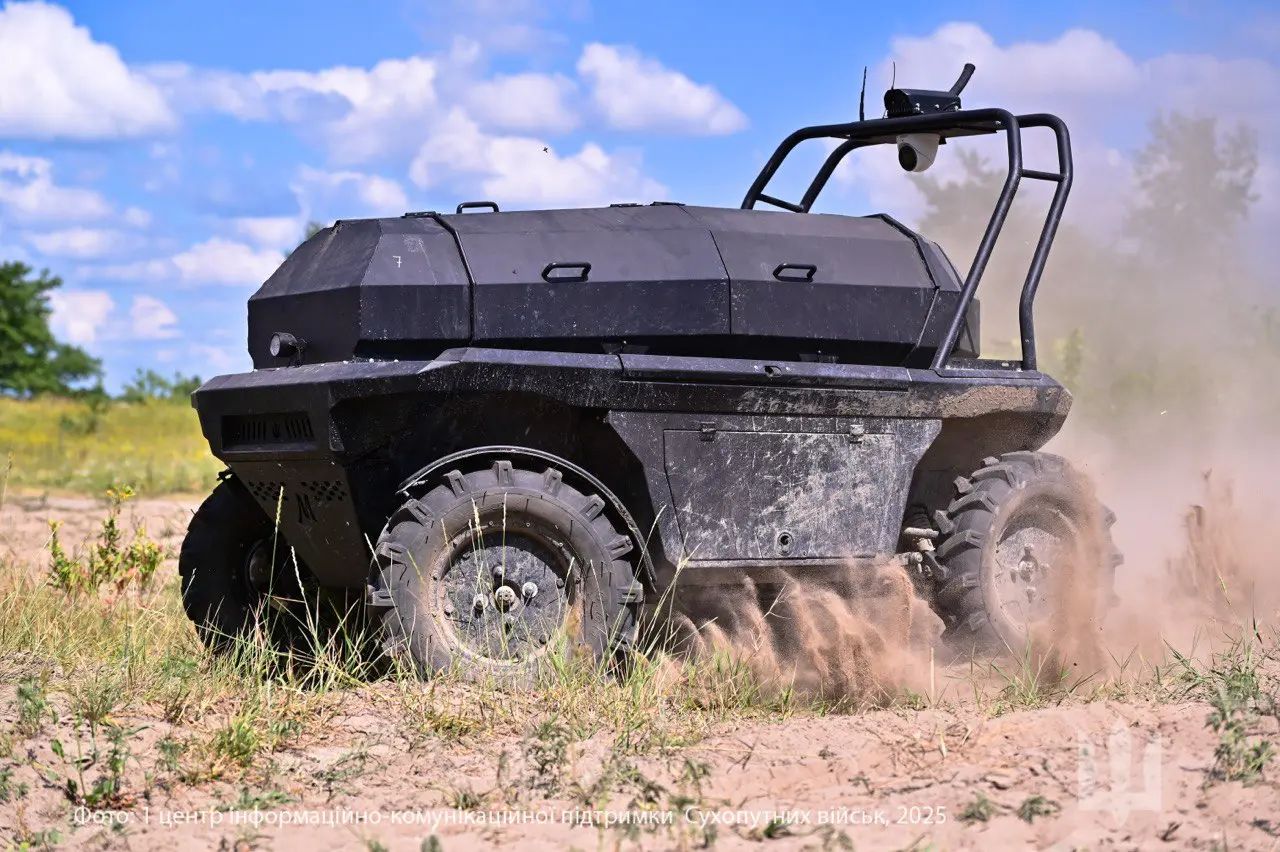
The AIDronesUA MAUL is a Ukrainian 4×4 unmanned ground vehicle developed primarily for casualty evacuation from hazardous frontline areas. Its design allows a wounded person to be transported inside a protected capsule without exposing a medical evacuation team to the same level of battlefield risk.
MAUL is also a multifunctional platform. Its 200 kg payload capacity allows it to carry supplies, ammunition and other cargo, while the platform can also be configured with a remote-controlled weapon station.
Development has been driven primarily by feedback from soldiers using the vehicle rather than by artificial intelligence. By 2026, MAUL was in operational use in Ukraine and continued to be refined from battlefield experience.
Development and field refinement
MAUL was developed by the Ukrainian company AIDronesUA as a vehicle capable of moving casualties across difficult terrain under conditions shaped by widespread aerial surveillance, artillery fire, mines and attack drones. The vehicle combines four-wheel drive, independent suspension at all four wheels and relatively high road and off-road speed with a low-profile chassis.
The casualty-evacuation configuration uses a protected transport capsule. The patient is secured with three restraint straps, while structural protection limits movement against the interior during travel. An interior camera allows the operator or medical personnel to monitor the casualty during evacuation. The capsule has also been described as using polypropylene armor intended to protect the occupant from drone-dropped munitions and artillery fragments.
Industrial partnership
In June 2026, AIDronesUA and the Swedish company Njord Technology AB signed a memorandum of strategic partnership covering planned joint production of MAUL in Sweden and cooperation on future robotic systems. The agreement was intended to expand manufacturing capacity while retaining Ukrainian battlefield experience as a basis for further development. At that time, the price of a MAUL was stated as approximately UAH 1 million to UAH 1.5 million, depending on the communications system installed.
Design
Chassis and mobility
MAUL uses a four-wheel-drive chassis with suspension on all four wheels. The vehicle is 2.30 m long, 1.45 m wide and 0.62 m high, with 200 mm of ground clearance. Operating weight is 420 kg and permissible gross weight is 620 kg, providing a payload capacity of 200 kg.
The vehicle is powered by a combustion engine supplied from a 15 L tank using premium gasoline. Maximum speed is stated as 50 km/h on paved roads and 40 km/h on unpaved tracks. Stated range is 110 km on paved roads and 100 km off-road, while tactical operating radius is 50 km.
For cross-country operation, MAUL is designed to negotiate inclines of up to 30 degrees and lateral slopes of up to 25 degrees. The combination of all-wheel drive, suspension and 200 mm ground clearance is intended to improve mobility over broken terrain.
Casualty evacuation system
The core MAUL configuration is optimized for casualty evacuation. A wounded person is placed inside the protected transport capsule and restrained for movement across uneven terrain. The enclosed arrangement reduces the need for personnel to accompany the vehicle into highly exposed areas, while the interior camera provides visual monitoring during transport.
Modular roles
Although casualty evacuation is MAUL's primary mission, its 200 kg payload capacity supports additional roles including logistics support, ammunition delivery and general cargo transport. The platform can also accept a remote-controlled weapon station, although the medical evacuation configuration remains distinct from an armed configuration.
Operational history
MAUL has been used by Ukrainian forces during the Russia-Ukraine war. In one documented mission, the Ukrainian 1st Medical Battalion used a MAUL to retrieve a wounded soldier from approximately 64 km inside Russian-held territory. During the return movement, the vehicle was subjected to repeated drone attacks and survived at least one mine blast. The wounded soldier survived inside the protected casualty capsule.
The vehicle's continued development reflects a broader Ukrainian practice of modifying unmanned ground systems in response to direct operator feedback. For MAUL, this feedback loop has been a major source of practical improvements to the platform.
Operators
- Ukraine — Used by Ukrainian forces for casualty evacuation and other unmanned ground support tasks, including documented employment by the 1st Medical Battalion.
Specifications (MAUL casualty-evacuation configuration)
General characteristics
- Configuration: 4×4 unmanned ground vehicle
- Length: 2.30 m
- Width: 1.45 m
- Height: 0.62 m
- Ground clearance: 200 mm
- Operating weight: 420 kg
- Permissible gross weight: 620 kg
- Payload: 200 kg
- Powerplant: Combustion engine
- Fuel capacity: 15 L
- Fuel: Premium gasoline
Performance
- Maximum speed on paved roads: 50 km/h
- Maximum speed on unpaved tracks: 40 km/h
- Road range: 110 km
- Off-road range: 100 km
- Tactical operating radius: 50 km
- Maximum incline: 30 degrees
- Maximum lateral slope: 25 degrees
Casualty evacuation equipment
- Patient accommodation: Protected evacuation capsule
- Restraint system: Three patient restraint straps
- Monitoring: Interior camera
- Suspension: Suspension on all four wheels
 Argentina
 Armenia
 Australia
 Austria
 Austria-Hungary
 Belgium
 Brazil
 United Kingdom
 United States
 Brunei
 Bulgaria
 Canada
 Chile
Chile China
China Colonial America
 Colombia
 Confederate States
 Croatia
 Czech
Czech Denmark
 Egypt
Egypt Finland
 France
 Georgia
 Germany
 German Imperial
 Greece
 Holland
 Hungary
 India
India Indonesia
 Iran
Iran Iraq
Iraq Ireland
 Israel
 Italy
Italy Japan
Japan Japan (1940)
 Jordan
 Kingdom of Italy
 Malaysia
 Mexico
 Myanmar
 Nazi Germany
 Netherlands
 New Zealand
 North Korea
 Norway
 Pakistan
 Peru
Peru Philippines
 Poland
 Portugal
 Prussia
 Romania
 Russia
 Saudi Arabia
 Serbia
 Singapore
 Slovakia
 Slovenia
 South Africa
 South Korea
 Soviet Union
 Spain
Spain Sweden
 Switzerland
 Syria
Syria Taiwan
 Thailand
 Turkey
 UAE
UAE Vietnam
 Yugoslavia