History
Valinor HarborPOD is a modular casualty-evacuation and logistics payload designed for unmanned vehicles. It allows a compatible unmanned platform to transport supplies toward the battlefield and evacuate a wounded person on the return journey.
The system combines a protected patient compartment with medical monitoring, communications, environmental control, and HarborOS software. It is intended to transmit patient information to medical personnel while the casualty is being transported.
HarborPOD is related to Valinor's larger Harbor deployable medical system but serves a different role. HarborPOD is intended to move a casualty from the battlefield toward a Harbor facility or another medical treatment location rather than provide the full treatment capabilities of the larger Harbor modules.
Development and testing
Valinor publicly unveiled HarborPOD in August 2026 as a payload for unmanned casualty evacuation and logistics resupply. According to Tectonic Defense, the company described the system as platform-agnostic and intended it for installation on different unmanned vehicles.
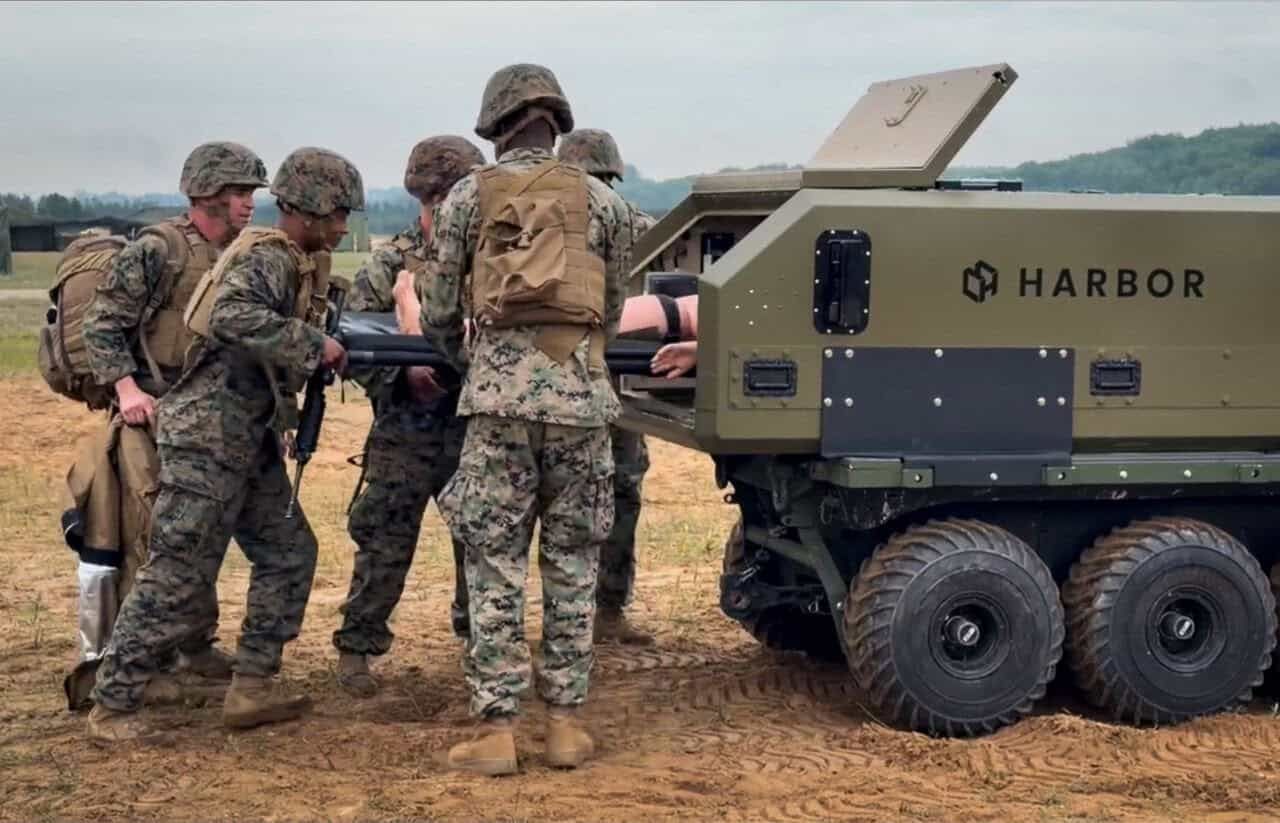
By August 2026, HarborPOD had already been tested with U.S. Marine Corps personnel. It was also used during the Northern Strike exercise in Michigan and subsequently taken to the T-REX event in North Dakota. Militarnyi also reported testing of the modular system by U.S. military personnel using an unmanned ground vehicle.
Valinor stated that it was discussing the system with the U.S. Army, Navy, and Marine Corps. The available information describes testing and evaluation rather than operational service.
Design
HarborPOD is a compact containerized module that can carry one casualty on a litter. It is designed to be mounted on unmanned platforms without requiring a dedicated casualty-evacuation vehicle design.
The module is hardened against blast effects and gunfire and includes climate control for the patient compartment. Multiple access points are provided to simplify loading a casualty. Valinor stated that the system is intended to require minimal configuration after the patient has been placed inside and connected to the monitoring equipment.
HarborOS and medical monitoring
Each HarborPOD uses HarborOS software to combine information from patient sensors, cameras, and the host vehicle. Supported functions include wireless monitoring of vital signs, two-way audio and video communications, patient tracking, and status updates.
The system can transmit patient information to the medical team receiving the casualty. This allows personnel at the destination to prepare equipment and plan treatment before the patient arrives. HarborPOD also includes Class VIII medical-supply forecasting and logistics support and is intended to interoperate with different command-and-control systems and partner platforms.
Platform integration
HarborPOD was described as compatible with unmanned ground vehicles and unmanned surface vessels. Valinor also identified unmanned aerial vehicles as a possible future host platform. This proposed aerial application had not been described as an operational capability in the available 2026 information.
Testing described in August 2026 included the module installed on an unmanned ground vehicle. The intended logistics concept allows such a vehicle to deliver cargo on an outward journey and carry a casualty during its return movement.
Program status
As of August 2026, HarborPOD was undergoing military testing and demonstrations. Testing with the U.S. Marine Corps and participation in Northern Strike and T-REX showed that physical systems existed during 2026, but the available sources do not establish operational fielding or series production.
Valinor presented HarborPOD as part of a broader approach to distributed battlefield medicine. The related Harbor medical system provides deployable treatment facilities, while HarborPOD is intended to connect wounded personnel with those facilities or other medical centers through unmanned transportation.
Specifications (HarborPOD)
General characteristics
- Type: Modular casualty-evacuation and logistics payload for unmanned vehicles
- Patient capacity: One casualty on a litter with full equipment
- Payload capacity: More than approximately 136 kg (300 lb)
- Protection: Hardened against blast effects and gunfire
- Environmental system: Climate-controlled patient compartment
- Access: Multiple patient-loading entry points
Medical and communications equipment
- Patient monitoring: Wireless vital-sign monitoring
- Communications: Two-way audio and video
- Patient management: Patient tracking and status updates
- Software: HarborOS
- Logistics support: Class VIII forecasting and medical-logistics support
- Integration: Interoperability with different command-and-control systems and partner platforms
Compatible platforms
- Unmanned ground vehicles: Supported
- Unmanned surface vessels: Supported
- Unmanned aerial vehicles: Identified as a future integration option
 Argentina
 Armenia
 Australia
 Austria
 Austria-Hungary
 Belgium
 Brazil
 United Kingdom
 United States
 Brunei
 Bulgaria
 Canada
 Chile
Chile China
China Colonial America
 Colombia
 Confederate States
 Croatia
 Czech
Czech Denmark
 Egypt
Egypt Finland
 France
 Georgia
 Germany
 German Imperial
 Greece
 Holland
 Hungary
 India
India Indonesia
 Iran
Iran Iraq
Iraq Ireland
 Israel
 Italy
Italy Japan
Japan Japan (1940)
 Jordan
 Kingdom of Italy
 Malaysia
 Mexico
 Myanmar
 Nazi Germany
 Netherlands
 New Zealand
 North Korea
 Norway
 Pakistan
 Peru
Peru Philippines
 Poland
 Portugal
 Prussia
 Romania
 Russia
 Saudi Arabia
 Serbia
 Singapore
 Slovakia
 Slovenia
 South Africa
 South Korea
 Soviet Union
 Spain
Spain Sweden
 Switzerland
 Syria
Syria Taiwan
 Thailand
 Turkey
 UAE
UAE Ukraine
 Vietnam
 Yugoslavia