
History
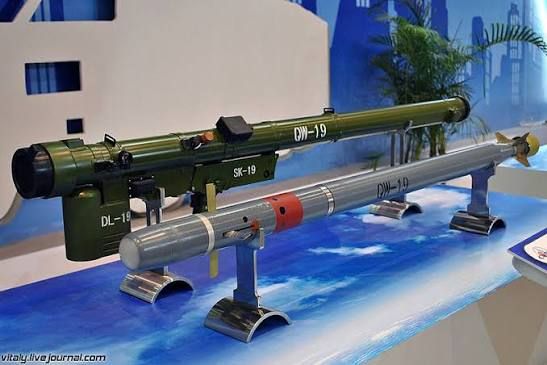
The QW-19 is a Chinese man-portable surface-to-air missile system in the Qianwei family developed by China Aerospace Science and Industry Corporation. It is an improved development of the QW-18 and is intended for very-short-range air defense against low-flying aerial targets.
The QW-19 was publicly revealed at the 2014 Zhuhai Airshow. Its development built on the QW-18, which had appeared in 2006 with a dual-band passive infrared seeker intended to improve resistance to infrared countermeasures.
The QW-19 introduced further changes to the seeker and firing equipment, including all-aspect engagement capability, a digital seeker, a revised battery, an improved cooling system, and a new firing unit.
Development
The QW series evolved from earlier Chinese man-portable air-defense systems. The QW-18 represented an improvement over earlier Qianwei designs through its dual-band infrared seeker, which could track different infrared characteristics of an aircraft and improve discrimination against countermeasures. The QW-19 continued this development with updated electronics and support equipment.
The QW-19 was revealed in 2014 alongside continuing Chinese development of increasingly capable short-range air-defense missiles. Its configuration retained the portable launch-tube arrangement characteristic of the Qianwei family while introducing improvements intended to increase engagement flexibility and seeker performance.
Possible Russian appearance
In September 2026, an unmarked man-portable air-defense system was shown during training with a mobile fire group of Russia's 51st Air Defense Division in Rostov Oblast. The launcher did not closely match established Russian MANPADS and showed similarities to the Chinese QW-18A and QW-19 as well as the Iranian Misagh-3.
Visual details, including an additional element near the front of the launcher, appeared more consistent with a Chinese Qianwei-family system than with available images of the Misagh-3. However, the available imagery did not permit a reliable distinction between the QW-18 and QW-19. Russia therefore cannot be treated as a confirmed QW-19 operator on the basis of this appearance alone. Pasted text
Design
The QW-19 is a shoulder-launched very-short-range surface-to-air missile system. The operator carries the missile in a launch tube with an associated firing unit, allowing the weapon to be deployed by infantry without a dedicated vehicle launcher.
Guidance
The system uses passive infrared guidance derived from the dual-band seeker technology of the QW-18. The QW-19 is described as having a digital seeker and all-aspect target engagement capability, allowing acquisition from a wider range of target approach angles than older tail-aspect infrared missiles. Improved cooling and revised electrical power equipment support the seeker and firing system.
Technical descriptions also identify an impact and laser-proximity fuze arrangement. A proximity fuze allows the warhead to detonate close to a target even when a direct impact is not achieved, an important characteristic when engaging small or maneuvering aerial targets.
Targets
The QW-19 is intended for low-altitude air defense against aircraft, helicopters, and unmanned aerial vehicles. Its portability allows small ground units to provide local air defense without relying on a larger vehicle-mounted missile system.
Program status
The QW-19 has been publicly known since its 2014 unveiling and is described as an active member of the Qianwei MANPADS family. Public information on production quantities, confirmed customers, and unit-level deployment remains limited.
Claims concerning Russian possession in 2026 remain uncertain because the system shown in Russian service could not be conclusively distinguished from the related QW-18 or other Qianwei-derived systems.
Specifications (QW-19)
General characteristics
- Type: Man-portable surface-to-air missile system
- Country of origin: China
- Developer: China Aerospace Science and Industry Corporation
- Missile length: approximately 1.526 m
- Launch tube length: approximately 1.576 m
- Missile diameter: approximately 71 mm
- Propulsion: solid-fuel rocket motor
- Warhead: high-explosive fragmentation
- Guidance: dual-band passive infrared seeker with digital processing
- Fuze: impact and laser-proximity fuze
Performance
- Effective range: approximately 0.5-5 km to 0.5-6 km, depending on the published specification
- Maximum engagement altitude: approximately 4,000-4,500 m
- Missile speed: approximately 600-660 m/s
- Engagement capability: all-aspect infrared targeting
Related equipment
- QW-18: Earlier Qianwei MANPADS on which the QW-19 was developed, using a dual-band passive infrared seeker.
- QW-12: Another Chinese Qianwei-family MANPADS revealed in 2014 and developed from the QW-2.
- Misagh-3: Iranian MANPADS derived from the Chinese QW family and externally similar to later Qianwei systems.
- Anza series: Pakistani man-portable air-defense systems based on earlier Chinese Qianwei designs.
 Argentina
 Armenia
 Australia
 Austria
 Austria-Hungary
 Belgium
 Brazil
 United Kingdom
 United States
 Brunei
 Bulgaria
 Canada
 Chile
Chile Colonial America
 Colombia
 Confederate States
 Croatia
 Czech
Czech Denmark
 Egypt
Egypt Finland
 France
 Georgia
 Germany
 German Imperial
 Greece
 Holland
 Hungary
 India
India Indonesia
 Iran
Iran Iraq
Iraq Ireland
 Israel
 Italy
Italy Japan
Japan Japan (1940)
 Jordan
 Kingdom of Italy
 Malaysia
 Mexico
 Myanmar
 Nazi Germany
 Netherlands
 New Zealand
 North Korea
 Norway
 Pakistan
 Peru
Peru Philippines
 Poland
 Portugal
 Prussia
 Romania
 Russia
 Saudi Arabia
 Serbia
 Singapore
 Slovakia
 Slovenia
 South Africa
 South Korea
 Soviet Union
 Spain
Spain Sweden
 Switzerland
 Syria
Syria Taiwan
 Thailand
 Turkey
 UAE
UAE Ukraine
 Vietnam
 Yugoslavia