
History
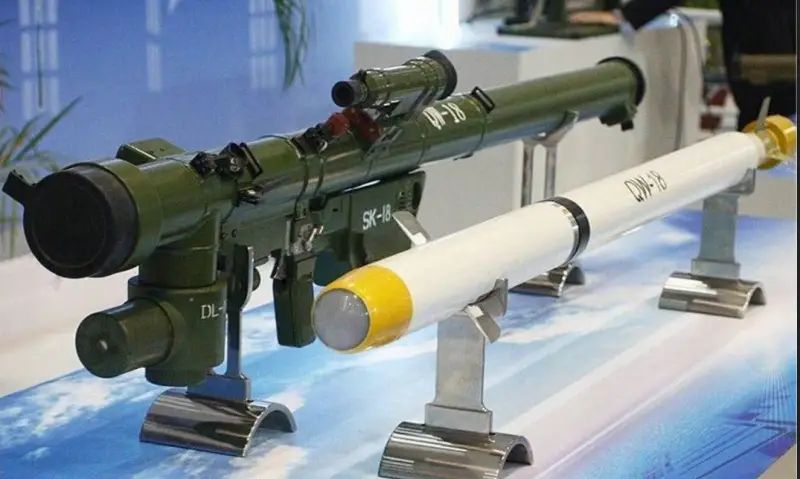
The CASIC QW-18 is a Chinese man-portable air-defense system designed for short-range engagement of low- and very-low-altitude aircraft. It is a shoulder-fired surface-to-air missile system intended for mobile air-defense units and for the protection of important battlefield locations.
The QW-18 was revealed at the 2006 Zhuhai Airshow as a further development of the earlier QW family. Its principal improvement is a dual-band passive infrared seeker designed to improve resistance to infrared countermeasures by tracking different infrared characteristics of the target.
The system can engage fixed-wing aircraft, armed helicopters, transport aircraft and unmanned aerial vehicles. Its published engagement envelope extends to a slant range of 5 km and an altitude of 4 km.
Development of the QW family followed earlier Chinese man-portable air-defense systems. The QW-18 represented a further improvement of the QW-11/QW-1 line and was publicly shown in 2006. A later derivative, the QW-19, was revealed in 2014 with additional improvements to the seeker, firing unit, battery and cooling system.
In September 2026, an unidentified man-portable air-defense system appeared during exercises involving a mobile air-defense group of Russia's 51st Air Defense Division in Rostov Oblast. Personnel referred to the weapon as "Iva." The unmarked launcher visually resembled Chinese QW-18A/QW-19 systems and the Iranian Misagh-3, but the available imagery did not allow the exact model or origin to be confirmed. Russian use of the QW-18 therefore remains unconfirmed.
Design
Missile and launcher
The QW-18 is configured as a shoulder-fired missile system. The complete system has a published weight of 18 kg. The launch tube weighs 4 kg and the firing unit weighs 1.7 kg. The system is designed for rapid deployment, with conversion from matching to operational readiness stated as no more than 10 seconds.
The missile has a published flight speed of 600 m/s. It is intended to engage targets moving at speeds of up to 300 m/s and can maneuver at a maximum stated overload of 16 g. The missile has a self-destruction time of 14 to 18 seconds.
Guidance
The QW-18 uses a dual-band passive infrared seeker. The seeker is designed to observe both the target body and its infrared plume, improving target discrimination and resistance to infrared countermeasures. The system is intended for omnidirectional engagement of approaching, crossing or receding targets within its supported engagement limits.
Employment
The system is intended to provide local air defense for motorized infantry, artillery and airborne forces. It can also protect battlefield locations such as command centers, bridges, airports and ferry sites. The QW-18 can be integrated with other air-defense weapons as part of a wider defensive network.
Published environmental limits give an operating temperature range from -40 °C to +60 °C and a shelf life of 10 years.
Related equipment
- QW-11: An earlier member of the QW family from which the QW-18 was further developed.
- QW-19: A later improved development of the QW-18 revealed in 2014. It introduced all-aspect targeting improvements, a new firing unit, a digital seeker, a revised battery and an improved cooling system.
- Misagh-3: An Iranian locally produced system associated with the QW-18 design.
Specifications (QW-18)
General characteristics
- Type: Man-portable surface-to-air missile system
- Launch mode: Shoulder-fired
- Total system weight: 18 kg
- Launch tube weight: 4 kg
- Firing unit weight: 1.7 kg
- Operating temperature: -40 °C to +60 °C
- Shelf life: 10 years
Performance
- Lethal slant range: 500-5,000 m
- Interception altitude: 10-4,000 m
- Maximum target speed: 300 m/s
- Missile speed: 600 m/s
- Maximum overload: 16 g
- Readiness conversion time: No more than 10 seconds
- Self-destruction time: 14-18 seconds
Guidance
- Seeker: Dual-band passive infrared
- Engagement: Omnidirectional
- Counter-countermeasures: Designed for improved resistance to infrared jamming and decoys
 Argentina
 Armenia
 Australia
 Austria
 Austria-Hungary
 Belgium
 Brazil
 United Kingdom
 United States
 Brunei
 Bulgaria
 Canada
 Chile
Chile Colonial America
 Colombia
 Confederate States
 Croatia
 Czech
Czech Denmark
 Egypt
Egypt Finland
 France
 Georgia
 Germany
 German Imperial
 Greece
 Holland
 Hungary
 India
India Indonesia
 Iran
Iran Iraq
Iraq Ireland
 Israel
 Italy
Italy Japan
Japan Japan (1940)
 Jordan
 Kingdom of Italy
 Malaysia
 Mexico
 Myanmar
 Nazi Germany
 Netherlands
 New Zealand
 North Korea
 Norway
 Pakistan
 Peru
Peru Philippines
 Poland
 Portugal
 Prussia
 Romania
 Russia
 Saudi Arabia
 Serbia
 Singapore
 Slovakia
 Slovenia
 South Africa
 South Korea
 Soviet Union
 Spain
Spain Sweden
 Switzerland
 Syria
Syria Taiwan
 Thailand
 Turkey
 UAE
UAE Ukraine
 Vietnam
 Yugoslavia