
History
The HQ-9B is a Chinese long-range, high-altitude surface-to-air missile system developed by China Aerospace Science and Industry Corporation as an improved member of the HQ-9 family. It is intended for strategic area air defence and is designed to engage aircraft, unmanned aerial vehicles, cruise missiles and tactical ballistic missile threats.
The system combines road-mobile vertical launchers, phased-array radar, mobile command-and-control equipment and long-range solid-propellant interceptor missiles. Compared with earlier HQ-9 versions, the HQ-9B is associated with a substantially extended engagement range, improved electronic-counter-countermeasures and dual-mode terminal guidance combining active radar and passive infrared sensing.
The exact development chronology remains partly undisclosed. Early testing of the HQ-9B is placed in February 2006, while initial operational capability is cited as 2014. The system subsequently became part of China's integrated ground-based air-defence network and has been deployed in strategically important regions.
Development
The broader HQ-9 program originated during the 1970s, with full-scale development beginning in the late 1980s. The original HQ-9 incorporated a mixture of design approaches associated with long-range Soviet and Western surface-to-air missile technology, while later Chinese variants progressively introduced improved radar, guidance, networking and electronic warfare resistance.
The HQ-9A preceded the HQ-9B as an improved version of the basic system. The HQ-9B represented a further major development, extending the stated maximum engagement range to approximately 260 km and adding a passive infrared seeker to complement active radar terminal guidance. The resulting guidance arrangement was intended to improve engagement performance against difficult targets and to reduce dependence on a single terminal sensing method.
The HQ-9B entered the period of operational deployment during the 2010s. It has been associated with fixed and mobile air-defence positions protecting major population centres, military facilities, frontier regions and strategically important coastal areas. Deployment of HQ-9B systems to Chinese-controlled artificial islands in the South China Sea was identified in 2016.
Designation practices for foreign versions of the HQ-9 family are not entirely consistent. Some foreign acquisitions are described as HQ-9B systems, while other material distinguishes the Chinese-service HQ-9B from export configurations such as FD-2000B or HQ-9BE. Foreign operator claims therefore require attention to the exact configuration involved.
Design
System architecture
The HQ-9B is a mobile, networked air-defence system rather than a single launcher vehicle. A firing unit can include transporter-erector-launchers, a phased-array engagement radar, long-range surveillance radar, a mobile command post, datalink equipment, power-supply vehicles and communications support vehicles. These elements allow the battery to detect, track and engage multiple aerial targets while operating as part of a wider integrated air-defence network.
The command-and-control architecture is derived from the earlier HQ-9 family but incorporates changes intended to support longer engagement ranges and more complex guidance requirements. The system can receive target information from associated surveillance sensors and other air-defence assets, allowing engagements to be coordinated beyond the immediate sensor coverage of an individual launcher.
Launcher and mobility
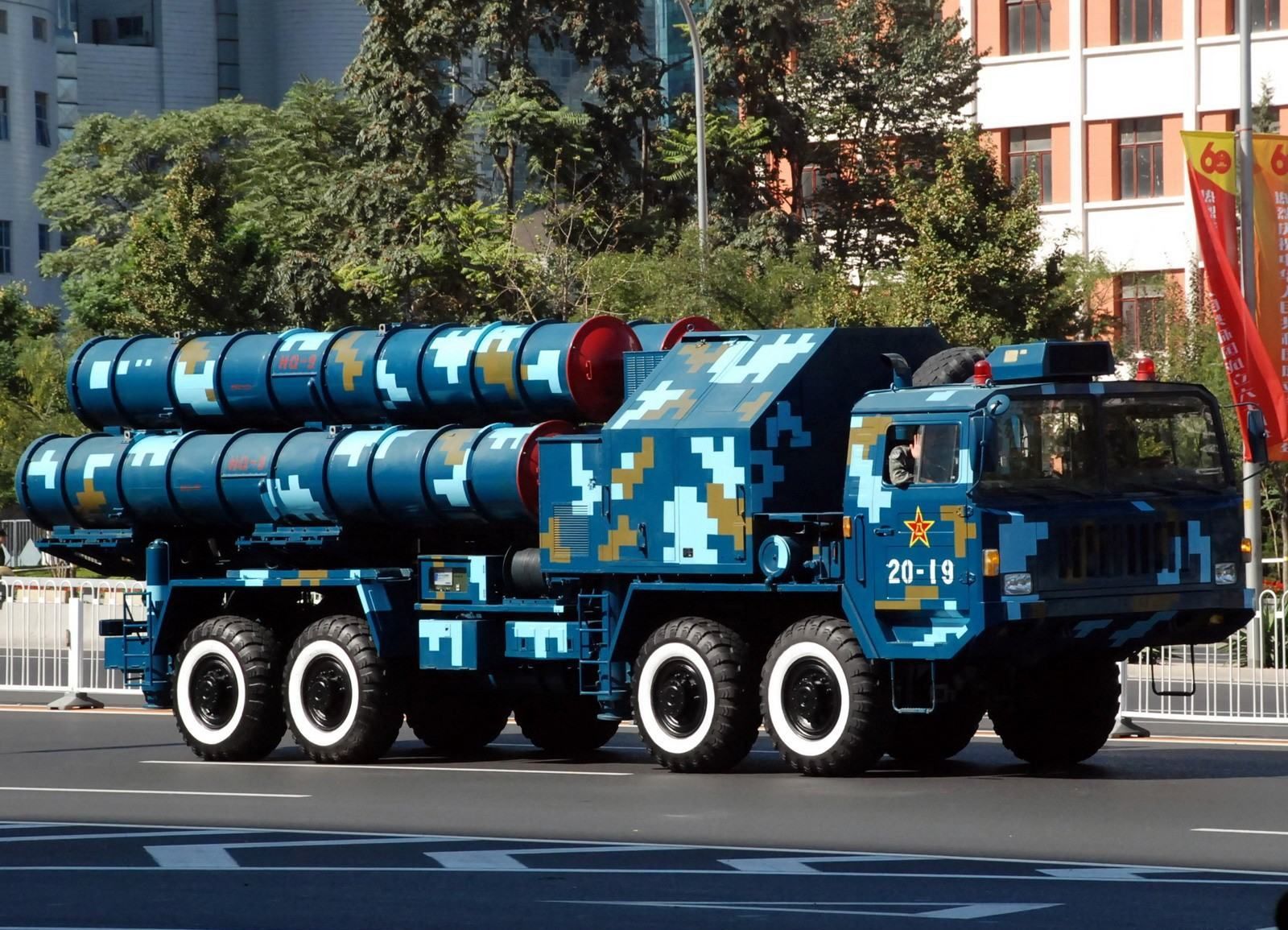
The HQ-9B transporter-erector-launcher is associated with the Taian TA5380 8×8 high-mobility truck chassis. Each launcher carries four cylindrical missile canisters in a vertical arrangement. The road-mobile configuration allows launchers to change firing positions, disperse and operate away from permanent prepared sites.
The launcher uses a cold-launch system. Gas pressure ejects the missile from its canister before the rocket motor ignites, separating the initial ejection process from main motor operation. Vertical launch permits engagement in any direction without requiring the launcher vehicle to be physically aimed toward the target before firing.
The launcher vehicle is approximately 12 m long, 3 m wide and 3.5 m high. Stated road speed is approximately 65–70 km/h, with a cruising range of roughly 600–800 km. These figures relate to the launcher vehicle rather than the missile's engagement performance.
Missile
The HQ-9B interceptor is described as a two-stage solid-propellant missile carrying a fragmentation high-explosive warhead. Missile mass is approximately 1,300–1,500 kg. Maximum speed is stated as exceeding Mach 4.
Guidance combines inertial navigation during the initial portion of flight with mid-course corrections transmitted through a datalink. Terminal guidance uses active radar together with a passive infrared seeker. The dual-mode arrangement is intended to provide an additional means of target acquisition and tracking in conditions involving electronic interference or targets with reduced radar signatures.
The stated maximum engagement range against aerodynamic targets is up to approximately 260 km. Engagement altitude is cited as reaching about 50 km. A shorter engagement range of approximately 50–100 km is stated for ballistic targets. These figures represent the published performance envelope of the HQ-9B and can vary with target type, altitude, trajectory and engagement conditions.
Radar and command equipment
The HQ-9 family uses phased-array fire-control radar together with longer-range surveillance sensors. The HT-233 radar is associated with the family, while HQ-9B configurations are described as using upgraded radar equipment capable of supporting the longer-range missile and improved target processing.
The command post processes radar tracks, assigns targets and coordinates missile engagements. Digital datalinks provide mid-course missile updates and permit information exchange between the firing battery and other surveillance or command elements. The architecture is designed for integration into a larger air-defence network rather than isolated operation by individual launchers.
Electronic-counter-countermeasures form an important part of the HQ-9B upgrade. Improvements in radar processing, datalinks and terminal guidance are intended to preserve engagement capability in an electromagnetic environment affected by jamming, decoys and other countermeasures.
Operational history
The HQ-9B is operational within China's ground-based air-defence network. It has been deployed in strategically important areas including the vicinity of major population centres, western regions and coastal positions. Its mobility allows batteries to be relocated or dispersed while remaining connected to wider surveillance and command networks.
China deployed HQ-9B systems to artificial islands in the South China Sea in 2016. The deployment demonstrated the use of the system for long-range area defence from geographically isolated positions where mobile launchers, radar and command vehicles could form an integrated battery.
Algeria has also been described as having procured HQ-9B systems from China for its national air-defence network. In Algerian service the Chinese long-range system has been described as complementing Russian S-300PMU-2 and S-400 systems. The exact export configuration and designation have not been consistently identified in available descriptions, and the wider HQ-9 family includes dedicated export versions.
No confirmed live-combat use of the HQ-9B is established in the supplied material. Its operational record therefore primarily consists of deployment, training, exercises and integration into layered air-defence networks.
Variants
- HQ-9 — Original land-based long-range surface-to-air missile system of the family.
- HQ-9A — Improved version preceding the HQ-9B, with changes to tracking, electronic-counter-countermeasures and engagement capability.
- HQ-9B — Extended-range land-based variant with a stated range of up to 260 km and dual-mode terminal guidance using active radar and passive infrared sensing.
- HHQ-9B — Naval surface-launched derivative of the HQ-9B family.
- HQ-9C — Later ground-based development associated with additional ballistic-missile interception capability.
- FD-2000B — Export development of the HQ-9 family with a stated range of approximately 250 km. It is distinct from the Chinese-service designation even though foreign descriptions sometimes use HQ-9B-related terminology for export systems.
Operators
- China — The People's Liberation Army Air Force operates the HQ-9B as part of China's integrated ground-based air-defence network.
- Algeria — Procurement of HQ-9B systems has been described as part of Algeria's layered air-defence network, complementing Russian long-range surface-to-air missile systems. The precise export configuration is not consistently identified.
Specifications (HQ-9B)
General characteristics
- Type: Long-range mobile surface-to-air missile system
- Developer: China Aerospace Science and Industry Corporation
- Launcher vehicle: Taian TA5380 8×8 high-mobility truck
- Missiles per launcher: Four vertical canisters
- Launch method: Cold-launch vertical ejection
- Missile propulsion: Two-stage solid propellant
- Missile mass: Approximately 1,300–1,500 kg
- Warhead: Fragmentation high explosive
- Launcher length: Approximately 12 m
- Launcher width: Approximately 3 m
- Launcher height: Approximately 3.5 m
Performance
- Maximum range against aerodynamic targets: Up to approximately 260 km
- Range against ballistic targets: Approximately 50–100 km
- Maximum engagement altitude: Up to approximately 50 km
- Missile speed: More than Mach 4
- Launcher road speed: Approximately 65–70 km/h
- Launcher cruising range: Approximately 600–800 km
Guidance and sensors
- Initial guidance: Inertial navigation
- Mid-course guidance: Datalink correction
- Terminal guidance: Active radar and passive infrared dual-mode homing
- Fire-control sensor: Phased-array engagement radar
- Additional system elements: Long-range surveillance radar, mobile command post, communications and support vehicles
 Argentina
 Armenia
 Australia
 Austria
 Austria-Hungary
 Belgium
 Brazil
 United Kingdom
 United States
 Brunei
 Bulgaria
 Canada
 Chile
Chile Colonial America
 Colombia
 Confederate States
 Croatia
 Czech
Czech Denmark
 Egypt
Egypt Finland
 France
 Georgia
 Germany
 German Imperial
 Greece
 Holland
 Hungary
 India
India Indonesia
 Iran
Iran Iraq
Iraq Ireland
 Israel
 Italy
Italy Japan
Japan Japan (1940)
 Jordan
 Kingdom of Italy
 Malaysia
 Mexico
 Myanmar
 Nazi Germany
 Netherlands
 New Zealand
 North Korea
 Norway
 Pakistan
 Peru
Peru Philippines
 Poland
 Portugal
 Prussia
 Romania
 Russia
 Saudi Arabia
 Serbia
 Singapore
 Slovakia
 Slovenia
 South Africa
 South Korea
 Soviet Union
 Spain
Spain Sweden
 Switzerland
 Syria
Syria Taiwan
 Thailand
 Turkey
 UAE
UAE Ukraine
 Vietnam
 Yugoslavia