

History
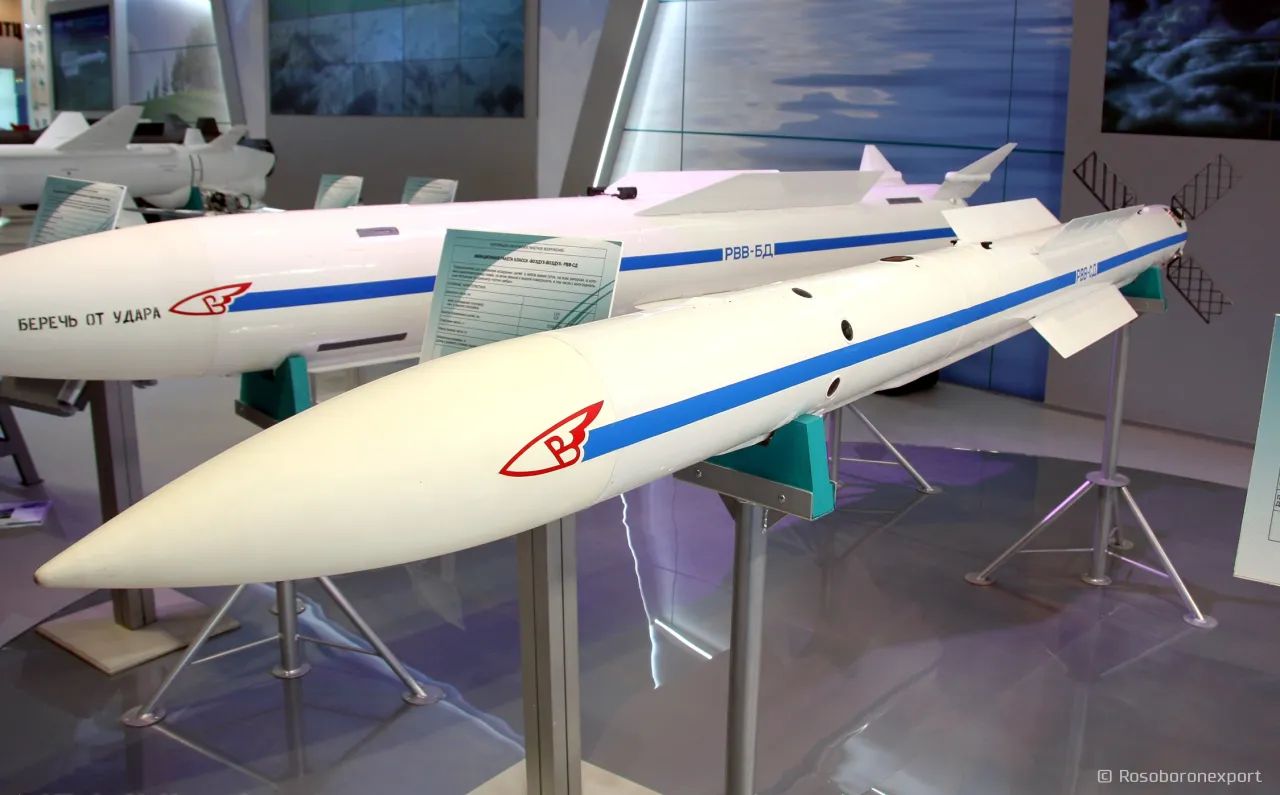
The RVV-SDM is a Russian medium-range air-to-air missile developed and manufactured by Tactical Missiles Corporation, also known as KTRV. It is intended primarily for the export-standard Su-57E fighter.
The missile is designed to engage fixed-wing aircraft, helicopters, cruise missiles, and unmanned aerial vehicles. Its guidance system combines inertial navigation, radio-transmitted course updates, and an active-passive radar seeker for use in contested electromagnetic environments.
Rosoboronexport began an international marketing campaign for the RVV-SDM on 29 July 2026. The campaign presented it as the medium-range component of a layered Su-57E air-to-air weapons package.
Development and presentation
The RVV-SDM was developed as a more capable member of Russia's export air-to-air missile portfolio. Rosoboronexport described improvements in launch range, power-to-weight ratio, aerodynamic performance, effectiveness, guidance accuracy, and resistance to electronic countermeasures. The company did not publish the missile's dimensions, launch weight, motor arrangement, warhead, maximum velocity, or precise maximum launch range.
The missile was publicly promoted with the short-range RVV-MD2 and long-range RVV-BD. Together, these weapons are intended to give the Su-57E options for close, medium-range, and longer-range aerial engagements.
According to the Army Recognition report, the campaign was intended to present the Su-57E as an integrated combat system rather than an aircraft offered without a mature weapons package. The 2026 announcement is the earliest documented physical milestone for the exact RVV-SDM in the supplied evidence.
Export plans
Rosoboronexport markets the RVV-SDM primarily for the Su-57E. The exporter also states that the missile can be adapted for other Russian-built aircraft and potentially integrated with foreign-made combat aircraft after appropriate modifications.
Integration with another aircraft would require compatible electrical and data interfaces, fire-control software, carriage equipment, separation testing, flight-envelope clearance, and weapons certification. No completed integration on a foreign-designed aircraft has been identified.
Design
Mission and target set
The RVV-SDM is intended for day-and-night interception of aircraft, helicopters, cruise missiles, and unmanned aerial vehicles. It is designed to operate when electronic countermeasures are present.
The disclosed target-altitude envelope extends from 15 m to 25 km. The missile can engage targets travelling at speeds of up to Mach 3. This figure describes the maximum stated speed of the target and not the flight speed of the missile.
Guidance
The missile uses an inertial control system during the initial and middle portions of flight. A radio update link can transmit revised target information to compensate for target movement before terminal acquisition.
Terminal guidance is provided by an active-passive radar seeker. In active operation, the seeker transmits radar energy to acquire and track the target. The passive channel can use electromagnetic emissions in the engagement environment without relying exclusively on the seeker's transmitter.
The manufacturer claims that the passive channel improves discretion, accuracy, resistance to jamming, and fire-and-forget effectiveness. Public information does not establish whether passive guidance is intended to track a target's radar emissions, home on jamming, or perform both functions. Seeker acquisition range, field of view, processing methods, and counter-countermeasure logic have not been disclosed.
Propulsion and aerodynamics
Rosoboronexport claims that the RVV-SDM has a higher power-to-weight ratio and improved aerodynamic performance compared with earlier weapons. These characteristics could help the missile retain energy during terminal manoeuvres, but the type of motor, powered-flight duration, and manoeuvring limits remain undisclosed.
The missile's exact maximum launch range has not been published. The earlier RVV-SD has a stated maximum launch range of 110 km, but this figure must not be assigned to the RVV-SDM. Reports that the newer missile exceeds that distance remain unverified until an official numerical specification is released.
Aircraft integration
The RVV-SDM is associated primarily with the Su-57E. Weapons offered for this fighter can be carried in internal bays to limit their effect on radar signature or on external hardpoints when greater payload capacity is required.
Internal carriage supports reduced-observable missions but imposes dimensional, mechanical, and separation requirements on the missile and its launcher. The supplied sources do not disclose the RVV-SDM's dimensions or confirm whether its airframe is identical to that of the RVV-SD.
Program status
As of the July 2026 international campaign, the RVV-SDM was being offered to countries eligible to purchase Russian military equipment. Rosoboronexport stated that Russian military requirements would remain the priority when production and delivery schedules were arranged.
Rosoboronexport has claimed that the missile was used by the Su-57 under combat conditions. No engagement dates, target records, launch conditions, success rates, or independently verifiable evidence accompanied that statement. It therefore remains a manufacturer claim rather than confirmed operational history.
No export contract, foreign customer, delivery quantity, or confirmed operational operator for the RVV-SDM was identified in the available evidence. A contemporary Defence Industry Europe report likewise described the weapon as the subject of an international sales campaign.
Specifications (RVV-SDM)
General characteristics
- Type: Medium-range air-to-air guided missile
- Country of origin: Russia
- Developer and manufacturer: Tactical Missiles Corporation, or KTRV
- Primary associated platform: Su-57E fighter
- Intended targets: Fixed-wing aircraft, helicopters, cruise missiles, and unmanned aerial vehicles
- Operating conditions: Day or night, including environments with electronic countermeasures
Guidance
- Mid-course guidance: Inertial control with radio-transmitted target updates
- Terminal guidance: Active-passive radar seeker
- Electronic protection: Improved resistance to jamming claimed by the manufacturer
Engagement envelope
- Minimum target altitude: 15 m
- Maximum target altitude: 25 km
- Maximum stated target speed: Mach 3
- Maximum launch range: Not publicly disclosed; described by the manufacturer as increased
Related equipment
- RVV-SD: Earlier export-standard medium-range missile using inertial guidance, radio correction, and active radar terminal homing.
- RVV-MD2: Short-range air-to-air missile offered as the close-combat component of the Su-57E weapons package.
- RVV-BD: Long-range air-to-air missile offered as the extended-range component of the Su-57E weapons package.
- Su-57E: Export-oriented fighter and the primary aircraft for which the RVV-SDM is marketed.
 Argentina
 Armenia
 Australia
 Austria
 Austria-Hungary
 Belgium
 Brazil
 United Kingdom
 United States
 Brunei
 Bulgaria
 Canada
 Chile
Chile China
China Colonial America
 Colombia
 Confederate States
 Croatia
 Czech
Czech Denmark
 Egypt
Egypt Finland
 France
 Georgia
 Germany
 German Imperial
 Greece
 Holland
 Hungary
 India
India Indonesia
 Iran
Iran Iraq
Iraq Ireland
 Israel
 Italy
Italy Japan
Japan Japan (1940)
 Jordan
 Kingdom of Italy
 Malaysia
 Mexico
 Myanmar
 Nazi Germany
 Netherlands
 New Zealand
 North Korea
 Norway
 Pakistan
 Peru
Peru Philippines
 Poland
 Portugal
 Prussia
 Romania
 Saudi Arabia
 Serbia
 Singapore
 Slovakia
 Slovenia
 South Africa
 South Korea
 Soviet Union
 Spain
Spain Sweden
 Switzerland
 Syria
Syria Taiwan
 Thailand
 Turkey
 UAE
UAE Ukraine
 Vietnam
 Yugoslavia