
History
The HQ-20 is a Chinese medium-range surface-to-air missile system developed to provide an intermediate layer within the People's Liberation Army's integrated air and missile defence network. It uses road-mobile launch vehicles carrying a comparatively large number of ready-to-fire interceptors.
The system became publicly identifiable in 2025. The precise month of its public unveiling is unclear, with September and October 2025 both associated with its debut. By September 2026, the HQ-20 had been shown in frontline People's Liberation Army service and participating in live-fire exercises.
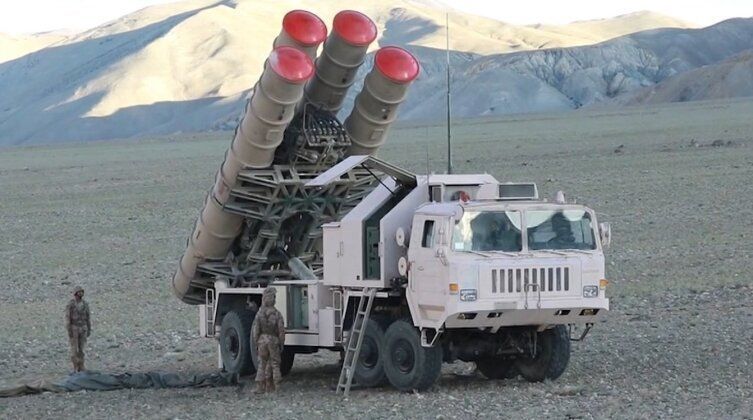
The HQ-20 is positioned between shorter-range point-defence weapons and larger long-range surface-to-air missile systems. Its launcher carries eight relatively slender interceptor canisters, giving each vehicle a higher ready-to-fire missile count than configurations using fewer larger missiles.
The HQ-20 has been associated with the development path of the HQ-16 family and is expected to replace older HQ-16 variants in some roles. Its public appearance also showed that it is a separate system from the HQ-11, HQ-22A, HQ-9C, HQ-19 and HQ-29, which occupy other portions of China's layered air and missile defence structure.
Live-fire exercises displayed the HQ-20 as one component of a wider network rather than as an isolated missile battery. The broader arrangement combines interceptor systems covering different altitude and range bands with radars, data links and command elements that support coordinated engagements.
Design
Launcher
The HQ-20 uses a large eight-wheeled transporter-erector-launcher. The launcher carries eight canisterized interceptors arranged for vertical launch. Its general launcher architecture resembles that used by the larger HQ-9 family, although the HQ-20 uses a greater number of smaller missile canisters.
Vertical launch allows an interceptor to be launched without first turning the entire transporter toward the target. The eight-missile load also provides a relatively high number of immediately available interceptors on each launcher vehicle, an important characteristic for a system intended to form a dense intermediate air-defence layer.
Battery and sensors
Descriptions of the system identify a battery organization consisting of a command vehicle, a guidance vehicle and multiple launch vehicles. The command element has been associated with a meter-wave search radar, while the guidance element has been described as using an active electronically scanned array radar. Detailed official performance figures for these sensors have not been disclosed in the supplied material.
Missile
The HQ-20 interceptor is smaller and more slender than the missiles carried by the HQ-9 family. It has also been described as an evolution of the HQ-16 concept, with the reduced missile dimensions allowing eight interceptors to be carried on one launcher rather than the six associated with some HQ-16 configurations.
The exact engagement envelope has not been officially established in the supplied information. Published estimates vary substantially. Figures extending to approximately 150–160 km have been associated with the system, while other assessments give a broader estimated envelope beginning around 50 km and extending to approximately 150 km. These values should therefore be treated as estimates rather than confirmed specifications.
The missile has been described as using inertial navigation during the initial portion of flight, a mid-course data link and active radar homing during the terminal phase. It has also been associated with a dual-pulse solid rocket propulsion arrangement. Detailed missile performance figures remain insufficiently confirmed for inclusion as definitive specifications.
Network integration
The HQ-20 is intended to operate within a layered air-defence architecture rather than independently. Its medium-range position allows it to cover the gap between shorter-range defensive systems and long-range interceptors. Networked radars, data links and command systems can distribute target information among different defensive layers.
The system's combination of road mobility, vertical launch and eight ready-to-fire interceptors is suited to formations that may need to engage multiple aerial threats. The supplied information identifies aircraft, cruise missiles and unmanned aerial vehicles among the types of targets associated with the HQ-20's intended engagement environment, but detailed target-specific performance limits have not been officially confirmed.
Operational history
By September 2026, the HQ-20 had been shown in frontline service with the People's Liberation Army. Its appearance in live-fire exercises demonstrated that the system had progressed beyond its initial public unveiling and was being integrated with other Chinese air and missile defence systems.
During these exercises, the HQ-20 was displayed as part of a layered defensive network alongside other interceptor systems, including the HQ-11, HQ-22A, HQ-9-series systems, HQ-19 and HQ-29. The arrangement illustrated the use of different missile systems for separate portions of the range and altitude spectrum while sharing a wider sensor and command network.
Operators
- People's Liberation Army: The HQ-20 has been shown in frontline service and in live-fire air-defence exercises.
Specifications (HQ-20)
General characteristics
- Type: Medium-range surface-to-air missile system.
- Launcher: Eight-wheeled transporter-erector-launcher.
- Ready-to-fire missiles: Eight canisterized interceptors per launcher vehicle.
- Launch method: Vertical launch.
- Battery elements: Command vehicle, guidance vehicle and multiple launch vehicles.
Performance
- Engagement range: Not officially disclosed; supplied estimates vary, with figures extending to approximately 150–160 km.
- Guidance: Described as inertial navigation with mid-course data-link updates and terminal active radar homing.
- Propulsion: Described as a dual-pulse solid rocket motor.
Role
- Primary function: Intermediate-layer air defence between shorter-range point-defence systems and long-range interceptors.
- Network role: Integrated operation with radars, data links, command systems and other surface-to-air missile layers.
 Argentina
 Armenia
 Australia
 Austria
 Austria-Hungary
 Belgium
 Brazil
 United Kingdom
 United States
 Brunei
 Bulgaria
 Canada
 Chile
Chile Colonial America
 Colombia
 Confederate States
 Croatia
 Czech
Czech Denmark
 Egypt
Egypt Finland
 France
 Georgia
 Germany
 German Imperial
 Greece
 Holland
 Hungary
 India
India Indonesia
 Iran
Iran Iraq
Iraq Ireland
 Israel
 Italy
Italy Japan
Japan Japan (1940)
 Jordan
 Kingdom of Italy
 Malaysia
 Mexico
 Myanmar
 Nazi Germany
 Netherlands
 New Zealand
 North Korea
 Norway
 Pakistan
 Peru
Peru Philippines
 Poland
 Portugal
 Prussia
 Romania
 Russia
 Saudi Arabia
 Serbia
 Singapore
 Slovakia
 Slovenia
 South Africa
 South Korea
 Soviet Union
 Spain
Spain Sweden
 Switzerland
 Syria
Syria Taiwan
 Thailand
 Turkey
 UAE
UAE Ukraine
 Vietnam
 Yugoslavia