
History
The JL-1, also rendered Jing Lei-1, is a Chinese nuclear-capable air-launched ballistic missile developed for carriage by the Xi'an H-6N bomber. It provides the People's Liberation Army Air Force with an air-launched strategic missile capability and is intended to allow the bomber to release its weapon from standoff distance.
The missile was reported to be under development by 2018. Western reporting previously referred to a related air-launched ballistic missile program as KF-21 or CH-AS-X-13, although the exact relationship between those designations and the production JL-1 has not been conclusively established in the available sources.
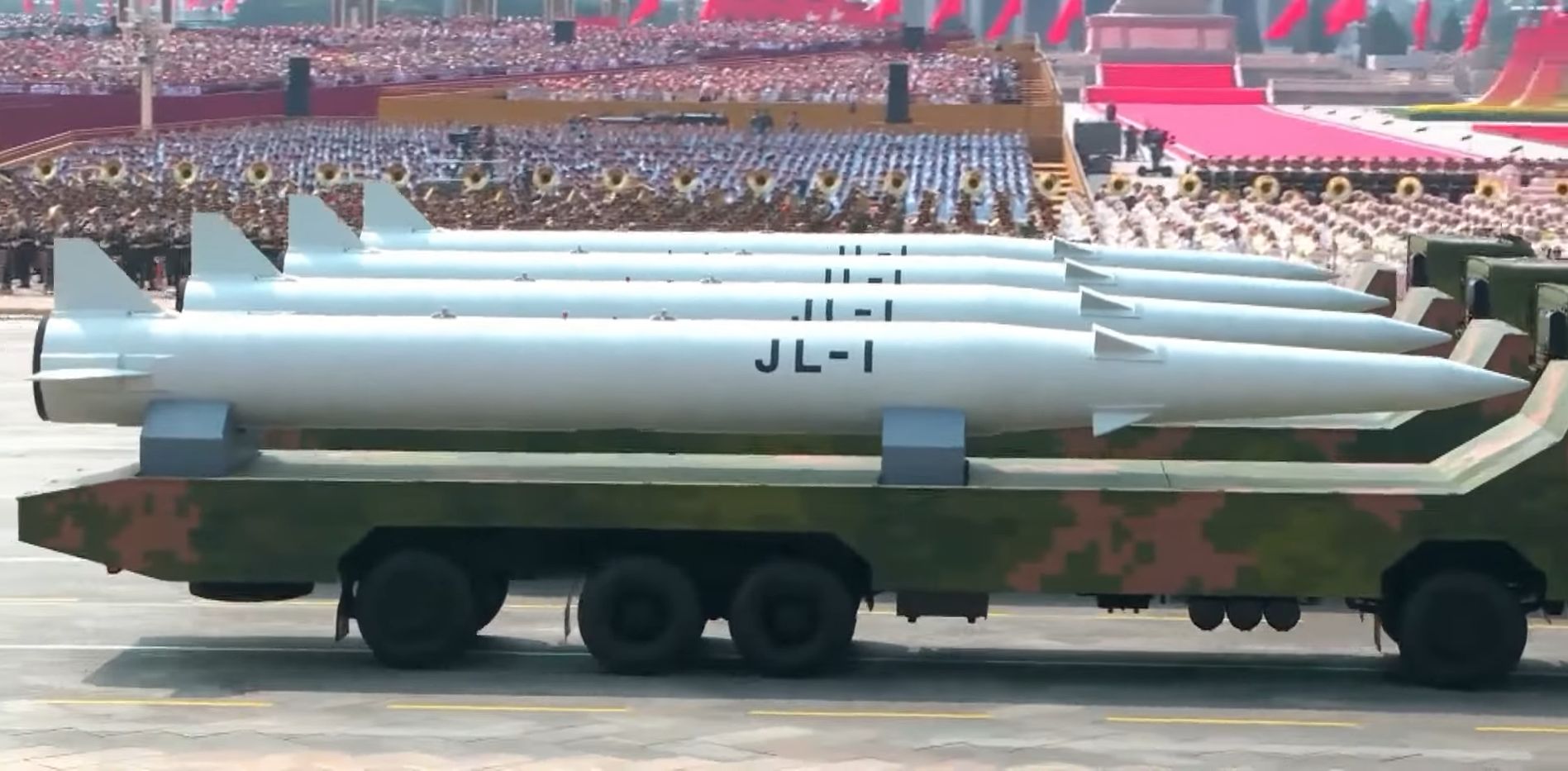
The JL-1 was publicly unveiled during China's military parade on 3 September 2025. In 2026, footage released by the People's Liberation Army showed an H-6N carrying the missile during a joint anti-ship exercise, providing additional public evidence of the integration of the missile with the bomber.
Development and public unveiling
Analysts have associated the JL-1 with earlier Chinese work on an air-launched derivative of the DF-21 medium-range ballistic missile. The JL-1 reference summary reports that the missile was in development by 2018 and that the United States had previously projected deployment readiness by 2025.
The missile was formally displayed in Beijing during the 2025 parade marking the 80th anniversary of the end of the Second World War in Asia. Contemporary reporting described the event as the first public unveiling of the JL-1 as an air-launched nuclear-capable ballistic missile associated with the H-6 bomber force. Military Watch Magazine reported that it was expected to equip Chinese H-6 strategic bombers.
Public information about the missile remains limited. Some reporting has described the JL-1 as partly derived from the DF-21 family, but detailed technical information about its propulsion, guidance, warhead and demonstrated range has not been officially disclosed in the supplied material.
Design
The JL-1 is an air-launched ballistic missile designed for external carriage by the Xi'an H-6N. The H-6N differs from earlier H-6 variants by having a modified lower fuselage able to carry very large external weapons and by incorporating aerial refuelling capability. These features allow it to serve as a carrier for weapons significantly larger than conventional air-launched cruise missiles.
The missile is intended to function as a standoff weapon. Rather than requiring the H-6N to fly directly over a target, the aircraft can carry the missile toward a launch area and release it while remaining at greater distance from defended airspace.
Configuration
Open-source reporting has described the JL-1 as a two-stage solid-fuel ballistic missile. Analysts have also proposed that its design may be related to the DF-21 family. These assessments remain analytical rather than confirmed technical specifications from the manufacturer or Chinese authorities.
Reports concerning range vary substantially. Earlier reporting about the associated KF-21 or CH-AS-X-13 concept cited a range of about 3,000 km (1,900 mi). During the JL-1's public reveal, an 8,000 km (5,000 mi) figure was reported. Military Watch Magazine noted uncertainty over whether that larger figure represented missile range alone or included the combat radius of the carrying H-6. The supplied evidence therefore does not establish a definitive independently verified missile range.
Warhead and role
The JL-1 has been publicly described as nuclear-capable. Its integration with the H-6N gives China an airborne strategic delivery option alongside its land-based and submarine-launched ballistic missile forces. Some open-source reporting has also discussed possible conventional or anti-ship applications for related air-launched ballistic missile concepts, but the available evidence does not establish a specific conventional JL-1 configuration.
Program status
The JL-1 was publicly unveiled in 2025 and has since been shown carried by an H-6N. In September 2026, published reporting on PLA footage described an H-6N flying with the JL-1 during a joint anti-ship exercise.
The available sources demonstrate aircraft integration and public military presentation, but they do not provide independently confirmed information on production totals, the number of missiles in service, operational units or formal service-entry dates. Claims that the system was fully operational by 2025 should therefore be treated separately from the confirmed public unveiling and subsequent carriage demonstrations.
Specifications (JL-1)
General characteristics
- Type: Air-launched ballistic missile
- Country of origin: China
- Launch platform: Xi'an H-6N bomber
- Propulsion: Reported as two-stage solid-fuel propulsion
- Warhead capability: Nuclear-capable
Performance
- Range: An 8,000 km (5,000 mi) figure was reported at the missile's public reveal, but available reporting states that it is uncertain whether this represents missile range alone or includes the reach of the launch aircraft. Earlier estimates for the associated KF-21 or CH-AS-X-13 concept were about 3,000 km (1,900 mi).
Related equipment
- Xi'an H-6N: Modified H-6 bomber variant used as the publicly demonstrated launch platform for the JL-1.
- DF-21: Chinese medium-range ballistic missile family that analysts have proposed as a technological basis for the JL-1 or its predecessor concept.
 Argentina
 Armenia
 Australia
 Austria
 Austria-Hungary
 Belgium
 Brazil
 United Kingdom
 United States
 Brunei
 Bulgaria
 Canada
 Chile
Chile Colonial America
 Colombia
 Confederate States
 Croatia
 Czech
Czech Denmark
 Egypt
Egypt Finland
 France
 Georgia
 Germany
 German Imperial
 Greece
 Holland
 Hungary
 India
India Indonesia
 Iran
Iran Iraq
Iraq Ireland
 Israel
 Italy
Italy Japan
Japan Japan (1940)
 Jordan
 Kingdom of Italy
 Malaysia
 Mexico
 Myanmar
 Nazi Germany
 Netherlands
 New Zealand
 North Korea
 Norway
 Pakistan
 Peru
Peru Philippines
 Poland
 Portugal
 Prussia
 Romania
 Russia
 Saudi Arabia
 Serbia
 Singapore
 Slovakia
 Slovenia
 South Africa
 South Korea
 Soviet Union
 Spain
Spain Sweden
 Switzerland
 Syria
Syria Taiwan
 Thailand
 Turkey
 UAE
UAE Ukraine
 Vietnam
 Yugoslavia