
History
The NCSIST Qiang Bow, also rendered as Chiang Kung and translated as Strong Bow, is a Taiwanese land-based ballistic missile defence system developed by the state-owned National Chung-Shan Institute of Science and Technology. It is intended to intercept tactical ballistic missiles and forms a higher-tier development related to Taiwan's Tien Kung air-defence family.
The complete system combines a hypersonic interceptor missile, a mobile vertical-launch vehicle, a tactical command vehicle, and a vehicle-mounted active electronically scanned array radar. NCSIST publicly disclosed detailed information about the system in 2026, including its two-stage propulsion, guidance arrangement, radar, and command functions.
Qiang Bow remained associated with planned procurement and mass-production funding in 2026 rather than an established operational deployment. Its disclosed configuration is intended to provide a higher ballistic-missile interception layer than Taiwan's existing lower-tier defences.
Development
Development of an enhanced Tien Kung-3 anti-ballistic missile began in 2014. The programme was also described as an enhanced Tien Kung-3 and, in a Taiwanese Ministry of National Defense control list released in July 2024, as Tien Kung-4. The system later appeared publicly under the Chiang Kung or Qiang Bow name.
The enhanced missile reportedly passed initial combat evaluations in February 2023. This provides the earliest explicitly supported physical test milestone for the Qiang Bow programme. A December 2023 Legislative Yuan award also referred to the development of Chiang Kung and its combined-attitude control system, which was intended to preserve manoeuvrability in the thin atmosphere at high altitude and support engagement of manoeuvring ballistic missiles. Background information on the earlier Tien Kung family is available from the Missile Defense Advocacy Alliance.
Qiang Bow made its first public debut at the Taipei Aerospace and Defense Technology Exhibition in September 2025. Analysis published by the Open Nuclear Network described the displayed missile as a real example without its warhead and solid propellant rather than a mock-up. The same analysis reported a maximum interception altitude of about 70 km, while noting that the exact missile dimensions were not officially disclosed.
In August 2026 NCSIST released product information describing the system's major components and technical principles. Janes reported that NCSIST identified Qiang Bow as a domestically developed hypersonic mid-tier counter-tactical ballistic missile system. NCSIST did not disclose the system's engagement range.
The disclosure occurred while Taiwan was seeking funding for mass production. According to the South China Morning Post, the programme had been excluded from a reduced special defence spending package approved in May 2026, and the defence ministry intended to seek funding again through a supplementary budget.
Design
System architecture
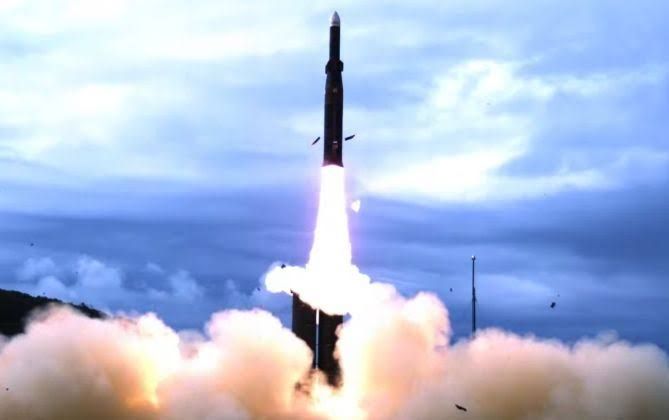
Qiang Bow is a mobile, land-launched ballistic missile defence system. NCSIST describes the principal elements as the interceptor missile, a mobile vertical-launch vehicle, a tactical command vehicle, and an AESA radar vehicle. Images released by NCSIST show the interceptor leaving a canister-type launcher vertically.
The tactical command vehicle provides fire-control, target-identification, and threat-assessment functions. Information shown by NCSIST also indicates that a Qiang Bow command vehicle can process radar information from both the Qiang Bow engagement radar and a Tien Kung-3 engagement radar, suggesting that the newer system can be integrated with existing Tien Kung-3 batteries.
Interceptor
The Qiang Bow interceptor uses a two-stage solid-fuel propulsion system and is capable of hypersonic speed. The second stage has been described by NCSIST personnel as a kill vehicle powered by a sustainer rocket motor. Published images show a narrow streamlined missile with a pointed nose and small control surfaces around the middle of the airframe.
The missile uses inertial navigation during flight, with radar uplink corrections in the midcourse phase. It then transitions to an active radar seeker for terminal guidance. Unlike a pure hit-to-kill interceptor, Qiang Bow uses a high-explosive fragmentation warhead. NCSIST describes the warhead as directional, concentrating fragments toward the incoming target.
Terminal manoeuvrability is supported by thrust-vector control. Analysis of the system also describes a combined-attitude control arrangement using aerodynamic control surfaces together with thrust-vector control, allowing the interceptor to retain control in the thin atmosphere at high altitude.
Radar and command system
The Qiang Bow engagement radar is an active electronically scanned array system. NCSIST states that it can identify and track targets, perform identification friend or foe functions, resist electronic interference, and support engagements against multiple ballistic missile targets.
The radar is vehicle-mounted and can be repositioned as part of the mobile system. Information collected from its 2025 public display indicated that its antenna assembly can be rotated in azimuth during setup. The available evidence does not establish that it rotates continuously during an engagement.
Program status
Qiang Bow had completed developmental testing milestones and had been publicly displayed by 2025. In 2026 NCSIST disclosed detailed system information, but procurement and mass production were still associated with pending government funding. The available sources therefore do not establish Qiang Bow as an operationally deployed system.
Published analysis describes Qiang Bow as a higher endo-atmospheric ballistic missile defence layer that could complement Patriot PAC-3/PAC-3 MSE and Tien Kung-3 systems operating at lower interception altitudes. Reports have also referred to a possible Qiang Bow-2 interceptor with an interception altitude around 100 km, but the available material explicitly notes that authoritative information on such a programme is lacking.
Variants
- Qiang Bow / Chiang Kung: The disclosed two-stage hypersonic interceptor and associated mobile ballistic missile defence system intended for tactical ballistic missile interception.
- Qiang Bow-2: A reported follow-on concept associated in outside reports with an interception altitude around 100 km. No authoritative programme information is available in the supplied evidence.
Specifications (Qiang Bow)
General characteristics
- Type: Mobile mid-tier counter-tactical ballistic missile defence system
- Developer: National Chung-Shan Institute of Science and Technology
- Launch method: Vertical launch from a mobile canister-type launcher
- Propulsion: Two-stage solid-fuel rocket propulsion
- Guidance: Inertial navigation with radar uplink corrections during midcourse and active radar seeker guidance in the terminal phase
- Terminal control: Thrust-vector control combined with aerodynamic control surfaces
- Warhead: High-explosive directional fragmentation warhead
- System components: Interceptor missile, mobile vertical-launch vehicle, tactical command vehicle, and AESA radar vehicle
Performance
- Speed: Hypersonic
- Reported interception altitude: About 70 km
- Engagement range: Not disclosed by NCSIST
Sensors and fire control
- Radar: Active electronically scanned array engagement radar
- Radar functions: Target identification and tracking, identification friend or foe, electronic-interference countermeasures, and multiple ballistic-target engagement support
- Command functions: Fire-control, target identification, and threat assessment
Related equipment
- Tien Kung-3: Taiwanese air-defence and ballistic-missile-interception system from which the Qiang Bow development evolved. Qiang Bow retains elements including active radar terminal guidance and a directional fragmentation warhead while introducing a larger two-stage interceptor and higher-altitude control features.
 Argentina
 Armenia
 Australia
 Austria
 Austria-Hungary
 Belgium
 Brazil
 United Kingdom
 United States
 Brunei
 Bulgaria
 Canada
 Chile
Chile China
China Colonial America
 Colombia
 Confederate States
 Croatia
 Czech
Czech Denmark
 Egypt
Egypt Finland
 France
 Georgia
 Germany
 German Imperial
 Greece
 Holland
 Hungary
 India
India Indonesia
 Iran
Iran Iraq
Iraq Ireland
 Israel
 Italy
Italy Japan
Japan Japan (1940)
 Jordan
 Kingdom of Italy
 Malaysia
 Mexico
 Myanmar
 Nazi Germany
 Netherlands
 New Zealand
 North Korea
 Norway
 Pakistan
 Peru
Peru Philippines
 Poland
 Portugal
 Prussia
 Romania
 Russia
 Saudi Arabia
 Serbia
 Singapore
 Slovakia
 Slovenia
 South Africa
 South Korea
 Soviet Union
 Spain
Spain Sweden
 Switzerland
 Syria
Syria Thailand
 Turkey
 UAE
UAE Ukraine
 Vietnam
 Yugoslavia