
History
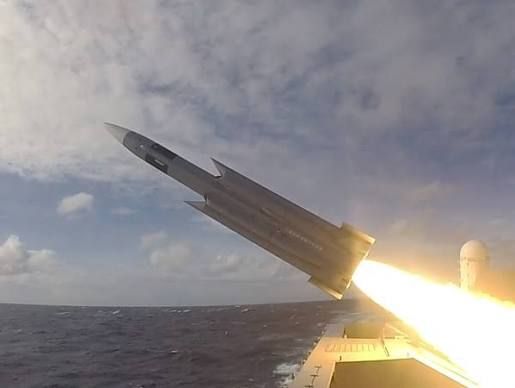
Ching Tien is a reported Taiwanese long-range high-speed cruise-missile program developed by the National Chung-Shan Institute of Science and Technology. The name is also romanised Qingtian and translates approximately as supporting or holding up the sky. Taiwanese reporting identifies it as a development of the classified Yun Feng II program.
Public information about the missile is limited and comes primarily from unnamed officials and outside assessments. In August 2026, Taiwanese media reported that full-system design had been completed and that the Ministry of National Defense could request production funding in the regular fiscal-year 2027 budget.
The program is intended to give Taiwan a road-mobile conventional strike weapon able to reach fixed military targets at operational and strategic depth. Reported ranges would extend beyond China's southeastern coast toward inland command, air-base, missile, logistics, and transport infrastructure.
Development
Yun Feng development began years before the Ching Tien designation appeared publicly. Taiwan acknowledged aspects of the program in 2021, while an earlier Qilin Project funded work to extend range and investigate related propulsion and space-launch technology.
In 2019, Taiwan reportedly ordered a limited batch of enhanced Yun Feng missiles and mobile launchers. Ching Tien is described as a further configuration with a new or revised cruise stage, guidance architecture, airframe, and road-mobile launch system rather than a simple renaming of every earlier Yun Feng weapon.
Production plan
A senior official quoted by Taiwanese media stated that Ching Tien could be ready for mass production in 2027 at the earliest. Inclusion in the annual defence budget would establish a procurement line and permit force formation, but funding, quantity, and schedule remained subject to government and legislative decisions.
No confirmed number of missiles, launchers, batteries, reload vehicles, or annual production rate had been released as of August 2026. The system should therefore be described as a completed design approaching possible production, not an operational missile.
Design
Ching Tien is reported to use two-stage propulsion. A solid-propellant booster accelerates the missile from its launcher and raises it to the speed and altitude required for the air-breathing cruise stage. After booster separation, a ramjet is expected to provide sustained atmospheric propulsion.
Propulsion
A ramjet has no compressor driven by a turbine. Forward speed compresses inlet air, which is mixed with fuel and burned to produce thrust. Since a ramjet cannot operate efficiently from rest, the missile requires a rocket booster for initial acceleration.
Taiwan has relevant ramjet experience from the Hsiung Feng III anti-ship missile. A much longer-range weapon would nevertheless require more fuel, different inlet and thermal design, longer-duration combustion, and a substantially different airframe. No official source has confirmed Ching Tien's dimensions, launch mass, fuel, or engine performance.
Speed classification
Outside estimates place speed between Mach 3 and Mach 5. Mach 5 is the conventional lower boundary of hypersonic flight, so the lower portion of the reported envelope is supersonic rather than hypersonic. The available evidence does not establish how long the missile can sustain the upper speed or whether Mach 5 refers to peak rather than cruise velocity.
High-speed atmospheric flight produces severe heating at the nose, inlet, leading edges, and control surfaces. Materials, thermal protection, stable inlet operation, and accurate control under changing pressure and temperature are major technical requirements. Details of Taiwan's solutions remain classified.
Guidance
A long-range conventional weapon requires inertial navigation accurate enough to maintain a useful position estimate when external signals are disrupted. Satellite, terrain-reference, image-correlation, or other update methods are possible, but none has been officially confirmed for Ching Tien.
The missile is described as a weapon against fixed strategic targets. Public sources do not confirm a seeker for independently detecting moving targets, an in-flight retargeting link, circular error probable, or warhead design.
Launcher
Ching Tien is expected to use a heavy road-mobile transporter-erector-launcher with a 10×10 or 12×12 chassis. Mobility would allow launchers to leave tunnels or hardened shelters, use prepared firing positions, and relocate after launch.
A large vehicle requires suitable roads, bridge capacity, turning space, security, communications, maintenance, and reload support. Survivability therefore depends on dispersal, concealment, decoys, emission control, and a wider support network rather than the launcher alone.
Program status
As of August 2026, NCSIST had reportedly completed full-system design, but Taiwan had not publicly confirmed a production contract or operational deployment. Fiscal year 2027 was the earliest reported production date.
The missile's strategic effect would depend on inventory, readiness, accuracy, launcher survival, penetration of air defences, and warhead effect. The theoretical ability to reach a distant location does not by itself establish the ability to destroy a defended military target.
Variants
- Yun Feng — earlier Taiwanese high-speed long-range missile program.
- Enhanced Yun Feng — configuration reportedly ordered in limited numbers with mobile launchers from 2019.
- Yun Feng II or Ching Tien — reported two-stage solid-booster and ramjet missile considered for production from fiscal year 2027.
Operators
No operational user had been confirmed as of August 2026. The Republic of China Armed Forces were the intended future operator if production received funding.
Specifications (Ching Tien planned configuration)
General characteristics
- Type: Road-mobile long-range high-speed cruise missile.
- Developer: National Chung-Shan Institute of Science and Technology.
- Booster: Solid-propellant rocket.
- Cruise propulsion: Ramjet, reported.
- Launch platform: Planned heavy 10×10 or 12×12 road-mobile transporter-erector-launcher.
- Guidance: Undisclosed.
- Warhead: Undisclosed conventional payload.
Performance
- Maximum speed: Estimated Mach 3–5; not officially confirmed.
- Range: Approximately 1,250 km (777 mi) in one Taiwanese report; broader outside estimates extend from 1,200 to 2,000 km (746–1,243 mi).
Related equipment
- Yun Feng — preceding Taiwanese long-range missile program.
- Hsiung Feng III — Taiwanese ramjet-powered supersonic anti-ship missile demonstrating relevant propulsion experience.
- Qiang Gong — separate Taiwanese high-altitude interceptor program intended for defensive missions.
 Argentina
 Armenia
 Australia
 Austria
 Austria-Hungary
 Belgium
 Brazil
 United Kingdom
 United States
 Brunei
 Bulgaria
 Canada
 Chile
Chile China
China Colonial America
 Colombia
 Confederate States
 Croatia
 Czech
Czech Denmark
 Egypt
Egypt Finland
 France
 Georgia
 Germany
 German Imperial
 Greece
 Holland
 Hungary
 India
India Indonesia
 Iran
Iran Iraq
Iraq Ireland
 Israel
 Italy
Italy Japan
Japan Japan (1940)
 Jordan
 Kingdom of Italy
 Malaysia
 Mexico
 Myanmar
 Nazi Germany
 Netherlands
 New Zealand
 North Korea
 Norway
 Pakistan
 Peru
Peru Philippines
 Poland
 Portugal
 Prussia
 Romania
 Russia
 Saudi Arabia
 Serbia
 Singapore
 Slovakia
 Slovenia
 South Africa
 South Korea
 Soviet Union
 Spain
Spain Sweden
 Switzerland
 Syria
Syria Thailand
 Turkey
 UAE
UAE Ukraine
 Vietnam
 Yugoslavia