
History
Hyunmoo-5 is a South Korean road-mobile ballistic missile developed as a conventional deep-strike weapon against hardened and deeply buried military targets. Its unusually heavy warhead is intended to concentrate destructive and kinetic effects against underground command facilities, missile installations, storage sites, and other protected infrastructure. Pasted text
The missile uses solid-fuel propulsion and a cold-launch system in which it is ejected from its cylindrical canister before the main propulsion system ignites. This arrangement supports deployment from a mobile ground launcher and reduces the effects of rocket ignition on the launcher.
Hyunmoo-5 forms part of South Korea's effort to maintain a powerful conventional retaliatory capability against North Korean nuclear and missile forces. It is associated particularly with the Korea Massive Punishment and Retaliation component of South Korea's Three-Axis deterrence system.
Development
The requirement for a much heavier penetrating ballistic missile emerged from South Korea's need for improved conventional options against North Korea's extensive underground military infrastructure. Development of the broader capability dates to the early 2010s, when restrictions governing the range and payload of South Korean ballistic missiles still constrained missile design.
Restrictions on South Korean ballistic-missile warhead mass were removed in 2017, and the remaining bilateral missile limits ended in 2021. These changes allowed development of missiles carrying much heavier conventional payloads. By late 2023, development of the Hyunmoo-5 had advanced sufficiently for preparations for serial production.
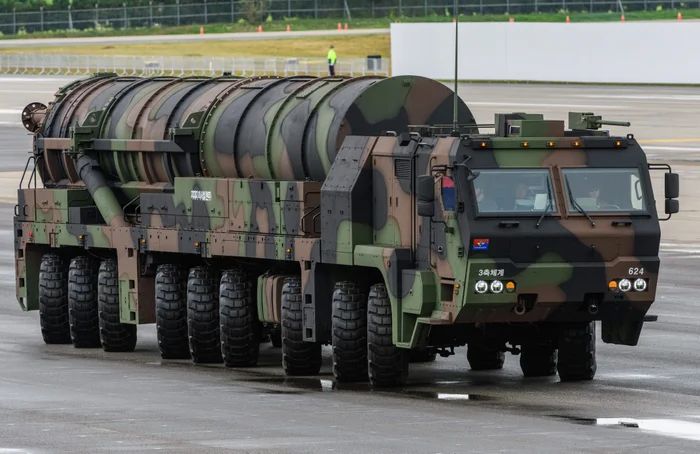
South Korea publicly displayed the Hyunmoo-5 launcher during Armed Forces Day events in 2024. The presentation showed the large cylindrical launch canister mounted on a nine-axle transporter-erector-launcher, although detailed official performance data remained limited.
Serial production preceded operational deployment, which began in late 2025. Deployment to military units continued during 2026, with plans for phased expansion of the missile inventory.
Test footage
In October 2026, South Korea released rare footage showing a Hyunmoo-5 launch sequence. The footage showed the missile being expelled from its launch canister before engine ignition, followed by stabilizer deployment and transition into powered flight. The sequence provided direct confirmation of the missile's cold-launch architecture.
Design
Hyunmoo-5 is a canisterized, ground-launched ballistic missile carried by a nine-axle mobile launcher. Available estimates place its launch mass at approximately 36 tonnes. Estimated dimensions are about 15 to 20 m in length and approximately 1.6 m in diameter, although complete official dimensional data have not been released.
Propulsion and launch system
The missile is described as using two-stage solid-fuel propulsion. Solid propellant reduces preparation requirements compared with liquid-fuel systems and is suitable for mobile deployment. The missile is stored and transported inside a cylindrical launch canister.
During launch, a separate mechanism first ejects the missile from the canister. The main rocket motor ignites only after the missile has cleared the launcher. This cold-launch process reduces direct rocket exhaust loads on the launch vehicle and can support rapid displacement after firing.
Warhead and target set
The defining characteristic of Hyunmoo-5 is its exceptionally heavy conventional payload. South Korean information generally associates the missile with an approximately 8-tonne warhead, while some estimates have suggested a figure approaching 9 tonnes. The heavy-warhead configuration is intended primarily for attacks on hardened and deeply buried targets rather than broad-area effects.
The penetrating concept relies on a combination of warhead mass, impact velocity, accuracy, and dense penetrator materials to transfer large amounts of energy into rock, reinforced concrete, and underground structures. A smaller explosive component may detonate after penetration. Detailed warhead construction remains undisclosed.
Claims concerning precise penetration depth, terminal velocity, and circular error probable remain uncertain. Available estimates describe very high terminal speed and accuracy measured in several metres, but these values have not been confirmed as official performance specifications.
Range and payload relationship
Published range estimates vary substantially because the missile's achievable range depends heavily on payload mass and flight profile. Estimates for the very heavy bunker-penetrating configuration have included approximately 300 km, while other sources attribute substantially greater ranges to Hyunmoo-5. Lighter payload configurations are expected to permit much longer flight distances, potentially extending into several thousand kilometres. South Korea has not publicly provided a definitive range-and-payload performance table.
Operational history
Operational deployment began in late 2025, with Hyunmoo-5 missiles entering South Korean military units as production expanded. Deployment was continuing in 2026 and was planned as a phased process rather than a single introduction event.
The missile supports South Korea's conventional deterrence posture against North Korea. Its primary target set includes buried command installations, strategic storage facilities, missile-related sites, and other fixed high-value infrastructure protected by rock or reinforced structures.
Hyunmoo-5 is associated with the Korea Massive Punishment and Retaliation concept, which provides a conventional retaliatory option following a North Korean attack. The missile complements other elements of South Korea's Three-Axis system by providing a mobile ground-based weapon capable of concentrating very large conventional effects on designated strategic targets.
South Korean plans call for a substantial inventory of high-power missiles, including Hyunmoo-5 and future successor systems. The exact number of Hyunmoo-5 missiles to be produced and deployed has not been officially established in the available information.
Specifications (Hyunmoo-5)
General characteristics
- Type: Road-mobile surface-to-surface ballistic missile
- Propulsion: Two-stage solid-fuel rocket
- Launch method: Cold launch from cylindrical canister
- Launcher: Nine-axle transporter-erector-launcher
- Estimated launch mass: Approximately 36 tonnes
- Estimated length: Approximately 15 to 20 m
- Estimated diameter: Approximately 1.6 m
Performance
- Range: Not officially disclosed; published estimates vary significantly with payload and flight profile
- Primary mission: Conventional strike against hardened and deeply buried targets
Warhead
- Warhead type: Heavy conventional penetrating warhead
- Reported warhead mass: Approximately 8 tonnes in the principal bunker-penetrating configuration; some estimates are higher
 Argentina
 Armenia
 Australia
 Austria
 Austria-Hungary
 Belgium
 Brazil
 United Kingdom
 United States
 Brunei
 Bulgaria
 Canada
 Chile
Chile China
China Colonial America
 Colombia
 Confederate States
 Croatia
 Czech
Czech Denmark
 Egypt
Egypt Finland
 France
 Georgia
 Germany
 German Imperial
 Greece
 Holland
 Hungary
 India
India Indonesia
 Iran
Iran Iraq
Iraq Ireland
 Israel
 Italy
Italy Japan
Japan Japan (1940)
 Jordan
 Kingdom of Italy
 Malaysia
 Mexico
 Myanmar
 Nazi Germany
 Netherlands
 New Zealand
 North Korea
 Norway
 Pakistan
 Peru
Peru Philippines
 Poland
 Portugal
 Prussia
 Romania
 Russia
 Saudi Arabia
 Serbia
 Singapore
 Slovakia
 Slovenia
 South Africa
 Soviet Union
 Spain
Spain Sweden
 Switzerland
 Syria
Syria Taiwan
 Thailand
 Turkey
 UAE
UAE Ukraine
 Vietnam
 Yugoslavia