
History
The U.S. Army issued a requirement for an active protection system for the Bradley infantry fighting vehicle in 2016. Initial integration testing of the Elbit Systems Iron Fist APS in 2018 achieved a threat-defeat rate of approximately 50 percent, with failures attributed in part to electrical power interruptions on the M2A3 platform. Elbit Systems and integrator General Dynamics Ordnance and Tactical Systems subsequently revised the radar and sensor installation and calibration, computer cabling, countermeasure configuration, and the intercept-determination software. The redesigned Iron Fist Light Decoupled (IF-LD) system underwent more demanding testing between February and September 2022 at Aberdeen Proving Ground, Maryland, and White Sands Missile Range, New Mexico, including engagements conducted with buildings, vehicles, and other battlefield clutter nearby. Threat-defeat performance rose to roughly 70 percent, a gain of 20 percentage points over the 2018 result.
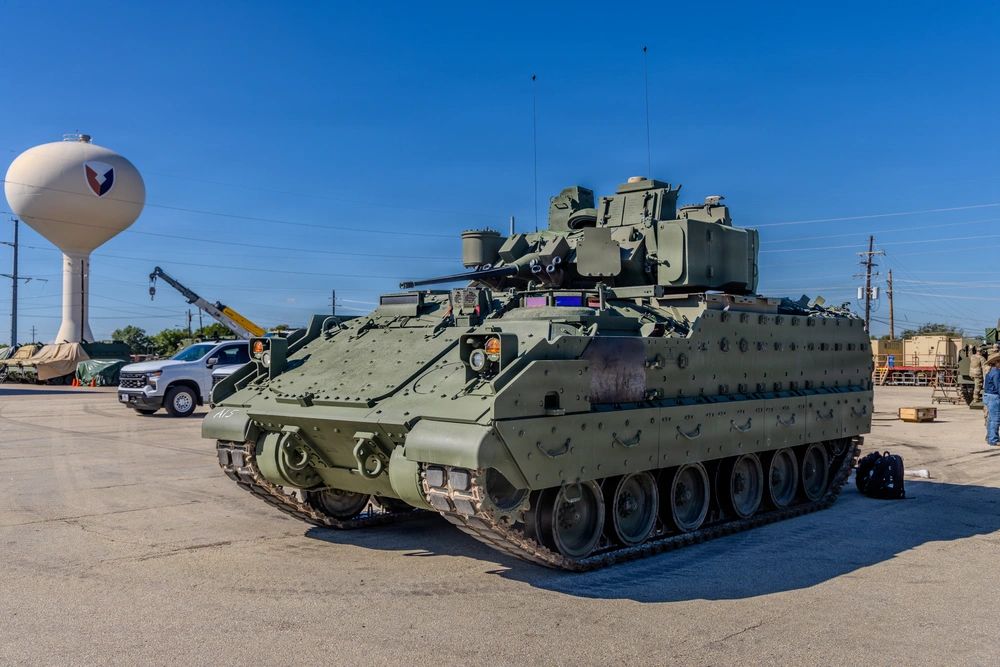
The M2A4E1 is built on the M2A4 Bradley baseline, which introduced an auxiliary power unit and a revised power-generation and distribution architecture necessary to operate the APS and additional sensors. The M2A3 variant did not generate sufficient electrical power to run the Iron Fist. On 5 October 2026, the U.S. Army began fielding the first operational M2A4E1 vehicles, making the M2A4E1 the first U.S. infantry fighting vehicle officially equipped with an active protection system.
Design
The M2A4E1 retains the Bradley three-person crew and hull layout. The A4 baseline uses a 675 hp engine, compared with 600 hp on the A3, reaches 66 km/h, and has a combat weight near 36 tonnes, an increase of nearly 60 percent over an early M2. BAE Systems identifies the three principal E1 additions over the A4 as the Iron Fist active protection system, an improved gunner's sight, and an improved environmental control system.
Active protection system
The Iron Fist Light Decoupled system, developed by Elbit Systems, provides a 360-degree sensor envelope using four radar units and four optical sensors distributed around the turret. Two trainable interceptor launchers fire explosive countermeasures when the system determines that an incoming rocket-propelled grenade, anti-tank guided missile, or unmanned aerial vehicle is on an impact trajectory. The IF-LD configuration has a published mass of 329 kg and an electrical demand of 610 W continuous and 820 W at peak. The system outputs the threat type and launch location, allowing the crew to identify and suppress the enemy team before another weapon is fired. Sensor detection range against drones and loitering munitions is approximately 1.5 km, a threat that was not part of the original 2016 requirement. The system does not provide unlimited protection against mass first-person-view drone attacks, as a finite interceptor magazine can be depleted by repeated or simultaneous UAV assaults.
Armament and sensors
The M2A4E1 retains the standard Bradley armament: one M242 25x137 mm Bushmaster cannon, one M240C 7.62 mm coaxial machine gun, and a twin BGM-71 TOW anti-tank guided missile launcher. The gunner receives an IBAS Block 2.8 high-definition long-wave infrared sighting system. An improved environmental control system is fitted to prevent crew heat stress in extreme conditions. The E1 variant does not alter the primary weapon system; its focus is on protection, electrical capacity, and defensive electronics.
Operational history
On 5 October 2026, the 6th Squadron, 9th Cavalry Regiment within the 3rd Armored Brigade Combat Team, 1st Cavalry Division, began receiving the first Iron Fist-equipped M2A4E1 Bradley IFVs. In parallel, the 2nd Battalion, 82nd Field Artillery Regiment received M7A4E1 Battlefield Fire Support vehicles, which replace the TOW launcher with targeting equipment to coordinate artillery and air-delivered fires within combined-arms formations. Initial procurement was measured in dozens of vehicles; a $228 million Iron Fist contract announced in January 2026 followed earlier awards of $37 million and $127 million in 2024.
Operators
- United States – U.S. Army, 3rd Armored Brigade Combat Team, 1st Cavalry Division (initial fielding, October 2026)
Specifications (M2A4E1)
General characteristics
- Crew: 3 (commander, gunner, driver) plus up to 6 dismounted infantry
- Combat weight: approximately 36 tonnes
- Engine output: 675 hp
- Top speed: 66 km/h
Armament
- Main gun: M242 25x137 mm Bushmaster cannon
- Coaxial machine gun: M240C 7.62 mm
- Anti-tank missiles: Twin BGM-71 TOW launcher
Active protection
- System: Iron Fist Light Decoupled (IF-LD), Elbit Systems
- Sensors: 4 radar units, 4 optical sensors (360-degree coverage)
- Interceptor launchers: 2 trainable
- APS mass: 329 kg
- Electrical demand: 610 W continuous / 820 W peak
- Drone detection range: approximately 1.5 km
 Argentina
 Armenia
 Australia
 Austria
 Austria-Hungary
 Belgium
 Brazil
 United Kingdom
 Brunei
 Bulgaria
 Canada
 Chile
Chile China
China Colonial America
 Colombia
 Confederate States
 Croatia
 Czech
Czech Denmark
 Egypt
Egypt Finland
 France
 Georgia
 Germany
 German Imperial
 Greece
 Holland
 Hungary
 India
India Indonesia
 Iran
Iran Iraq
Iraq Ireland
 Israel
 Italy
Italy Japan
Japan Japan (1940)
 Jordan
 Kingdom of Italy
 Malaysia
 Mexico
 Myanmar
 Nazi Germany
 Netherlands
 New Zealand
 North Korea
 Norway
 Pakistan
 Peru
Peru Philippines
 Poland
 Portugal
 Prussia
 Romania
 Russia
 Saudi Arabia
 Serbia
 Singapore
 Slovakia
 Slovenia
 South Africa
 South Korea
 Soviet Union
 Spain
Spain Sweden
 Switzerland
 Syria
Syria Taiwan
 Thailand
 Turkey
 UAE
UAE Ukraine
 Vietnam
 Yugoslavia