
History
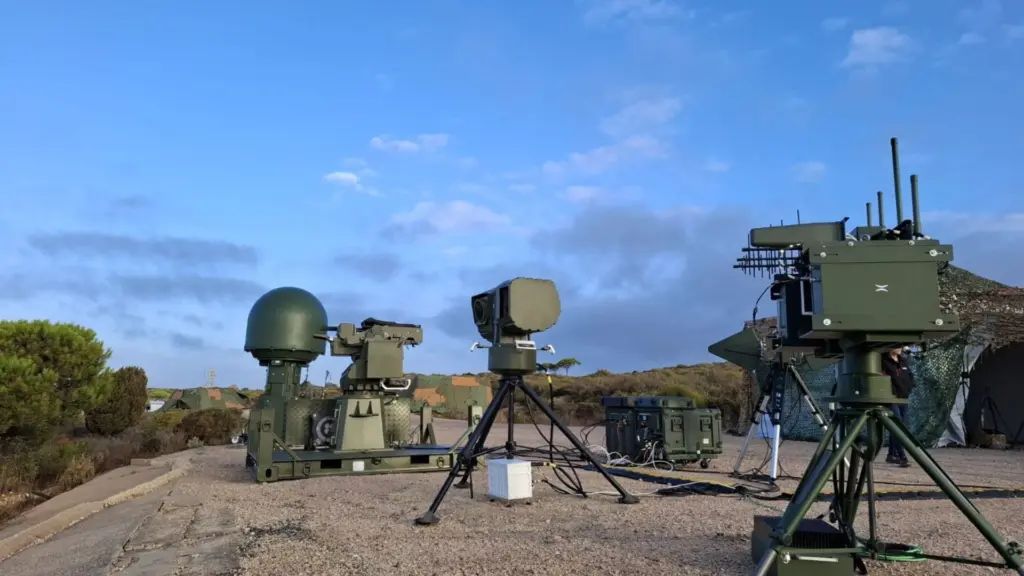
The ARACNE counter-UAS system was presented at the ATLAS25 joint military exercises held from 20 to 24 October 2025 at the Médano del Loro range in Huelva. The exercises, organized under the Defence Staff (EMAD) and led by the 71st Anti-Aircraft Artillery Regiment, were described as among Spain's most extensive recent operations for assessing emerging defence technologies and inter-service coordination. At the time, Indra stated that the system was scheduled for delivery to the Spanish Army by the end of 2025. The system was developed by Indra together with EM&E Group; one source additionally lists TRC as a member of the development consortium.
The first ARACNE systems were delivered to the 71st Anti-Aircraft Artillery Regiment on 8 October 2026, designating the regiment as the army's lead unit for preparation against unmanned aerial threats. The regiment has completed an operational evaluation of the system's soft-kill mode, which uses electronic-warfare means to suppress drone control and navigation channels. Hard-kill testing is planned during a future ATLAS exercise, with no exact date yet announced.
Spain is procuring 14 ARACNE systems for a total of €30.24 million: seven fixed and seven mobile. Army deliveries include five fixed and five mobile configurations for the protection of military columns and critical infrastructure; the remaining two fixed and two mobile systems are allocated to the Air and Space Force and the Navy. The Ministry of Defence is preparing a follow-on ARACNE contract whose value and scope have not yet been announced.
Specifications
The mobile ARACNE configuration consists of two VAMTAC ST5 tactical vehicles. The first vehicle carries the detection and electronic-warfare suite: the NEMUS radar, a compact active electronically scanned array (AESA) system designed for tactical operations; the SmartEar radio-frequency scanner; and the Brontes/EVO electronic-suppression system. The second vehicle is dedicated to hard-kill engagement and mounts the Guardian 2.0 remotely operated weapon module armed with a 40 mm Mk 19 automatic grenade launcher. The system integrates radar, radio-frequency, and electro-optical sensors with a command-and-control network, electronic-warfare effectors, and kinetic capability.
The NEMUS radar can detect small drones with a radar cross-section of 0.01 m² at a range of up to 4 km and larger targets at 12–15 km. The electronic-warfare suite can suppress satellite navigation signals at up to 15 km and drone control links at up to 5 km.
 Argentina
 Armenia
 Australia
 Austria
 Austria-Hungary
 Belgium
 Brazil
 United Kingdom
 United States
 Brunei
 Bulgaria
 Canada
 Chile
Chile China
China Colonial America
 Colombia
 Confederate States
 Croatia
 Czech
Czech Denmark
 Egypt
Egypt Finland
 France
 Georgia
 Germany
 German Imperial
 Greece
 Holland
 Hungary
 India
India Indonesia
 Iran
Iran Iraq
Iraq Ireland
 Israel
 Italy
Italy Japan
Japan Japan (1940)
 Jordan
 Kingdom of Italy
 Malaysia
 Mexico
 Myanmar
 Nazi Germany
 Netherlands
 New Zealand
 North Korea
 Norway
 Pakistan
 Peru
Peru Philippines
 Poland
 Portugal
 Prussia
 Romania
 Russia
 Saudi Arabia
 Serbia
 Singapore
 Slovakia
 Slovenia
 South Africa
 South Korea
 Soviet Union
 Sweden
 Switzerland
 Syria
Syria Taiwan
 Thailand
 Turkey
 UAE
UAE Ukraine
 Vietnam
 Yugoslavia