
History
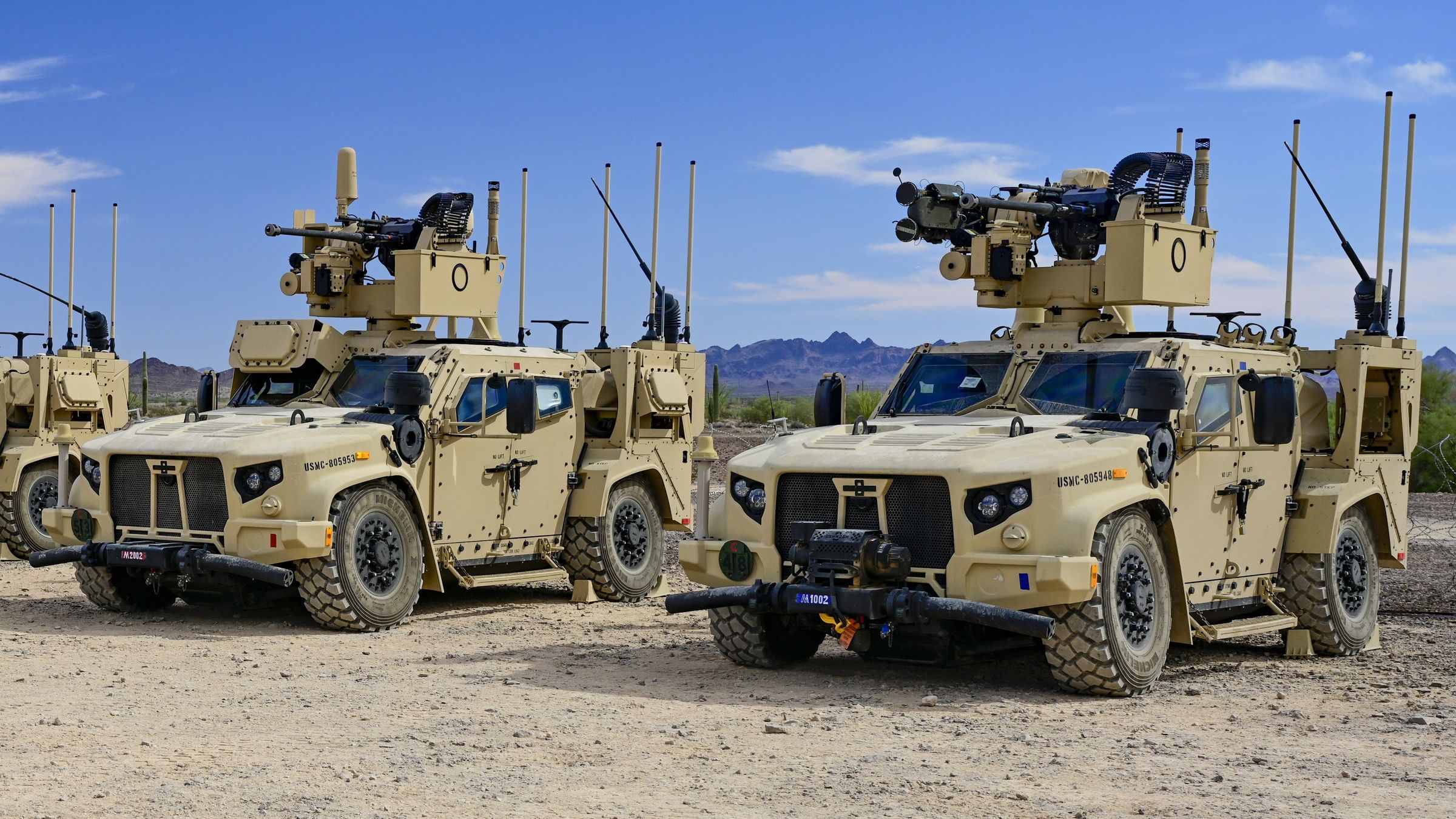
The Marine Air Defense Integrated System (MADIS) is a U.S. Marine Corps mobile short-range air-defense system designed to counter small unmanned aircraft systems, helicopters, and low-flying fixed-wing aircraft. It combines two Joint Light Tactical Vehicles that operate as a coordinated sensor-and-engagement team.
MADIS provides several methods of defeating aerial threats, including FIM-92 Stinger missiles, a 30 mm cannon, electronic warfare, radar, and networked command-and-control functions. The system was developed to give Low Altitude Air Defense units a mobile capability that can accompany dispersed Marine formations.
The system was undergoing testing at Yuma Proving Grounds in Arizona by September 2023. The 3rd Marine Littoral Regiment in Hawaii received MADIS in December 2024, and Marine units subsequently used the system during exercises in the Indo-Pacific.
Testing and production
Marine forces conducted a MADIS live-fire exercise during Exercise Balikatan in April 2025. The system was also used during Resolute Dragon 2025. According to Defense News, the first full-rate production version debuted in September 2025 after an extended period of trials. The production configuration incorporated improvements to targeting algorithms, sensors, and mobility.
The system was designed as a replacement for a previous Marine Corps approach based on man-portable air-defense weapons that required personnel to leave their vehicle before engaging aerial targets. MADIS instead allows crews to detect and engage threats from vehicle-mounted systems and can operate from stationary positions or while moving.
Indo-Pacific fielding
The 3rd Marine Division deployed MADIS to the Philippines for Exercises Balikatan 2025 and 2026. In June 2026, the Okinawa-based 12th Marine Littoral Regiment formally received MADIS together with the Navy-Marine Expeditionary Ship Interdiction System. The U.S. Marine Corps described MADIS as a short-range surface-to-air system intended to enable Low Altitude Air Defense Battalions to deter and neutralize unmanned aircraft and fixed-wing and rotary-wing aircraft.
On July 28, 2026, Marines conducted a MADIS live-fire exercise at Camp Schwab in Okinawa. The event followed the system's delivery to the 12th Marine Littoral Regiment and demonstrated its integration into the regiment's forward-deployed air-defense capability. The exercise was reported by Army Recognition.
Design
MADIS is based on a complementary pair of 4x4 Joint Light Tactical Vehicles. The vehicles divide sensing, command-and-control, electronic-warfare, and weapon functions while exchanging information through a network. This arrangement allows the system to detect, track, identify, and engage aerial targets while remaining mobile with Marine ground formations.
Sensor and command vehicle
One MADIS vehicle serves primarily as the sensor and command-and-control element. It uses 360-degree radar coverage, command-and-control equipment, and electronic-warfare systems for detecting and countering small unmanned aircraft. Sensor information can be distributed to the accompanying engagement vehicle through a wireless network.
Engagement vehicle
The complementary engagement vehicle carries a multi-Stinger missile pod, a turret-mounted 30 mm cannon, and electronic-warfare capabilities. These weapons provide different engagement options against unmanned aircraft, helicopters, and fixed-wing aircraft. Electronic warfare can be used against suitable unmanned systems, while the cannon and Stinger missiles provide kinetic engagement options.
Layered air defense
The combination of electronic warfare, gun armament, and surface-to-air missiles allows MADIS crews to select an engagement method according to the threat. This is particularly relevant against mixed groups of small drones and other low-altitude aircraft, where relying on a single type of interceptor would limit flexibility and ammunition management.
MADIS can operate as a mobile system rather than depending on a permanent radar or firing position. Its networked architecture also permits sensor tracks and targeting information to be exchanged between the two vehicles. The system is designed to support Marine formations operating across dispersed positions.
Operational history
The Hawaii-based 3rd Marine Littoral Regiment was the first Marine Littoral Regiment identified in the supplied sources as receiving MADIS, taking delivery in December 2024. The system subsequently participated in Exercise Balikatan 2025 and Resolute Dragon 2025.
During Balikatan 2026 in the Philippines, Marines demonstrated MADIS against quadcopters and fixed-wing unmanned aircraft. In June 2026, the 12th Marine Littoral Regiment on Okinawa received its first MADIS platforms as part of the Marine Corps' continuing fielding of modernized air-defense capabilities across the Indo-Pacific. The delivery was also reported by Military Times.
The July 2026 live-fire training at Camp Schwab focused on operation of the newly delivered system in Okinawa. MADIS is intended to protect Marine forces and associated combat assets from drones and low-altitude aircraft while supporting mobile and distributed operations.
Related equipment
- Light Marine Air Defense Integrated System (L-MADIS): A lighter system within the Marine Corps Ground Based Air Defense program. It uses two Polaris MRZR all-terrain vehicles rather than the two JLTVs of MADIS. In 2026, the Marine Corps selected the Bullfrog M240 robotic weapon system for prototype integration with L-MADIS under an agreement reported by Breaking Defense.
Specifications (MADIS full-rate production configuration)
General characteristics
- Type: Mobile short-range ground-based air-defense system
- Primary user: U.S. Marine Corps
- Vehicle basis: Two 4x4 Joint Light Tactical Vehicles operating as a coordinated pair
- Primary targets: Small unmanned aircraft systems, helicopters, and low-flying fixed-wing aircraft
- Sensor functions: 360-degree radar coverage, target detection and tracking, and networked information distribution
- Command and control: Vehicle-mounted command-and-control suite with wireless exchange of sensor tracks between the paired vehicles
- Electronic warfare: Electronic-warfare capability for countering suitable unmanned aircraft threats
Armament
- Surface-to-air missiles: FIM-92 Stinger missiles carried in a multi-missile pod
- Cannon: Turret-mounted 30 mm cannon
 Argentina
 Armenia
 Australia
 Austria
 Austria-Hungary
 Belgium
 Brazil
 United Kingdom
 Brunei
 Bulgaria
 Canada
 Chile
Chile China
China Colonial America
 Colombia
 Confederate States
 Croatia
 Czech
Czech Denmark
 Egypt
Egypt Finland
 France
 Georgia
 Germany
 German Imperial
 Greece
 Holland
 Hungary
 India
India Indonesia
 Iran
Iran Iraq
Iraq Ireland
 Israel
 Italy
Italy Japan
Japan Japan (1940)
 Jordan
 Kingdom of Italy
 Malaysia
 Mexico
 Myanmar
 Nazi Germany
 Netherlands
 New Zealand
 North Korea
 Norway
 Pakistan
 Peru
Peru Philippines
 Poland
 Portugal
 Prussia
 Romania
 Russia
 Saudi Arabia
 Serbia
 Singapore
 Slovakia
 Slovenia
 South Africa
 South Korea
 Soviet Union
 Spain
Spain Sweden
 Switzerland
 Syria
Syria Taiwan
 Thailand
 Turkey
 UAE
UAE Ukraine
 Vietnam
 Yugoslavia