
History
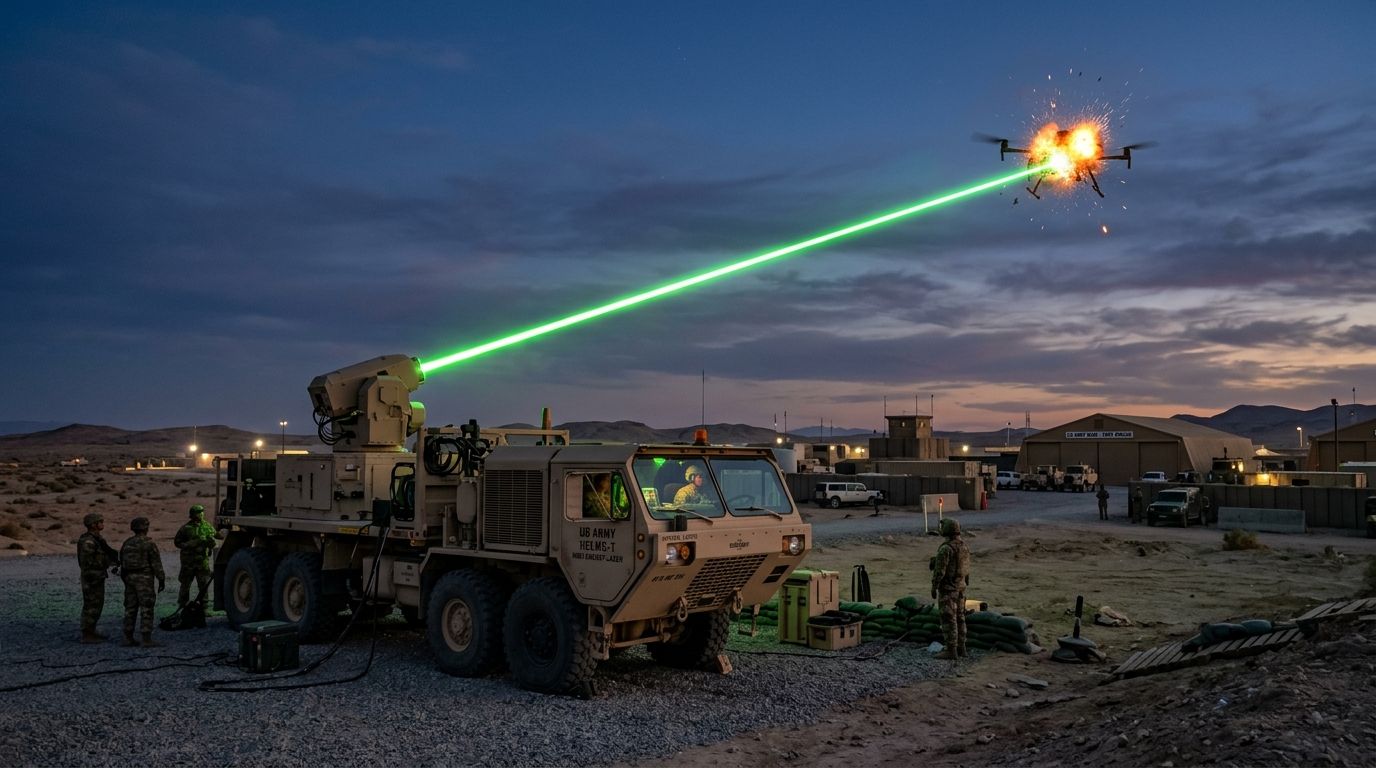
The KBR Firefly is a mobile high-energy laser weapon system developed by KORD, a KBR subsidiary, for countering adversarial drones. The Pentagon selected the system for a pilot program to test the defense of U.S. military installations against adversarial drones. The pilot places directed-energy weapons at military bases across the country for a yearlong assessment, during which service members will operate, maintain, and collect data on the weapons while the Pentagon gathers information on cost and logistics.
The system was designed, engineered, and tested in Huntsville, Alabama, where KBR employs approximately 1,000 personnel. During a public demonstration in Alabama in August 2026, company officials stated that a truck-mounted system can down a small drone in just a few seconds. A KBR senior director noted that the company has been working on directed energy for more than a decade.
Design
The Firefly is a palletized, modular, open-architecture system designed for transport on tactical vehicles or flatbed trucks. KBR states the system can be in place and operational in 30 minutes. It is battery-powered, with 15 hours of capacity rechargeable using standard off-the-shelf generators.
The system operates through a detect-track-intercept-defeat cycle. A radar or connected command-and-control system provides a cue, and advanced algorithms identify incoming unmanned aircraft systems. An independent camera payload with visible and infrared sensors establishes tracking at extended range, with AI capabilities tracking targets automatically. A human operator using an Xbox controller as the primary input device makes the decision on when and where to engage. The laser can be aimed at specific components of a target such as a propeller, engine, or fuel tank.
A KBR senior director cautioned that the Firefly can engage only one threat at a time, meaning that in a drone swarm the highest-priority threat must be selected and multiple systems would be required to handle concurrent threats. KORD's product description separately states that the system can defeat multiple UAS at range.
The system has accumulated 34 months of collective operation and is ruggedized to function in temperatures from −15 °C to 35 °C, surviving rain, snow, and blowing sand. KORD states it is offered for purchase via commercial terms.
Specifications
- Power: Scalable high-energy laser architecture from 5 kW to 40 kW. KORD describes available configurations at 10 kW and 20 kW, and its introductory product text references 5 kW to 30 kW options.
- Detection range: Up to 8 km (5 mi) for small drones.
- Engagement range: Approximately 2.4 km (1.5 mi) per KBR's published system specifications; a KBR director stated during the August 2026 demonstration that the laser attacks at 1.6 km (1 mi).
- Target neutralization time: 2 to 5 seconds.
- Operating temperature: −15 °C to 35 °C.
- Integration: Interfaces with military radar and command-and-control architectures including FAAD, MEDUSA, and Sentinel Radar, as well as stand-alone optical detection systems.
- Design: Modular Line Replaceable Units; self-contained with integrated power supply, thermal management, high-capacity batteries, radar, and electronic-warfare subsystems.
 Argentina
 Armenia
 Australia
 Austria
 Austria-Hungary
 Belgium
 Brazil
 United Kingdom
 Brunei
 Bulgaria
 Canada
 Chile
 China
 Colonial America
 Colombia
 Confederate States
 Croatia
 Czech
 Denmark
 Egypt
 Finland
 France
 Georgia
 Germany
 German Imperial
 Greece
 Holland
 Hungary
 India
 Indonesia
 Iran
 Iraq
 Ireland
 Israel
 Italy
 Japan
 Japan (1940)
 Jordan
 Kingdom of Italy
 Malaysia
 Mexico
 Myanmar
 Nazi Germany
 Netherlands
 New Zealand
 North Korea
 Norway
 Pakistan
 Peru
 Philippines
 Poland
 Portugal
 Prussia
 Romania

 Russia
 Saudi Arabia
 Serbia
 Singapore
 Slovakia
 Slovenia
 South Africa
 South Korea
 Soviet Union
 Spain
 Sweden
 Switzerland
 Syria
 Taiwan
 Thailand
 Turkey
 UAE
 Ukraine
 Vietnam
 Yugoslavia