
History
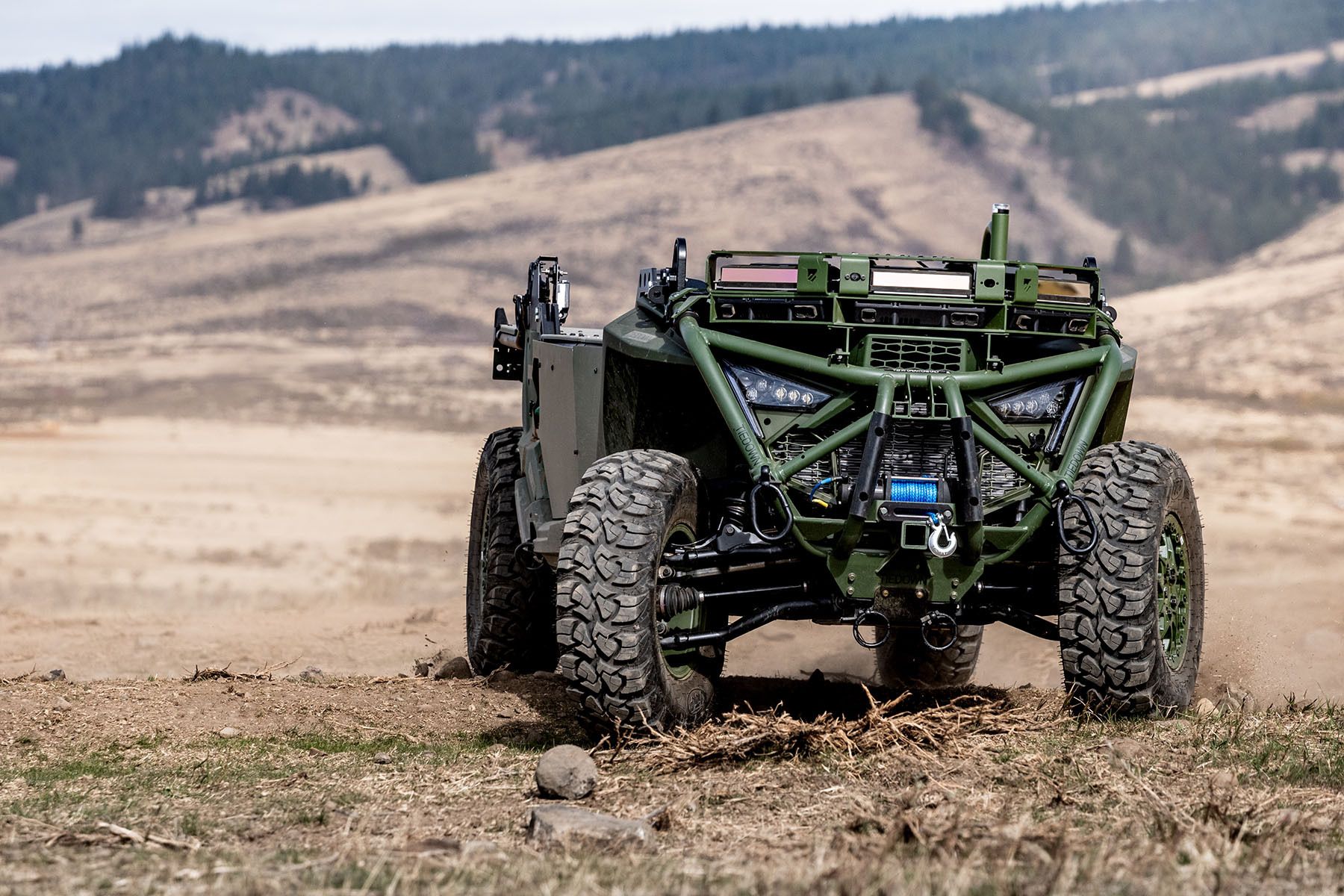
Overland AI, founded in 2022 and headquartered in Seattle, Washington, officially introduced the IBEX autonomous ground vehicle on October 7, 2026. The vehicle was presented for the first time at the Association of the United States Army (AUSA) exhibition, held October 12–14 in Washington, D.C., where it was displayed equipped with an Arnold Defense LAND-LGR4 laser-guided rocket launcher. The configuration illustrated potential combat applications but did not indicate that the Marine Corps had selected the launcher for its future IBEX vehicles.
The introduction followed a production contract announced on June 29, 2026, worth approximately $20 million under the U.S. Accelerate the Procurement and Fielding of Innovative Technologies (APFIT) initiative. Overland AI described the contract as the first primed by a ground autonomy company for the U.S. military. The agreement was awarded in coordination with the Marine Corps' Ground Based Air Defense program office and covers delivery of autonomous ground vehicles for integration into the Marine Air Defense Integrated System (MADIS). Program manager Joe Klocek stated that integrating the vehicles would extend the operational reach and lethality of Marine Corps air-defense units.
The APFIT contract was subsequently extended through an additional $4.5 million in funding for the U.S. Army's 75th Ranger Regiment, bringing the total to approximately $25 million. Overland AI is also working to integrate its autonomous driving technology into the Marine Corps' ROGUE Fires system, intended for expeditionary anti-ship strike operations. Initial deliveries were expected in 2027.
Specifications
IBEX is built on the Polaris MRZR light tactical vehicle platform, retaining its chassis, engine, and drivetrain. The vehicle has a gross weight of approximately 2,302 kg and a payload capacity of 907 kg (2,000 lb). It is powered by a 1.5-liter turbocharged diesel engine producing 120 hp and is compatible with both diesel and military JP-8 fuel.
In autonomous mode, IBEX can exceed 56 km/h (35 mph) and travel approximately 402 km (250 mi) at a cruising speed of 32 km/h (20 mph). A NATO-standard 24 V electrical interface provides up to 5 kW of export power to onboard equipment, supporting surveillance systems, communications equipment, electronic warfare devices, and counter-drone sensors or effectors. The vehicle is designed for transport aboard the V-22 Osprey tiltrotor aircraft.
Autonomous navigation is provided by Overland AI's OverDrive software, OverWatch interface, and SPARK computing and perception hardware, enabling operation in Denied, Degraded, Intermittent, and Limited (DDIL) environments without continuous remote control or teleoperation. Operators assign missions but do not need to steer the vehicle continuously.
 Argentina
 Armenia
 Australia
 Austria
 Austria-Hungary
 Belgium
 Brazil
 United Kingdom
 Brunei
 Bulgaria
 Canada
 Chile
 China
 Colonial America
 Colombia
 Confederate States
 Croatia
 Czech
 Denmark
 Egypt
 Finland
 France
 Georgia
 Germany
 German Imperial
 Greece
 Holland
 Hungary
 India
 Indonesia
 Iran
 Iraq
 Ireland
 Israel
 Italy
 Japan
 Japan (1940)
 Jordan
 Kingdom of Italy
 Malaysia
 Mexico
 Myanmar
 Nazi Germany
 Netherlands
 New Zealand
 North Korea
 Norway
 Pakistan
 Peru
 Philippines
 Poland
 Portugal
 Prussia
 Romania

 Russia
 Saudi Arabia
 Serbia
 Singapore
 Slovakia
 Slovenia
 South Africa
 South Korea
 Soviet Union
 Spain
 Sweden
 Switzerland
 Syria
 Taiwan
 Thailand
 Turkey
 UAE
 Ukraine
 Vietnam
 Yugoslavia