
History
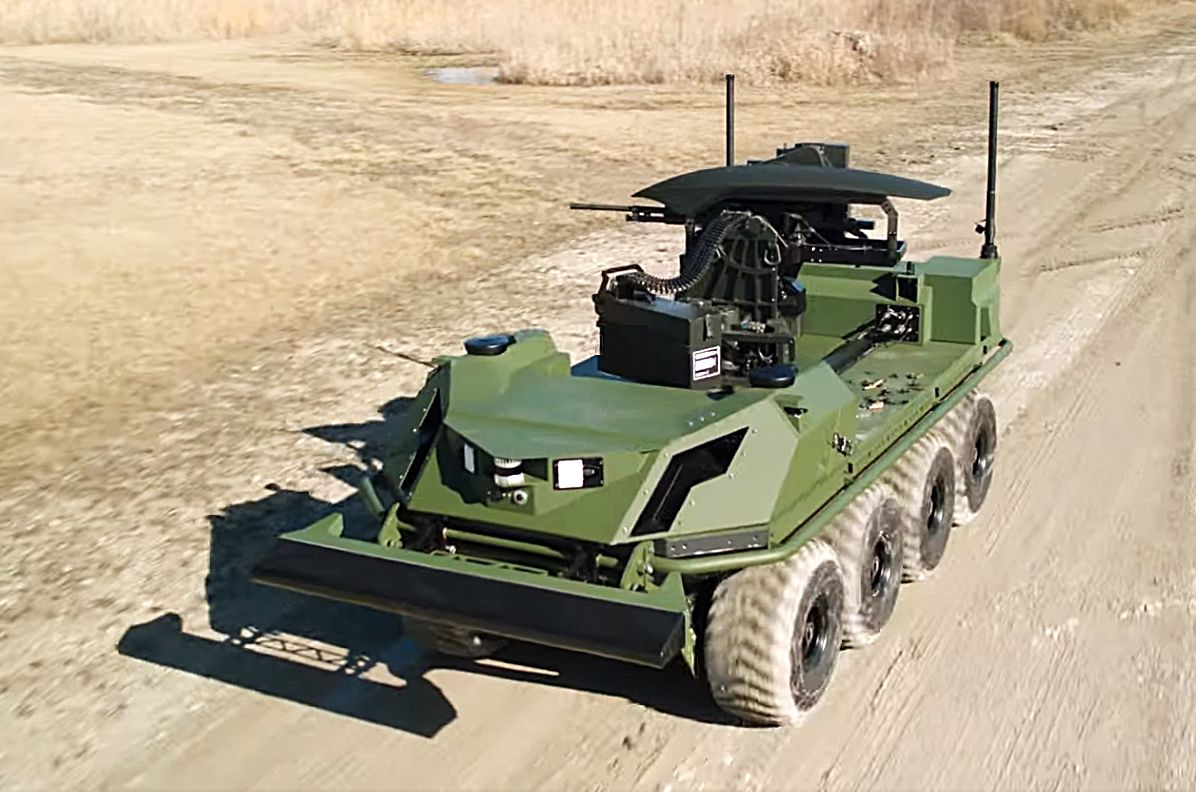
The Rheinmetall Mission Master SP is a compact autonomous unmanned ground vehicle developed as part of the Mission Master family. It combines electric propulsion, amphibious mobility, modular mission payloads, and Rheinmetall's PATH autonomy architecture for logistics, reconnaissance, casualty evacuation, surveillance, and other troop-support tasks.
The SP is intended to operate close to dismounted forces while reducing the need to expose personnel to dangerous terrain or contested areas. Its low-signature electric drive and interchangeable payload concept distinguish it from the larger Mission Master XT and CXT vehicles described within the same family.
The platform has been evaluated by several armed forces and has been used in military experimentation involving logistics, autonomous movement, amphibious operations, surveillance, casualty evacuation, and weapon-station integration. In September 2026, American Rheinmetall received a contract to deliver 12 Mission Master SP vehicles and five amphibious Marine Kits to the U.S. Marine Corps for further evaluation and capability development.
Development
The broader Mission Master unmanned ground vehicle program was publicly shown by Rheinmetall by 2018. An earlier Mission Master vehicle was based on an 8×8 all-terrain platform and was presented as a modular robotic vehicle for transport, reconnaissance, surveillance, medical evacuation, communications relay, CBRN detection, and armed support missions. Background information on the original Mission Master program is described by Army Technology.
By 2024, Rheinmetall was publicly presenting the Mission Master SP alongside the larger XT and CXT variants. The SP was described as a compact unmanned ground vehicle using a low-signature electric motor and offering amphibious capability. Rheinmetall also demonstrated its PATH autonomy technology across the Mission Master family. The 2024 family presentation was reported by SPARTANAT.
Testing and international evaluation
The Mission Master SP subsequently became part of several international trials and demonstrations. According to Army Recognition, the vehicle was evaluated in U.S. Marine Corps experimentation and was used for casualty evacuation, resupply, autonomous marches, and urban operations. The same source reports that the SP was demonstrated with a Fieldranger remote weapon station and participated in activities connected with Talisman Sabre and Apollo Shield.
Swedish trials included a demonstration in which an SP carried launchers for Thales FZ275 70 mm laser-guided rockets. The platform has also been demonstrated with other remotely operated weapon and sensor systems. These integrations illustrate the modular payload concept, but they do not mean every Mission Master SP is delivered as an armed vehicle.
In October 2025, the Japan Ground Self-Defense Force began verification trials involving the Mission Master SP and the Milrem THeMIS. The Japanese evaluation was intended to examine basic performance and concepts of operation for unmanned ground systems, with roles including reconnaissance, logistics, and troop support. The SP was characterized in that evaluation as a relatively compact electric system suited to low-signature forward support.
U.S. Marine Corps procurement
In September 2026, American Rheinmetall secured a $7.28 million award covering 12 Mission Master SP autonomous ground vehicles and five amphibious Marine Kits for the U.S. Marine Corps. The Defense Logistics Agency is handling procurement through ADS Inc., which acts as prime contractor in support of the Marine Corps Warfighting Laboratory.
The vehicles are intended for operational evaluation, experimentation, and capability development rather than being described as a completed fleet-wide operational fielding. The program supports Marine Corps work on autonomous logistics, expeditionary mobility, and reducing personnel exposure during operations. The contract and its purpose were reported independently by Defense Mirror and Defence Industry Europe.
The 2026 package includes engineering and technical support, logistics coordination, documentation, operator training, program management, and acceptance testing. American Rheinmetall leads the U.S. effort, while Rheinmetall Canada is identified as the vehicle's original equipment manufacturer and technical partner. The contract follows more than four years of cooperation between Rheinmetall and the Marine Corps involving earlier fielding, trials, live-fire work, and amphibious capability development.
Design
Vehicle configuration
The Mission Master SP uses a compact unmanned 8-wheel layout designed for off-road movement and operations close to dismounted troops. The SP is electrically powered, which reduces acoustic and thermal signatures compared with larger combustion-powered vehicles in the Mission Master family. This characteristic supports missions such as forward resupply and silent surveillance.
The vehicle is amphibious. A dedicated Marine Kit supplied under the 2026 U.S. Marine Corps contract is intended to extend its ability to operate in littoral and coastal environments. Five Marine Kits are included with the 12 vehicles ordered for Marine Corps experimentation.
Autonomy and control
Autonomous mobility is provided through Rheinmetall's PATH autonomy architecture. Reported functions include follow-me operation, convoy movement, and waypoint navigation. PATH is designed as an autonomy kit that can also be integrated with other military and commercial vehicle platforms.
The Mission Master family can be networked with Rheinmetall command-and-control and soldier-system technology. Armed configurations remain under human control for weapon employment; reported demonstrations do not indicate autonomous authorization of kinetic engagements.
Modular payloads
The Mission Master SP uses a modular architecture that permits mission payloads to be changed according to operational requirements. Reported configurations and demonstrations have included cargo transport, reconnaissance and surveillance equipment, casualty evacuation, CBRN detection, communications support, remote weapon stations, and other mission modules.
Rheinmetall has integrated the Fieldranger remote weapon station with the platform during U.S. work. Other demonstrations have included sensor systems, rocket launchers, and remote weapon stations. These are examples of payload integration and should not be interpreted as standard armament for all vehicles.
Program status
As of September 2026, the Mission Master SP is an established physical platform undergoing continued procurement, experimentation, and evaluation in several countries. The U.S. Marine Corps contract for 12 vehicles is specifically connected with the Marine Corps Warfighting Laboratory and capability-development activities.
- United States: The U.S. Marine Corps has conducted several years of experimentation with Mission Master systems. The September 2026 award covers 12 Mission Master SP vehicles and five Marine Kits for evaluation, experimentation, and capability development.
- Japan: The Japan Ground Self-Defense Force began verification trials of the Mission Master SP in October 2025 alongside the Milrem THeMIS.
- United Kingdom: Mission Master SP vehicles have been reported as procured under the Robotic Platoon Vehicles program in cargo and surveillance configurations.
Specifications (Mission Master SP)
General characteristics
- Type: Autonomous unmanned ground vehicle
- Configuration: Compact wheeled unmanned vehicle
- Propulsion: Electric motor
- Amphibious capability: Yes
- Mission architecture: Modular interchangeable payloads
- Autonomy system: Rheinmetall PATH autonomy architecture
Performance
- Maximum land speed: Up to 40 km/h without a heavy load
- Water speed: About 6 km/h
Mission equipment
- Autonomous functions: Follow-me, convoy, and waypoint navigation modes
- Reported roles: Logistics transport, reconnaissance, surveillance, casualty evacuation, CBRN detection, communications support, and tactical overwatch
- Weapon integration: Fieldranger remote weapon station and other demonstrated payloads; armed use remains under human control
Related equipment
- Rheinmetall Mission Master XT: A larger Mission Master family vehicle intended for heavier payloads and longer-range operations.
- Rheinmetall Mission Master CXT: A larger hybrid-drive Mission Master family vehicle designed for heavy payload transport and amphibious operations.
 Argentina
 Armenia
 Australia
 Austria
 Austria-Hungary
 Belgium
 Brazil
 United Kingdom
 United States
 Brunei
 Bulgaria
 Canada
 Chile
Chile China
China Colonial America
 Colombia
 Confederate States
 Croatia
 Czech
Czech Denmark
 Egypt
Egypt Finland
 France
 Georgia
 German Imperial
 Greece
 Holland
 Hungary
 India
India Indonesia
 Iran
Iran Iraq
Iraq Ireland
 Israel
 Italy
Italy Japan
Japan Japan (1940)
 Jordan
 Kingdom of Italy
 Malaysia
 Mexico
 Myanmar
 Nazi Germany
 Netherlands
 New Zealand
 North Korea
 Norway
 Pakistan
 Peru
Peru Philippines
 Poland
 Portugal
 Prussia
 Romania
 Russia
 Saudi Arabia
 Serbia
 Singapore
 Slovakia
 Slovenia
 South Africa
 South Korea
 Soviet Union
 Spain
Spain Sweden
 Switzerland
 Syria
Syria Taiwan
 Thailand
 Turkey
 UAE
UAE Ukraine
 Vietnam
 Yugoslavia