
History
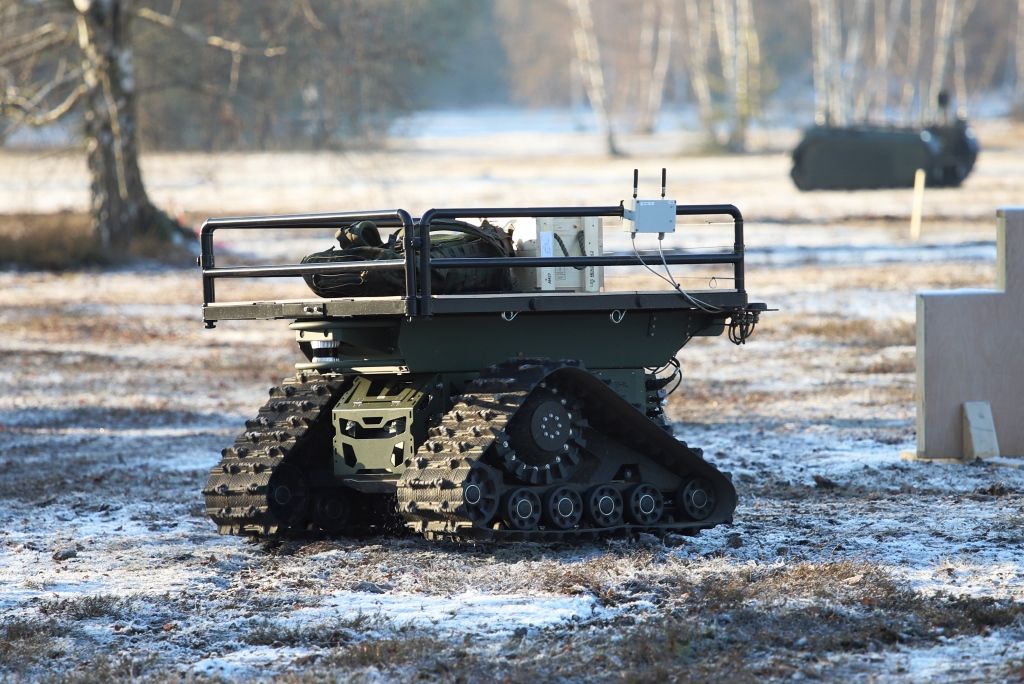
The Diehl Defence Ziesel is a tracked electric unmanned ground vehicle developed for close infantry support. Its documented roles include carrying equipment through difficult terrain, casualty evacuation, and autonomous movement alongside infantry units.
The military Ziesel is based on a civilian tracked platform produced by Austrian company Mattro. Diehl Defence converted the platform into an unmanned system by integrating its PLATON autonomy kit, which provides assisted, remote, and autonomous control functions.
The first unmanned Ziesel prototype was completed in 2019. The German Army later received prototypes for evaluation, while subsequent development introduced revised mobility, autonomy, and payload configurations. In 2026, Diehl Defence stated that Germany, Ukraine, and other armed forces were testing the system.
Development and testing
Diehl Defence had been researching unmanned systems and autonomy with the German Army since the mid-2010s. According to a Janes report, the company acquired its first Mattro vehicle in early 2019. Diehl integrated the PLATON autonomy kit and completed the first unmanned Ziesel prototype in August 2019.
The German Army received two prototype Ziesel UGVs in December 2022 for testing and evaluation. The vehicle was intended for close infantry support, particularly logistics and casualty evacuation, with its relatively compact dimensions selected partly for movement through forested terrain.
In June 2024, Ziesel participated in the European Land Robot Trial at the German military test facility WTD 41 in Trier. According to Diehl Defence, the vehicle placed first in the Mule scenario. The test required it to learn a route in Follow mode and then travel the route automatically under conditions including denied GNSS, heavy vegetation, difficult terrain, and blocked paths.
Diehl continued revising the platform and PLATON software. At Enforce Tac in February 2026, the company presented an updated Ziesel with improvements to control and mobility in difficult terrain. Diehl described the system as undergoing trials with several armed forces, including Germany and Ukraine.
Weapon integration was also demonstrated. In 2026, Diehl Defence, Rafael Advanced Defense Systems, and EuroSpike conducted firing trials using a SPIKE LR missile launcher installed on Ziesel. According to Diehl Defence, 17 missiles were fired during five days of testing to evaluate the platform's structural and operational ability to carry an effector system. The configuration remained a development and demonstration application rather than a confirmed operational production model.
On September 9, 2026, Ziesel was presented at the MSPO exhibition in Poland. The configuration shown there had a stated empty weight of 350 kg and could carry up to 500 kg. The MSPO report also described remote manual control, autonomous following, Push mode, and waypoint navigation.
Design
Ziesel uses a compact tracked chassis and a fully electric drivetrain. The military UGV is derived from the Mattro Ziesel platform, while Diehl Defence supplies the PLATON autonomy system and military integration. The tracked arrangement is intended to provide mobility over rough terrain and through areas such as forests where larger unmanned vehicles may have difficulty following dismounted troops.
Published dimensions and weights have varied as the vehicle has been revised. In 2024, Diehl Defence listed dimensions of approximately 1.48 m by 1.23 m, an empty weight of 350 kg, a payload of more than 500 kg, and replaceable 10 kWh lithium-ion batteries. In February 2026, Diehl described a current configuration approximately 1.6 m long and 1.3 m wide, weighing 380 kg and using replaceable 11 kWh lithium-ion batteries. The MSPO configuration shown in September 2026 was reported as 1.31 m long, 1.23 m wide, and 0.60 m high without its payload, with an empty weight of 350 kg.
Autonomy and control
The PLATON autonomy kit provides the principal autonomous functions of the Diehl Defence Ziesel. Diehl states that the vehicle's Follow mode can operate without LiDAR or GPS. This is intended to reduce dependence on systems that may be detectable or disrupted in contested environments.
In Follow mode, Ziesel can travel behind a soldier or another vehicle while maintaining a defined separation. The system can maneuver around obstacles and, where possible, cross them. Diehl has also demonstrated the vehicle transporting military equipment and supporting casualty evacuation.
The MSPO 2026 configuration supported remote manual control with assistance functions. In Push mode, Ziesel travels ahead of a soldier at a set distance and can serve as mobile cover. A separate autonomous navigation function allows the vehicle to follow predefined waypoints using map data.
Electric drive
The MSPO 2026 configuration was described as fully electric, with maximum torque of 1,000 Nm and a maximum speed of 20 km/h. Its stated range was up to 40 km, with operating endurance of up to 24 hours. The platform was also reported capable of climbing gradients of up to 60 percent.
Program status
Ziesel remained under development and military evaluation in 2026. The German Army had been testing prototype vehicles since receiving two systems in December 2022. Diehl Defence stated in 2026 that several armed forces were testing Ziesel, specifically identifying Germany and Ukraine. The available sources do not confirm regular production or formal operational service.
Development has included improvements to mobility and autonomous control as well as trials of different mission payloads. Diehl also designed PLATON as a modular autonomy kit that can be integrated with other vehicle platforms, separate from the Ziesel chassis itself.
Variants
- Logistics configuration: A cargo-carrying configuration intended to transport heavy equipment for infantry units over difficult terrain.
- CASEVAC configuration: A casualty evacuation configuration demonstrated as one of the platform's military applications.
- SPIKE LR demonstrator: A development configuration fitted with a SPIKE LR missile launcher. Live-fire testing was conducted in 2026, but the available sources do not establish it as an operational production variant.
Specifications (MSPO 2026 configuration)
General characteristics
- Type: Tracked unmanned ground vehicle
- Empty weight: 350 kg
- Maximum payload: 500 kg
- Length: 1.31 m
- Width: 1.23 m
- Height: 0.60 m, excluding payload
- Propulsion: Fully electric tracked drivetrain
- Maximum torque: 1,000 Nm
Performance
- Maximum speed: 20 km/h
- Range: Up to 40 km
- Operating endurance: Up to 24 hours
- Maximum gradient: Up to 60 percent
Control and autonomy
- Autonomy system: Diehl Defence PLATON kit
- Control modes: Remote manual control with assistance functions, autonomous following, Push mode, and waypoint navigation
- Following capability: Can follow a soldier or another vehicle while maintaining a safe distance
 Argentina
 Armenia
 Australia
 Austria
 Austria-Hungary
 Belgium
 Brazil
 United Kingdom
 United States
 Brunei
 Bulgaria
 Canada
 Chile
Chile China
China Colonial America
 Colombia
 Confederate States
 Croatia
 Czech
Czech Denmark
 Egypt
Egypt Finland
 France
 Georgia
 German Imperial
 Greece
 Holland
 Hungary
 India
India Indonesia
 Iran
Iran Iraq
Iraq Ireland
 Israel
 Italy
Italy Japan
Japan Japan (1940)
 Jordan
 Kingdom of Italy
 Malaysia
 Mexico
 Myanmar
 Nazi Germany
 Netherlands
 New Zealand
 North Korea
 Norway
 Pakistan
 Peru
Peru Philippines
 Poland
 Portugal
 Prussia
 Romania
 Russia
 Saudi Arabia
 Serbia
 Singapore
 Slovakia
 Slovenia
 South Africa
 South Korea
 Soviet Union
 Spain
Spain Sweden
 Switzerland
 Syria
Syria Taiwan
 Thailand
 Turkey
 UAE
UAE Ukraine
 Vietnam
 Yugoslavia