
History
POLARIS COBRA is a German unmanned missile-carrier aircraft developed by POLARIS Spaceplanes with Diehl Defence under the AirLAS program. The project is intended to provide an airborne launch platform for IRIS-T air-to-air missiles, moving the missile launch point closer to an aerial target.
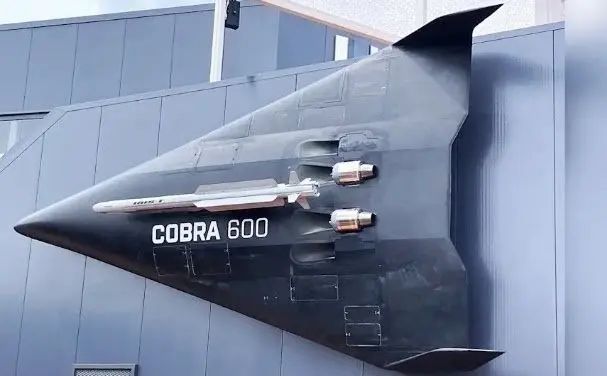
The aircraft is a reusable unmanned design derived from POLARIS Spaceplanes' work on high-speed and reusable spaceplane concepts. A public demonstrator designated Cobra 600 was unveiled at the ILA Berlin air show in June 2026, and the COBRA prototype completed its first reported flight in August 2026.
The program remained in development after the first flight, with further test flights planned. No confirmed procurement contract from the German military or another government had been announced at that stage.
Development
Diehl Defence and POLARIS Spaceplanes signed an exclusive cooperation agreement at the Paris Air Show in June 2025 to develop the AirLAS concept. The program combines an unmanned aircraft with an airborne IRIS-T launcher. The intended concept is to carry the missile toward the engagement area before launch, increasing the effective reach available from the missile-aircraft combination compared with launching from a fixed position.
The companies publicly presented the Cobra 600 demonstrator at ILA Berlin in June 2026. According to TURDEF, the aircraft used a semi-flying-wing configuration with wingtip vertical stabilizers, two small turbojet engines and a single IRIS-T missile carried on a dorsal pylon.
First flight
POLARIS Spaceplanes announced the first flight of the COBRA prototype in August 2026. The aircraft covered more than 20 km during the flight, which the company described as smooth. Additional test flights were planned for the following months. Reporting by Defence Blog stated that the prototype had a takeoff mass above 600 kg.
Design
COBRA uses a delta-wing, flying-wing-style airframe with vertical stabilizers at the wingtips. The Cobra 600 demonstrator displayed in June 2026 was approximately 6 m long. The configuration is intended for unmanned operation and missile carriage rather than operation as a conventional crewed fighter aircraft.
Powerplant
The Cobra 600 demonstrator displayed at ILA Berlin used two JetCat P1000-PRO micro turbojet engines. Each engine was reported to produce slightly less than 250 lbf of thrust. The airframe also incorporated intake openings for two additional engines, although the available sources do not confirm that four engines were installed or used during the first flight.
Armament
The demonstrator was displayed with one IRIS-T short-range infrared-guided air-to-air missile mounted on a pylon above the airframe. AirLAS is intended primarily for air-defense missions. The concept is to allow the unmanned aircraft to reposition the missile launch point before firing against aerial threats.
The developers have described the platform as recoverable and reusable after a mission. The concept can also permit expendable use when required, but the available sources do not establish this as the standard operating mode.
Program status
Following the first flight in August 2026, POLARIS planned additional COBRA test flights. The available reporting does not confirm entry into series production or operational military service. No government procurement contract had been publicly confirmed at the time of the reported first flight.
Variants
- Cobra 600: Public AirLAS missile-carrier demonstrator unveiled at ILA Berlin in June 2026. It was shown with two micro turbojets and a single dorsal IRIS-T missile.
Specifications (Cobra 600 demonstrator)
General characteristics
- Length: approximately 6 m
- Takeoff mass: above 600 kg
- Configuration: delta-wing, flying-wing-style unmanned aircraft with wingtip vertical stabilizers
- Powerplant: 2 × JetCat P1000-PRO micro turbojet engines
- Engine thrust: slightly less than 250 lbf per engine
Armament
- Missile carriage: 1 × IRIS-T air-to-air missile on a top-mounted pylon as displayed
 Argentina
 Armenia
 Australia
 Austria
 Austria-Hungary
 Belgium
 Brazil
 United Kingdom
 United States
 Brunei
 Bulgaria
 Canada
 Chile
Chile China
China Colonial America
 Colombia
 Confederate States
 Croatia
 Czech
Czech Denmark
 Egypt
Egypt Finland
 France
 Georgia
 German Imperial
 Greece
 Holland
 Hungary
 India
India Indonesia
 Iran
Iran Iraq
Iraq Ireland
 Israel
 Italy
Italy Japan
Japan Japan (1940)
 Jordan
 Kingdom of Italy
 Malaysia
 Mexico
 Myanmar
 Nazi Germany
 Netherlands
 New Zealand
 North Korea
 Norway
 Pakistan
 Peru
Peru Philippines
 Poland
 Portugal
 Prussia
 Romania
 Russia
 Saudi Arabia
 Serbia
 Singapore
 Slovakia
 Slovenia
 South Africa
 South Korea
 Soviet Union
 Spain
Spain Sweden
 Switzerland
 Syria
Syria Taiwan
 Thailand
 Turkey
 UAE
UAE Ukraine
 Vietnam
 Yugoslavia