History
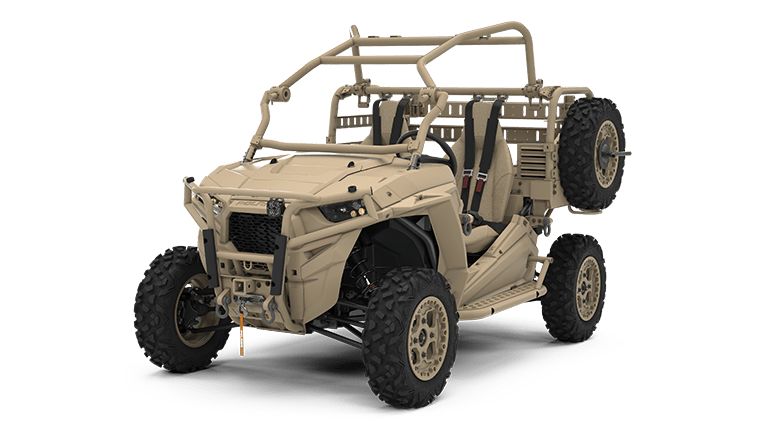
The Polaris MRZR is a family of ultra-light tactical vehicles that is being used as a common ground platform for U.S. Army testing of off-road autonomous driving systems. In 2026, the Army replaced Infantry Squad Vehicles used in its Unmanned Systems autonomy initiative with MRZR vehicles so competing autonomy developers could be evaluated on the same base platform.
Polaris confirmed that it supplied 12 MRZR Alpha vehicles for the Army initiative. The program focuses on evaluating off-road autonomy rather than selecting the MRZR itself as a future operational unmanned vehicle, and Army officials have said that several vehicle types could eventually receive advanced autonomy capabilities.
The MRZR Alpha was already designed to accommodate robotics integration before the Army's 2026 decision. Polaris has described the platform as technology-agnostic, with vehicle-by-wire capability and support for autonomy systems developed by multiple external companies.
Development of robotic capability
The military MRZR family developed from Polaris' light tactical vehicle line. Military versions listed for the family include the MRZR-2, MRZR-4, MRZR Alpha, MRZR Alpha XP, MRZR D2 and MRZR D4. Background information on the broader family is available from the Polaris RZR reference.
By 2024, Polaris was publicly discussing the MRZR Alpha as a platform for autonomous and semi-autonomous applications. The company said vehicle-by-wire capability was available and that the Alpha had been designed to accept autonomy kits from different robotics companies rather than relying on a proprietary Polaris autonomy system. Polaris stated that it intended to concentrate on the vehicle platform while specialist companies developed the software and robotic applications. These plans were described in an interview with Polaris Government & Defense.
U.S. Army UxS program
The Army's UxS autonomy effort followed work associated with DARPA's Robotic Autonomy in Complex Environments with Resiliency, or RACER, program. RACER developed autonomy software stacks intended to allow Army and Marine Corps unmanned ground vehicles to maneuver through complex off-road terrain.
The Army initially planned to integrate autonomy software from Forterra, Overland AI and Scout AI with Infantry Squad Vehicles under prototype contracts. According to the available reporting, the three companies collectively received $15.5 million for that integration effort. The Army later changed the program and allowed software developers to use preferred robotic platforms rather than requiring the ISV as the common surrogate vehicle.
By August 2026, the Army had gone further and stopped using the ISV in current UxS testing. Michael Rose, chief technology officer for CPE Mission Autonomy, said the service was using MRZRs as the common base platform to make direct comparisons among competing autonomy software stacks. Polaris confirmed that 12 MRZR Alphas had been provided for the initiative. The change was reported by Breaking Defense and was also covered by Ajans Savunma and RideApart.
Army officials did not identify which autonomy company was paired with each MRZR. Forterra, Overland AI and Scout AI nevertheless confirmed that they remained participants in the UxS program. The Army was also evaluating other potential autonomy developers, including candidates associated with its FUZE organization.
Design
The MRZR Alpha is a compact tactical mobility platform designed for military transport and mission equipment. Polaris has described the Alpha as suitable for infantry mobility, logistics, command and control, explosive ordnance disposal, indirect-fire support and missile-launch applications. The platform can also be transported by aircraft including the V-22 Osprey.
Robotics integration
For unmanned applications, an important feature is the availability of vehicle-by-wire controls. These allow steering, acceleration and other vehicle functions to be controlled electronically, creating an interface through which external autonomy or remote-control systems can operate the vehicle.
Polaris has described the MRZR Alpha as technology-agnostic for robotics integration. This means the vehicle is intended to accept autonomy kits from multiple suppliers instead of being tied to one software stack. The 2026 Army program uses that characteristic to place multiple software developers on the same basic vehicle platform for comparative testing.
Mobility and payload
Polaris has stated that the four-seat MRZR Alpha can carry up to 907 kg (2,000 lb) of payload. A six-wheel MRZR Alpha derivative has a payload exceeding 1,360 kg (3,000 lb). Track kits are available for operations in snow and mud.
The standard MRZR Alpha provides 1 kW of electrical export power above vehicle requirements. Polaris has also described export-power configurations providing additional electrical capacity, with solutions ranging from another 1 kW to as much as 5 kW while stationary or moving. Such power can support mission equipment and electronic payloads carried on the vehicle.
Program status
As of August 2026, the 12 MRZR Alpha vehicles supplied to the U.S. Army were being used as common test platforms for the UxS off-road autonomy initiative. The available sources do not establish that this configuration has entered operational service as a standardized unmanned ground vehicle.
Army officials have emphasized that the UxS effort is focused on off-road autonomy rather than on selecting a particular vehicle. Rose stated that the ISV, MRZR and other platforms could all become future hosts for advanced autonomy capabilities. No acquisition decision, production quantity for an unmanned MRZR configuration or program price was disclosed.
Variants
- MRZR Alpha: Four-seat tactical vehicle used as the common vehicle platform in the U.S. Army's 2026 UxS autonomy testing. Polaris supplied 12 vehicles for the initiative.
- MRZR Alpha 6x6: Six-wheel derivative described by Polaris with payload capacity exceeding 1,360 kg (3,000 lb). The available sources do not state that this variant is part of the Army's 12-vehicle UxS fleet.
- MRZR Alpha XP: Listed as a military member of the MRZR family. The supplied sources do not establish its use in the 2026 Army autonomy program.
- MRZR-2 and MRZR-4: Earlier gasoline-powered military MRZR variants.
- MRZR D2 and MRZR D4: Diesel-powered military variants of the MRZR family.
Specifications (MRZR Alpha)
General characteristics
- Configuration: Four-seat ultra-light tactical vehicle
- Maximum payload: Up to 907 kg (2,000 lb)
- Export electrical power: 1 kW above vehicle requirements in the standard configuration
- Optional export power: Additional configurations described with outputs from 1 kW up to 5 kW, available while stationary or moving
- Robotics interface: Vehicle-by-wire capability and support for autonomy kits from multiple suppliers
- Air transport: Transportable by the V-22 Osprey and other aircraft
Mission roles
- Supported applications: Infantry mobility, logistics, command and control, explosive ordnance disposal, indirect-fire support and missile-launch missions
- Unmanned application: Common test platform for off-road autonomy software in the U.S. Army UxS initiative
Related equipment
- Infantry Squad Vehicle: Previously used by the U.S. Army as the common surrogate platform for its UxS autonomy effort before current testing shifted to MRZR Alphas.
- RACER program vehicles: Experimental unmanned ground vehicles associated with DARPA's RACER program, which developed off-road autonomy technology preceding the Army's current UxS testing approach.
 Argentina
 Armenia
 Australia
 Austria
 Austria-Hungary
 Belgium
 Brazil
 United Kingdom
 United States
 Brunei
 Bulgaria
 Canada
 Chile
Chile China
China Colonial America
 Colombia
 Confederate States
 Croatia
 Czech
Czech Denmark
 Egypt
Egypt Finland
 France
 Georgia
 Germany
 German Imperial
 Greece
 Holland
 Hungary
 India
India Indonesia
 Iran
Iran Iraq
Iraq Ireland
 Israel
 Italy
Italy Japan
Japan Japan (1940)
 Jordan
 Kingdom of Italy
 Malaysia
 Mexico
 Myanmar
 Nazi Germany
 Netherlands
 New Zealand
 North Korea
 Norway
 Pakistan
 Peru
Peru Philippines
 Poland
 Portugal
 Prussia
 Romania
 Russia
 Saudi Arabia
 Serbia
 Singapore
 Slovakia
 Slovenia
 South Africa
 South Korea
 Soviet Union
 Spain
Spain Sweden
 Switzerland
 Syria
Syria Taiwan
 Thailand
 Turkey
 UAE
UAE Ukraine
 Vietnam
 Yugoslavia