
History
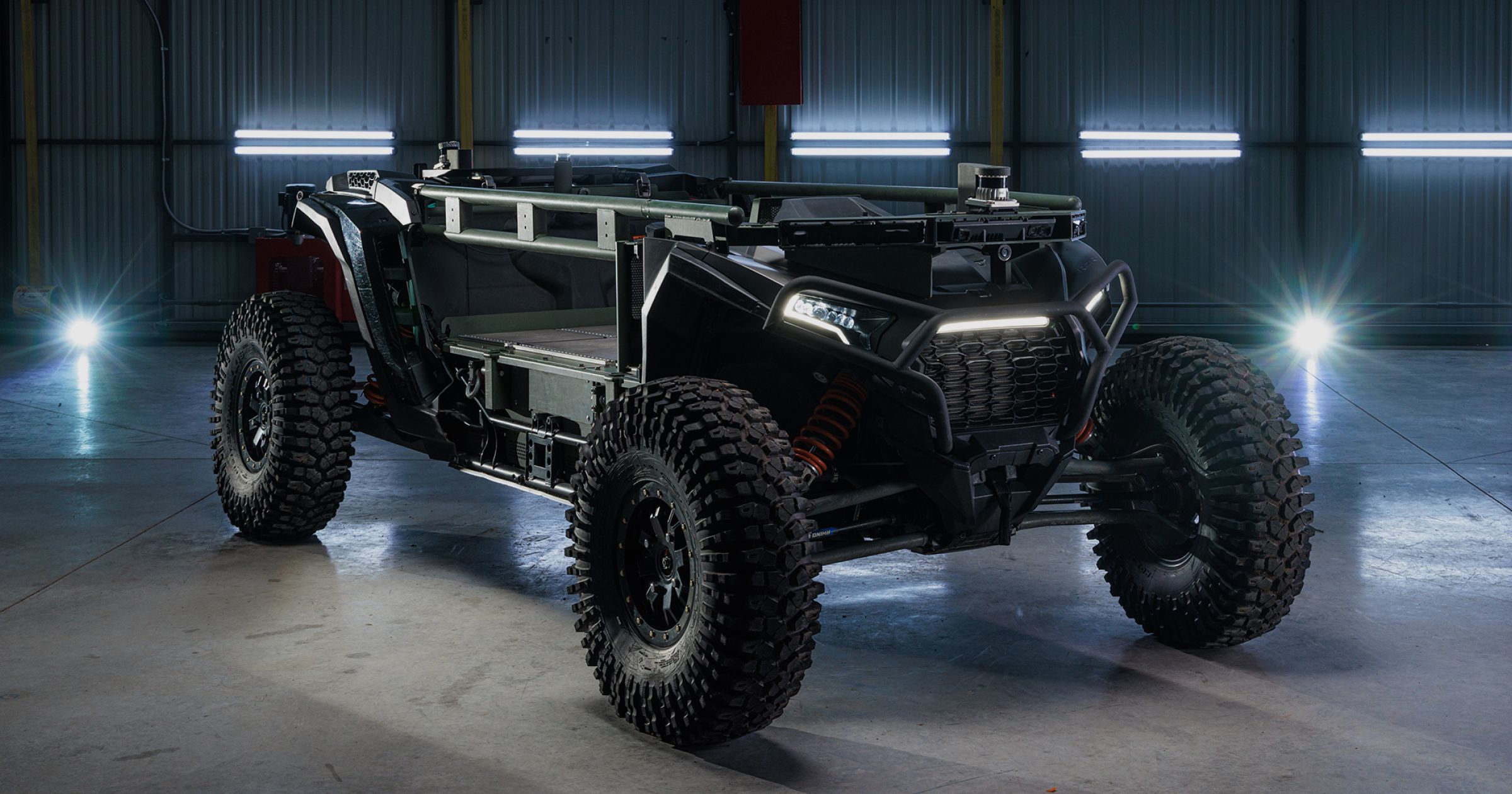
Overland AI ULTRA is a fully autonomous off-road tactical ground vehicle developed in the United States for military mobility and battlefield support. The platform is intended to transport equipment and mission payloads across terrain beyond conventional roads and prepared surfaces without continuous human driving.
ULTRA combines Overland AI's OverDrive autonomy software with terrain perception and adaptive route planning. The system is designed to navigate unfamiliar off-road terrain without relying on GPS, while the OverWatch command architecture allows a human operator to task and monitor multiple robotic vehicles and their payloads.
On September 1, 2026, the U.S. Army demonstrated ULTRA during Saber Junction 26 at the Joint Multinational Readiness Center's Hohenfels Training Area in Germany. During the event, the unmanned vehicle carried Soldiers' equipment while maneuvering across difficult terrain toward an objective, demonstrating its potential role in tactical logistics and support for dispersed formations.
Information released about ULTRA described an approximate vehicle weight of 1,134 kg (2,500 lb), a maximum payload of 454 kg (1,000 lb), a maximum speed of about 56 km/h (35 mph), and a cruising range of up to 161 km (100 mi). The vehicle was presented as a modular autonomous platform rather than only a robotic cargo carrier.
The September 2026 demonstration placed ULTRA in a multinational Army training environment that included electronic warfare, unmanned systems, dispersed maneuver, and contested communications. The event showed the vehicle performing an equipment-carrying mission, but the available source does not confirm U.S. Army production procurement or operational service. Further details of the demonstration are available from Army Recognition.
Design
Mobility
ULTRA uses four-wheel-drive mobility, large tires, and long-travel suspension for off-road movement. The vehicle is intended to operate in difficult terrain including mud, sand, snow, brush, and other surfaces where conventional road mobility may be restricted.
Autonomy and control
The vehicle uses Overland AI's OverDrive autonomy software, which combines real-time terrain perception with adaptive route planning. This allows ULTRA to select and adjust its path through unfamiliar terrain without continuous direct driving by a human operator and without depending on GPS for navigation.
Overland AI's OverWatch command architecture is designed for one-to-many control. A single operator can task and monitor teams of robotic vehicles and their payloads instead of directly driving each vehicle. This architecture is intended to reduce the personnel required to supervise multiple autonomous platforms.
Payloads and missions
ULTRA has a maximum stated payload of 454 kg (1,000 lb). Overland AI identifies logistics, reconnaissance, protection, and open-ended payload integration among possible applications. The platform can also support intelligence, surveillance and reconnaissance equipment, counter-UAS systems, and other mission payloads. These are described as supported or potential configurations rather than confirmed operational variants.
The manufacturer describes ULTRA as an attritable platform. In this context, the design is intended to permit commanders to use the unmanned vehicle for missions in which exposing a crewed vehicle and its personnel could involve greater risk. The available source does not state that ULTRA is disposable.
Program status
ULTRA was physically demonstrated by the U.S. Army in Germany during Saber Junction 26 in September 2026. The demonstration showed the vehicle carrying equipment in an off-road tactical training environment and highlighted autonomous logistics and mobility as possible applications.
The available information presents ULTRA as a platform undergoing military demonstration and experimentation. It does not establish that the vehicle has entered regular U.S. Army service, reached production for an Army program of record, or been assigned to operational units.
Specifications (ULTRA)
General characteristics
- Type: Fully autonomous off-road tactical ground vehicle
- Vehicle weight: Approximately 1,134 kg (2,500 lb)
- Maximum payload: 454 kg (1,000 lb)
- Drive: Four-wheel drive
- Suspension: Long-travel suspension
Performance
- Maximum speed: About 56 km/h (35 mph)
- Cruising range: Up to 161 km (100 mi)
Autonomous systems
- Autonomy software: OverDrive
- Command architecture: OverWatch
- Navigation: Real-time terrain perception and adaptive route planning without reliance on GPS
- Control concept: One operator can task and monitor multiple robotic vehicles
 Argentina
 Armenia
 Australia
 Austria
 Austria-Hungary
 Belgium
 Brazil
 United Kingdom
 Brunei
 Bulgaria
 Canada
 Chile
Chile China
China Colonial America
 Colombia
 Confederate States
 Croatia
 Czech
Czech Denmark
 Egypt
Egypt Finland
 France
 Georgia
 Germany
 German Imperial
 Greece
 Holland
 Hungary
 India
India Indonesia
 Iran
Iran Iraq
Iraq Ireland
 Israel
 Italy
Italy Japan
Japan Japan (1940)
 Jordan
 Kingdom of Italy
 Malaysia
 Mexico
 Myanmar
 Nazi Germany
 Netherlands
 New Zealand
 North Korea
 Norway
 Pakistan
 Peru
Peru Philippines
 Poland
 Portugal
 Prussia
 Romania
 Russia
 Saudi Arabia
 Serbia
 Singapore
 Slovakia
 Slovenia
 South Africa
 South Korea
 Soviet Union
 Spain
Spain Sweden
 Switzerland
 Syria
Syria Taiwan
 Thailand
 Turkey
 UAE
UAE Ukraine
 Vietnam
 Yugoslavia