
History
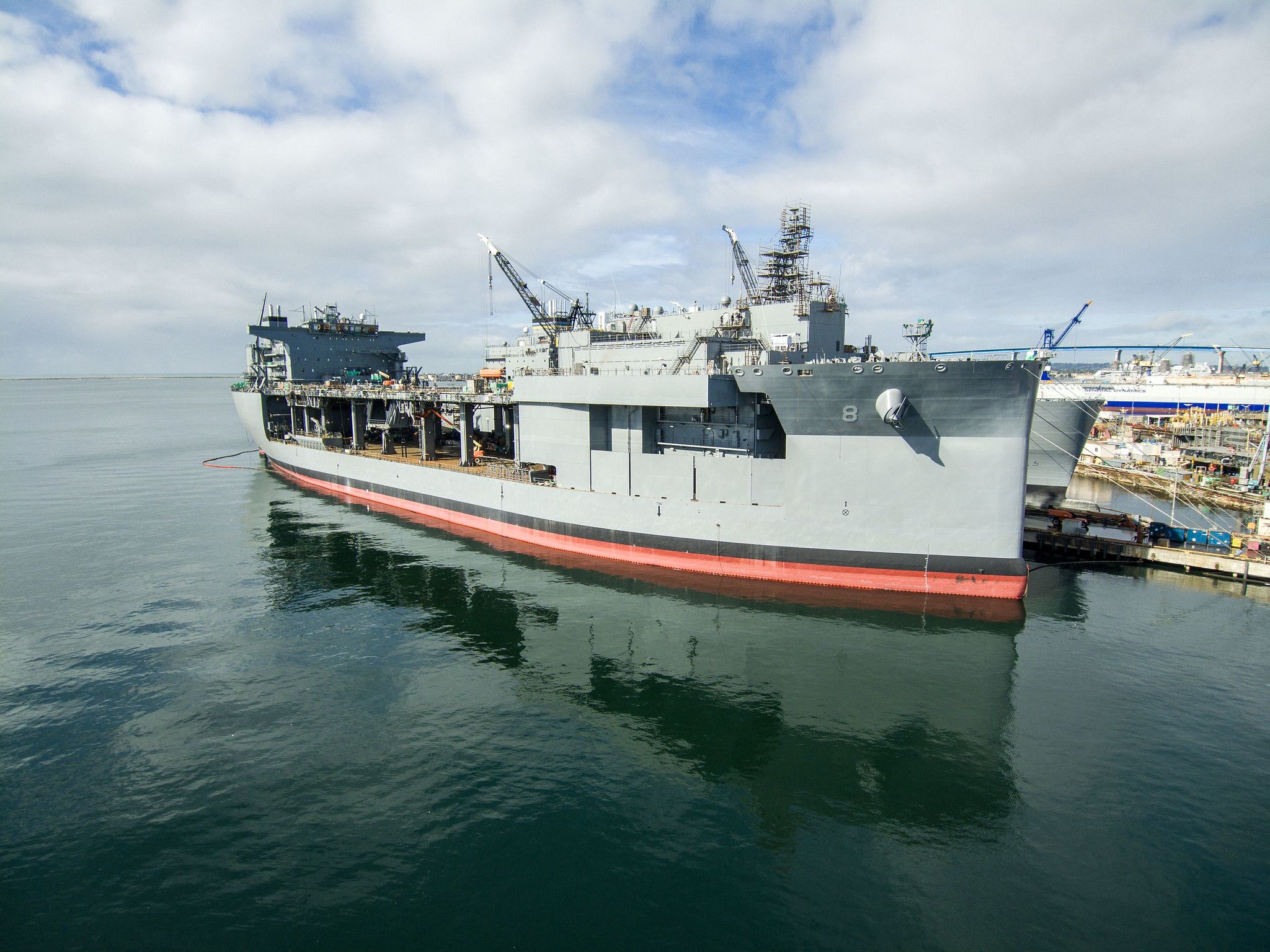
USNS Hector A. Cafferata Jr. (ESB-8) is an Expeditionary Sea Base built by General Dynamics NASSCO for the United States Navy. The large support ship is designed to provide aviation, logistics, command, maintenance, and personnel facilities without depending on established bases ashore.
ESB-8 is the final ship of the eight-hull Expeditionary Transfer Dock and Expeditionary Sea Base program. It is the sixth vessel built in the ESB configuration, following the two earlier Expeditionary Transfer Docks numbered ESD-1 and ESD-2.
The ship completed acceptance trials off Southern California in July 2026. Formal delivery was scheduled for later in the summer of 2026, so the vessel had not yet entered fleet service when the trials were announced.
Development of the sea-base concept
The program originated from United States Navy studies of seabasing, which sought to move personnel, vehicles, and equipment through offshore platforms when suitable ports were unavailable. Concept trials began in 2005 and continued with several combinations of transport and heavy-lift ships. These demonstrations examined transfers between vessels and the movement of cargo ashore by landing craft.
The initial production configuration became the Mobile Landing Platform, later designated Expeditionary Transfer Dock. General Dynamics NASSCO based its design on the commercial Alaska-class tanker hull. This approach produced a large diesel-electric platform at a lower cost than a purpose-built amphibious warfare ship.
A modified configuration was developed as the Afloat Forward Staging Base. It added accommodation, a hangar, a large elevated flight deck, equipment areas, and facilities for extended expeditionary missions. In September 2015, the Navy redesignated this configuration as the Expeditionary Mobile Base, or ESB. The type is also widely described as the Expeditionary Sea Base.
Construction and testing
ESB-8 was named in honor of Hector A. Cafferata Jr., a United States Marine who received the Medal of Honor for actions during the Korean War. The ship was constructed at the General Dynamics NASSCO shipyard in San Diego, California.
Acceptance trials took place during a three-day underway period off Southern California and concluded on July 17, 2026. Evaluators examined propulsion, electrical generation, navigation, communications, aviation support, and mission systems. They also assessed the ship's safe operation under underway conditions.
The trials were the principal contractual evaluation before delivery. Their successful completion confirmed that ESB-8 met the tested technical and contractual requirements. Reports from SeaWaves, Naval Today, and Army Recognition identified the vessel as the final ship in production and stated that delivery was planned for later in the summer of 2026.
Design
Hull and mission layout
ESB-8 uses the large commercial-derived hull developed for the Expeditionary Transfer Dock and Expeditionary Sea Base family. The ESB arrangement replaces the transfer dock's primary landing-craft function with facilities for aviation, command, special operations, mine countermeasures, maintenance, and equipment staging.
The ship acts as a mobile offshore support hub. It can host personnel and equipment near an operating area while reducing dependence on permanent ports and land bases. Supported roles include special-operations staging, maritime security, aviation support, mine-countermeasure support, humanitarian assistance, disaster relief, and command functions for unmanned aerial or surface systems.
An accommodation facility supports as many as 298 additional mission personnel. Deck areas provide space for mission equipment, stores, and maintenance activity. A crane rated for 11 metric tons can handle boats, towed equipment, and unmanned vehicles in conditions up to Sea State 3.
Aviation facilities
The ESB configuration has a flight deck covering approximately 4,800 square metres (52,000 square feet). It provides two helicopter operating spots and two parking spots. A hangar can accommodate two CH-53 heavy-lift helicopters.
The design also supports MV-22 Osprey tiltrotor operations after the installation of appropriate support equipment. Aviation facilities allow the ship to function as a forward refuelling, maintenance, staging, and operating base for embarked aircraft and mission personnel.
Propulsion
The class uses four MAN/B&W medium-speed diesel engines connected to a 24 MW diesel-electric power plant. Propulsion is provided through two screw propellers. A 2 MW azimuthing bow thruster assists low-speed manoeuvring.
The commercial-derived power system gives the ship a speed of more than 15 knots. Published class data indicate a range of approximately 17,600 km (9,500 nautical miles) at 15 knots.
Program status
As of July 2026, USNS Hector A. Cafferata Jr. had completed acceptance trials but remained scheduled for delivery. The ship therefore represented a completed and tested vessel rather than an operationally deployed fleet unit.
ESB-8 completes the numbered series extending from ESD-1 to ESB-8. Within that family, ESD-1 and ESD-2 are transfer docks, while ESB-3 through ESB-8 use the aviation-oriented Expeditionary Sea Base configuration. No additional ESB ships were identified as planned in the supplied 2026 reporting.
Operators
- United States Navy: ESB-8 was built for United States Navy service and was awaiting formal delivery after acceptance trials in July 2026.
Specifications (USNS Hector A. Cafferata Jr. ESB-8)
General characteristics
- Type: Expeditionary Sea Base
- Builder: General Dynamics NASSCO
- Length: 239 m (785 ft)
- Beam: 50 m (164 ft)
- Draft: 12 m (39.37 ft)
- Deadweight tonnage: More than 60,000 metric tons
- Additional mission personnel: Up to 298
Propulsion and performance
- Engines: Four MAN/B&W medium-speed diesel engines
- Power system: 24 MW diesel-electric plant
- Propulsors: Two screw propellers
- Bow thruster: 2 MW azimuthing unit
- Maximum speed: More than 15 knots (28 km/h; 17 mph)
- Range: Approximately 17,600 km (9,500 nautical miles) at 15 knots
Aviation and handling facilities
- Flight deck area: Approximately 4,800 m² (52,000 sq ft)
- Flight deck arrangement: Two operating spots and two parking spots
- Hangar capacity: Two CH-53 helicopters
- Supported aircraft: Heavy-lift helicopters and suitably supported MV-22 Osprey tiltrotor aircraft
- Crane capacity: 11 metric tons
- Boat handling: Boats up to approximately 12 m (41 ft) in conditions up to Sea State 3
Published dimensions and propulsion figures describe the common hull used by the ESD and ESB family. The aviation and mission-facility data apply to the ESB configuration represented by ESB-8. Additional class background and specifications are available in the supplied Expeditionary Transfer Dock reference.
 Argentina
 Armenia
 Australia
 Austria
 Austria-Hungary
 Belgium
 Brazil
 United Kingdom
 Brunei
 Bulgaria
 Canada
 Chile
Chile China
China Colonial America
 Colombia
 Confederate States
 Croatia
 Czech
Czech Denmark
 Egypt
Egypt Finland
 France
 Georgia
 Germany
 German Imperial
 Greece
 Holland
 Hungary
 India
India Indonesia
 Iran
Iran Iraq
Iraq Ireland
 Israel
 Italy
Italy Japan
Japan Japan (1940)
 Jordan
 Kingdom of Italy
 Malaysia
 Mexico
 Myanmar
 Nazi Germany
 Netherlands
 New Zealand
 North Korea
 Norway
 Pakistan
 Peru
Peru Philippines
 Poland
 Portugal
 Prussia
 Romania
 Russia
 Saudi Arabia
 Serbia
 Singapore
 Slovakia
 Slovenia
 South Africa
 South Korea
 Soviet Union
 Spain
Spain Sweden
 Switzerland
 Syria
Syria Taiwan
 Thailand
 Turkey
 UAE
UAE Ukraine
 Vietnam
 Yugoslavia