
History
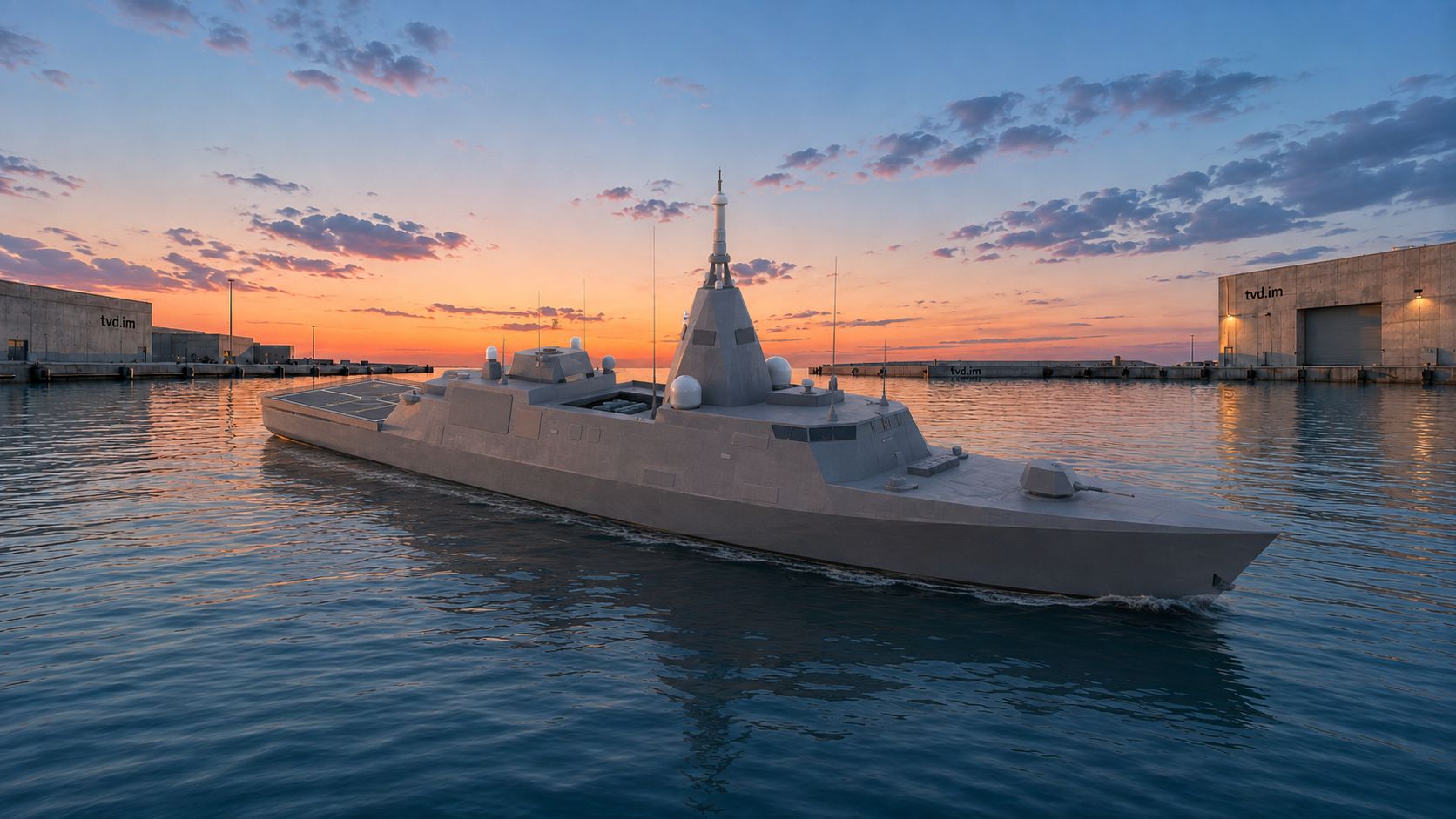
The Pohjanmaa class is a series of four multirole corvettes under construction by Rauma Marine Constructions for the Finnish Navy. The vessels form the central element of Finland's Squadron 2020 program and are designed for year-round operations in the Baltic Sea.
The class combines surface warfare, air defense, anti-submarine warfare, minelaying, maritime-connection protection, and command functions in one ice-capable platform. The four ships are intended to replace four Rauma-class fast attack craft, two Hämeenmaa-class minelayers, and the former minelayer Pohjanmaa.
The Finnish Navy plans to commission the corvettes in stages between 2027 and 2029. All four are expected to remain in service until the 2050s.
Development
Research and planning for Finland's future surface combatants began in 2008. The Squadron 2020 program was formally launched in 2015 to maintain the Finnish Navy's ability to control important sea and archipelago areas after the retirement of several older vessel classes.
Finland selected Rauma Marine Constructions and its subsidiary RMC Defence to build the ships. The Finnish Defence Forces Logistics Command placed the order, while Saab became the principal combat-system supplier and integrator. The shipbuilding contract was signed in September 2019.
The unusually large displacement for a vessel officially classified as a corvette reflects Finland's requirement to combine several missions in one hull. The Finnish Navy also required structural strengthening, ice-capable propulsion, substantial internal payload volume for naval mines, and the ability to remain at sea for extended periods. Although some commentators consider the ships comparable in size to frigates, Finland officially describes them as multirole corvettes intended primarily for Baltic coastal and littoral operations.
Construction
Construction of the first corvette began in October 2023. Its keel was laid on 11 April 2024, and the completed hull was launched on 21 May 2025. This launch was the class's first completed physical ship milestone. Outfitting subsequently continued at the Rauma shipyard.
Work on the second vessel began in October 2024. Its keel was laid in May 2025, and the ship was launched in May 2026. Construction of the third corvette began in August 2025, followed by keel laying in January 2026.
Steel cutting for the fourth and final ship began in January 2026. Its keel was laid on 4 August 2026. By that stage, the first two ships were undergoing outfitting, the third was in hull assembly, and all four vessels were under construction. The construction milestones are documented by the Janes report and the Finnish Navy program page.
Design
The Pohjanmaa class was designed specifically for the Baltic Sea's confined waters, severe weather, and seasonal ice. Each vessel has an ice-strengthened hull and ice-capable propulsion components. Its reported ice capability is comparable to Finnish-Swedish merchant ice class 1A, although naval vessels are not formally assigned that commercial classification.
The ships displace approximately 4,300 tonnes and measure 117 m in overall length. Published figures give a beam of approximately 16 m and a draught of 5 m. The normal complement is about 70 personnel. A flight deck and hangar support a medium helicopter and an unmanned aerial vehicle.
Propulsion
The class uses combined diesel-electric and gas propulsion. Four MAN 12V175D-MEL diesel generating sets, each rated at 1,920 kW, provide electrical power. Electric motors drive two ice-strengthened controllable-pitch propellers during normal operations.
A General Electric LM2500 gas turbine supplies additional power for high-speed operation through a common gearbox connected to both shafts. Total propulsion output is reported as 28 MW. Two bow thrusters assist low-speed maneuvering. The arrangement provides a reported maximum speed of approximately 26 knots and a range of about 3,500 nautical miles.
Two diesel generators are installed on resilient foundations inside sound-insulated enclosures. This arrangement reduces machinery noise and vibration, which is important when operating passive sonar during anti-submarine missions.
Combat system and sensors
The integrated combat system is based on Saab's 9LV combat management system and TactiCall communications system. Saab's Lightweight Integrated Mast carries four fixed faces of the Sea Giraffe 4A FF S-band active electronically scanned array radar and a Sea Giraffe 1X short-range X-band three-dimensional radar.
Two Saab CEROS 200 directors provide radar and electro-optical tracking for weapon control. The defensive equipment also includes a naval laser-warning system and four Rheinmetall Multi Ammunition Softkill System decoy launchers.
The underwater sensor suite combines several complementary systems. A Kongsberg SS2030 hull-mounted sonar provides detection from the ship, while a Kongsberg SD9500 dipping sonar supports operations in shallow or restricted waters. Patria's Sonac DTS dual-towed system combines an active variable-depth sonar with a passive thin-line receiving array.
Armament
The main gun is a Bofors 57 mm/70 Mk3 dual-purpose weapon capable of engaging surface and aerial targets. Two Saab Trackfire remotely controlled weapon stations provide close-range protection.
Surface-strike armament consists of eight Gabriel 5 anti-ship missiles, designated PTO 2020 by Finland. Air defense is based on RIM-162 Evolved Sea Sparrow Missile Block 2 weapons, known as ITO 20 in Finnish service. Up to 32 missiles can be carried by quad-packing four weapons into each of the ship's eight Mk 41 vertical-launch cells.
Anti-submarine armament includes Saab Torped 47 lightweight torpedoes. The class also retains a substantial minelaying capability, with stern equipment reported to accommodate as many as 100 PB 17 naval mines. These systems support the mission set described on the Finnish Navy capability page, including defense against ships, submarines, aircraft, and selected land targets.
Program status
As of August 2026, all four Pohjanmaa-class corvettes were under construction. The first and second hulls had been launched and were being outfitted. The third and fourth ships had reached the keel-laying or hull-assembly stages.
The Finnish Navy plans to commission the first vessels from 2027 and have all four in service by 2029. Until commissioning and operational acceptance are completed, the class remains a construction and integration program rather than an operational warship class.
Operators
- Finland: The Finnish Navy has ordered four Pohjanmaa-class corvettes under the Squadron 2020 program. All four were under construction in August 2026, with staged commissioning planned for 2027–2029.
Specifications (Pohjanmaa-class corvette)
General characteristics
- Type: Multirole corvette
- Displacement: Approximately 4,300 tonnes
- Length: 117 m
- Beam: Approximately 16 m
- Draught: 5 m
- Complement: Approximately 70
- Ice capability: Ice-strengthened for independent year-round Baltic operations; reported as comparable to merchant ice class 1A
- Aviation facilities: Flight deck and hangar for one medium helicopter and an unmanned aerial vehicle
Performance
- Propulsion: Combined diesel-electric and gas system
- Gas turbine: One General Electric LM2500
- Diesel generators: Four MAN 12V175D-MEL units rated at 1,920 kW each
- Total output: 28 MW
- Propulsors: Two controllable-pitch propellers and two bow thrusters
- Maximum speed: Approximately 26 knots
- Range: Approximately 3,500 nautical miles (6,500 km)
- Endurance: Approximately 14 days
Sensors and systems
- Combat management system: Saab 9LV
- Communications: Saab TactiCall integrated communications system
- Main radar: Four fixed Sea Giraffe 4A FF AESA radar faces
- Short-range radar: Saab Sea Giraffe 1X three-dimensional radar
- Fire control: Two Saab CEROS 200 directors
- Hull sonar: Kongsberg SS2030
- Dipping sonar: Kongsberg SD9500
- Towed sonar: Patria Sonac DTS active variable-depth sonar and passive towed array
- Countermeasures: Four Rheinmetall MASS decoy systems
Armament
- Main gun: One Bofors 57 mm/70 Mk3
- Surface-to-air missiles: Up to 32 RIM-162 ESSM Block 2 missiles in eight Mk 41 vertical-launch cells
- Anti-ship missiles: Eight Gabriel 5 missiles
- Torpedoes: Saab Torped 47 lightweight torpedoes
- Remote weapon stations: Two Saab Trackfire stations
- Naval mines: Capacity reported as up to 100 PB 17 mines
 Argentina
 Armenia
 Australia
 Austria
 Austria-Hungary
 Belgium
 Brazil
 United Kingdom
 United States
 Brunei
 Bulgaria
 Canada
 Chile
Chile China
China Colonial America
 Colombia
 Confederate States
 Croatia
 Czech
Czech Denmark
 Egypt
Egypt France
 Georgia
 Germany
 German Imperial
 Greece
 Holland
 Hungary
 India
India Indonesia
 Iran
Iran Iraq
Iraq Ireland
 Israel
 Italy
Italy Japan
Japan Japan (1940)
 Jordan
 Kingdom of Italy
 Malaysia
 Mexico
 Myanmar
 Nazi Germany
 Netherlands
 New Zealand
 North Korea
 Norway
 Pakistan
 Peru
Peru Philippines
 Poland
 Portugal
 Prussia
 Romania
 Russia
 Saudi Arabia
 Serbia
 Singapore
 Slovakia
 Slovenia
 South Africa
 South Korea
 Soviet Union
 Spain
Spain Sweden
 Switzerland
 Syria
Syria Taiwan
 Thailand
 Turkey
 UAE
UAE Ukraine
 Vietnam
 Yugoslavia