
History
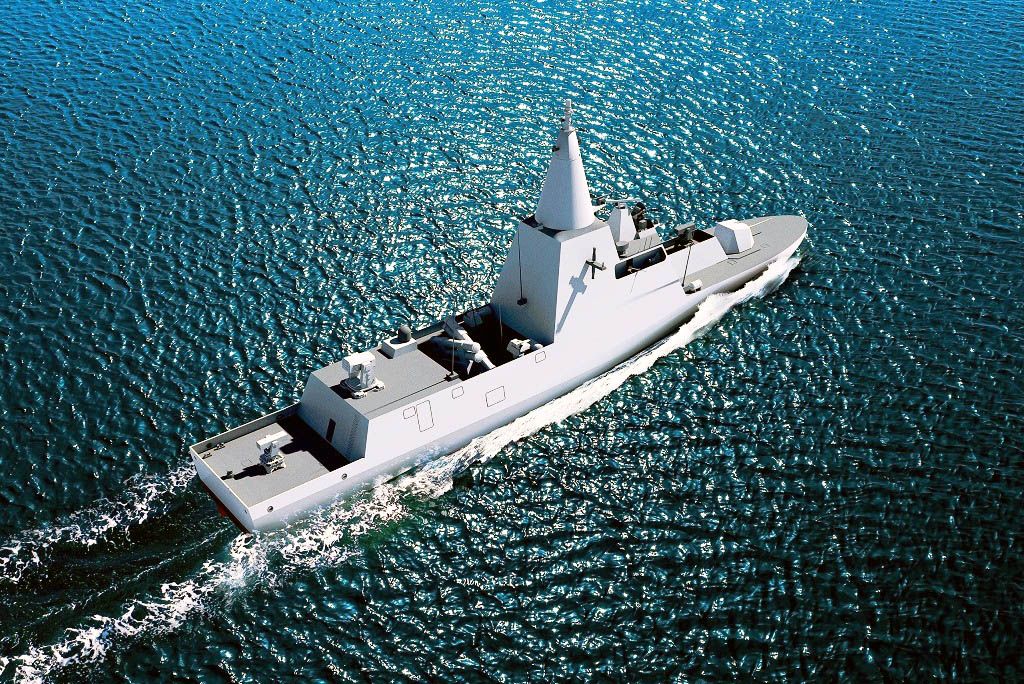
The Abu Dhabi Ship Building Falaj 3 is a heavily armed offshore patrol vessel developed for the United Arab Emirates Navy. Its compact hull combines patrol endurance with anti-ship missiles, two layers of missile-based air defense, guided rockets, and a medium-caliber naval gun.
The class is based on technology from the Fearless-class patrol vessels developed by Singapore's ST Engineering. Abu Dhabi Ship Building, part of EDGE Group, is responsible for construction in the United Arab Emirates.
Although originally designated an offshore patrol vessel, the Falaj 3 carries combat systems more commonly associated with missile boats and corvettes. Its missions include maritime security, search and rescue, surface warfare, air defense, and defense against small boats and uncrewed systems.
In May 2021, the UAE Ministry of Defence awarded Abu Dhabi Ship Building an AED 3.5 billion contract for four Falaj 3 vessels. The order was the largest contract received by the shipyard at that time. In November 2021, ADSB subcontracted ST Engineering to provide the basic, detailed, and production designs, platform equipment, and technical assistance for construction of the first ship. The arrangement was described in an ST Engineering announcement.
The lead vessel, Al Taf, also reported as Altaf, was launched at the ADSB shipyard on 14 January 2025. It was commissioned as P 163 during NAVDEX in February 2025. The launch and principal dimensions were reported by Naval News.
In June 2025, EDGE Group received a separate contract to supply Kuwait with eight vessels based on the Falaj 3 design. The Kuwaiti ships are identified as the Al Dorra class and include ammunition, logistics, trials, delivery, and in-service support under the contract.
Design
Hull and propulsion
The Falaj 3 has a low-observable superstructure intended to reduce radar cross-section, infrared emissions, and acoustic signatures. Its integrated mast contains major surveillance sensors while limiting exposed equipment. The design incorporates watertight subdivision, chemical, biological, radiological, and nuclear protection, redundant critical systems, and an embarked rigid-hull inflatable boat.
Four marine diesel engines drive four shafts with fixed-pitch propellers. Two rudders and a bow thruster support maneuvering in confined waters. Four electrical generators provide a combined output of 1.2 MW. An integrated platform management system centralizes monitoring and control of propulsion, electrical, and auxiliary equipment, helping a crew of 39 operate the vessel.
Sensors and combat management
The combat system is centered on Leonardo's ATHENA C Mk2 combat management system. A Leonardo Kronos Naval three-dimensional multifunction radar provides air and surface surveillance from the integrated mast. The sensor suite also includes Kelvin Hughes navigation radars, a SPYNEL infrared search-and-track system, and electronic support and countermeasure equipment.
A Leonardo NA-30S Mk2 radar and electro-optical fire-control system directs the main gun. The combination of active radar, passive infrared surveillance, and electronic warfare equipment supports detection and engagement of conventional and asymmetric threats.
Armament
The primary gun is a Leonardo 76 mm OTO Super Rapid in the STRALES configuration. It can fire conventional ammunition and DART guided projectiles. DART uses radio-beam guidance and a proximity fuze for engagements against maneuvering aerial targets and fast surface craft.
An eight-cell vertical launching system carries MBDA VL MICA surface-to-air missiles. A separate 21-cell Mk 49 launcher carries RIM-116 Rolling Airframe Missiles. These systems provide independent layers of air defense, with RAM intended mainly for close-range protection.
Four MM40 Exocet Block 3C anti-ship missiles are installed in two twin launchers amidships. The missiles provide an over-the-horizon surface-strike capability. Two trainable launchers carry 12 LOGIR imaging-infrared guided rockets each. These lower-cost weapons are intended for short-range engagements against small boats, uncrewed surface vessels, and aerial drones.
Close-range armament consists of two EOS R400-M remotely operated weapon stations fitted with M230F 30 mm cannons. Two 32-barrel Rheinmetall Multi Ammunition Soft-kill System launchers dispense decoys against guided weapons.
Operational history
Al Taf entered UAE Navy service in February 2025 as the first vessel of a planned four-ship class. Its combination of anti-ship missiles, guided naval artillery, two missile air-defense systems, and counter-swarm weapons reflects the short engagement distances and diverse threats found in the Persian Gulf. The remaining UAE vessels were under construction or planned under the original contract in the available reporting.
Variants
- Falaj 3: UAE Navy configuration constructed by Abu Dhabi Ship Building under the four-vessel program.
- Al Dorra class: Kuwaiti derivative based on the Falaj 3 design. Eight vessels were contracted in 2025, but the supplied information does not confirm their delivery or operational entry.
Operators
- United Arab Emirates Navy: Four vessels ordered. The lead ship, Al Taf P 163, was commissioned in February 2025.
Specifications (Falaj 3)
General characteristics
- Type: Offshore patrol vessel and missile boat
- Length: 62.7 m (206 ft); manufacturer material also describes it as a 60 m-class vessel
- Beam: 9.5 m (31 ft)
- Moulded depth: 4.45 m (14.6 ft)
- Draught: 2.6 m (8.5 ft), increasing to 3.4 m (11.2 ft) at the propellers
- Full-load displacement: Approximately 641–680 tonnes, depending on the cited configuration
- Crew: 39
- Propulsion: Four marine diesel engines driving four fixed-pitch propellers through four shafts
- Electrical generation: Four 300 kW generators, 1.2 MW combined
Performance
- Maximum speed: Approximately 25–26 knots (46–48 km/h)
- Range: 2,000 nautical miles (3,700 km) at 16 knots
Armament
- Main gun: One 76 mm OTO Super Rapid gun with STRALES and DART guided ammunition capability
- Surface-to-air missiles: Eight VL MICA missiles in vertical launch cells
- Point-defense missiles: One 21-cell Mk 49 launcher for RIM-116 RAM missiles
- Anti-ship missiles: Four MM40 Exocet Block 3C missiles
- Guided rockets: Twenty-four LOGIR imaging-infrared guided rockets in two 12-round launchers
- Remote weapon stations: Two EOS R400-M stations with 30 mm M230F cannons
- Countermeasures: Two 32-barrel Rheinmetall MASS decoy launchers
 Argentina
 Armenia
 Australia
 Austria
 Austria-Hungary
 Belgium
 Brazil
 United Kingdom
 United States
 Brunei
 Bulgaria
 Canada
 Chile
Chile China
China Colonial America
 Colombia
 Confederate States
 Croatia
 Czech
Czech Denmark
 Egypt
Egypt Finland
 France
 Georgia
 Germany
 German Imperial
 Greece
 Holland
 Hungary
 India
India Indonesia
 Iran
Iran Iraq
Iraq Ireland
 Israel
 Italy
Italy Japan
Japan Japan (1940)
 Jordan
 Kingdom of Italy
 Malaysia
 Mexico
 Myanmar
 Nazi Germany
 Netherlands
 New Zealand
 North Korea
 Norway
 Pakistan
 Peru
Peru Philippines
 Poland
 Portugal
 Prussia
 Romania
 Russia
 Saudi Arabia
 Serbia
 Singapore
 Slovakia
 Slovenia
 South Africa
 South Korea
 Soviet Union
 Spain
Spain Sweden
 Switzerland
 Syria
Syria Taiwan
 Thailand
 Turkey
 Ukraine
 Vietnam
 Yugoslavia