
History
The General Atomics Electromagnetic Aircraft Launch System, or EMALS, is an electromagnetic catapult developed for the United States Navy's Gerald R. Ford-class aircraft carriers. It replaces the steam-powered launch mechanism used on earlier U.S. carrier classes with stored kinetic energy, solid-state electrical power conversion and a linear induction motor.
EMALS performs the same basic mission as a steam catapult but provides more precise control of aircraft acceleration and launch end speed. The system was designed to support aircraft ranging from lightweight unmanned platforms to heavy strike fighters while reducing shipboard weight, maintenance requirements and aircraft launch stresses. The U.S. Navy describes these capabilities on its EMALS program page.
The system became a central element of the new carrier design that developed into USS Gerald R. Ford (CVN-78). Its development involved extensive land-based testing, ship integration and reliability improvements before operational flight-deck certification.
Development
In 1999, the U.S. Navy awarded technology-demonstration contracts to General Atomics and Northrop Grumman Marine Systems for competing electromagnetic catapult concepts. In 2004, the Navy selected the General Atomics design and entered a system design and development program intended to produce a full-scale, ship-representative system for testing at the Navy facility at Lakehurst, New Jersey.
Development included a full-scale, half-length prototype that demonstrated the basic electromagnetic launch principle. The program also produced production-representative motor-generator equipment and conducted high-cycle testing. U.S. Navy testimony later described testing of a motor-generator through approximately 10,000 launch-equivalent cycles, followed by another high-cycle phase that incorporated additional electrical components. The development history and integration challenges were examined during a 2009 congressional hearing on EMALS.
The original schedule called for full-scale testing to begin in 2007, but the program experienced delays, cost growth and technical problems. By July 2009, complete full-scale launch testing at Lakehurst had not yet begun, while production decisions for the first Ford-class ship set were already approaching. Engineering work identified issues including motor-generator vibration, oil mist and leakage, and moisture intrusion into linear-motor components. Corrective work included changes to bearing cooling and sealing arrangements.
Aircraft compatibility testing
Land-based aircraft launches began in 2010. EMALS launched a T-45 Goshawk in June 2010, followed by a C-2 Greyhound later that month and an F/A-18E Super Hornet on 18 December 2010. An E-2D Advanced Hawkeye was launched in September 2011, and an F-35C Lightning II followed in November 2011.
The first Aircraft Compatibility Testing phase concluded in 2011 after 134 launches. A second phase ran from June 2013 to April 2014 and added 310 launches, including tests involving the EA-18G Growler and F/A-18C Hornet. Test scenarios included off-center launches and planned system faults. By June 2014, the Navy had completed 450 manned aircraft launches during the two compatibility campaigns.
Full-speed shipboard testing followed in 2015 as EMALS equipment was integrated into USS Gerald R. Ford. The ship's installation uses four aircraft catapults connected to shared energy-storage and power-conversion equipment.
Design
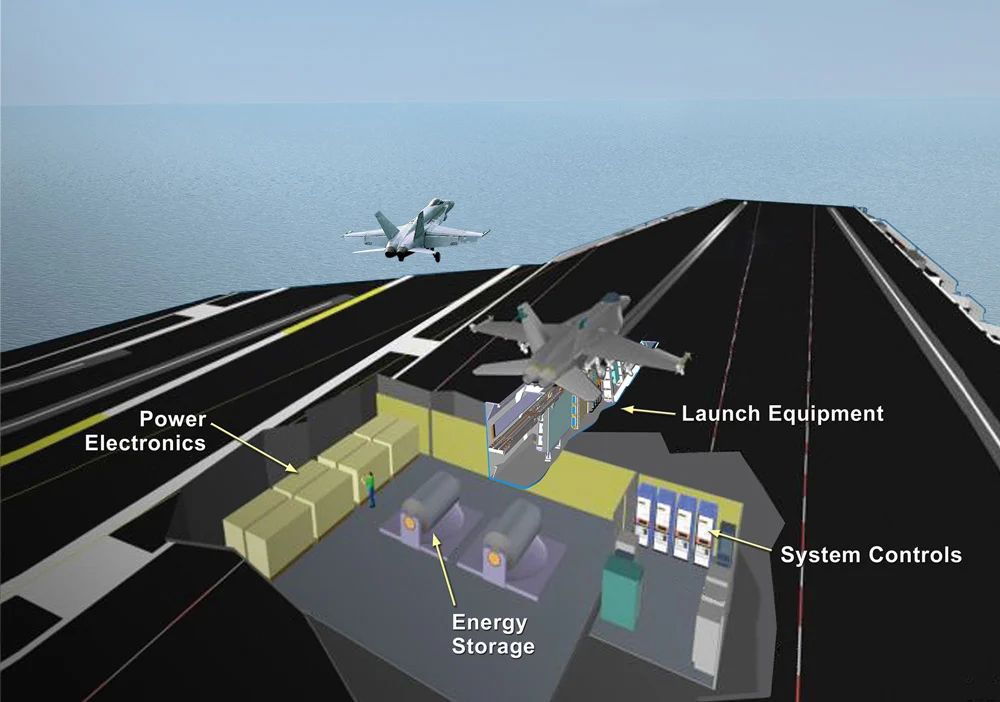
EMALS converts electrical energy from the carrier into controlled electromagnetic thrust. Ship-generated electrical power is accumulated as kinetic energy in rotating motor-generator units. During a launch, that stored energy passes through power-conversion equipment to linear motors installed along the catapult track.
Linear induction motor
The launch motor operates as a linear form of an induction motor. Sequentially energized stator sections create a moving magnetic field along the catapult. This field induces current in the moving armature connected to the launch shuttle, producing the force required to accelerate the aircraft.
Only the motor sections needed around the moving launch carriage are energized at a given moment. The system therefore controls acceleration throughout the launch rather than applying the less precisely regulated force characteristic of a steam catapult.
Energy storage and power conversion
A carrier's electrical generators cannot directly provide the complete short-duration power surge required for an aircraft launch. EMALS therefore stores energy between launches in high-mass rotating motor-generator units. U.S. Navy testimony concerning the Ford-class installation described 12 such energy-storage units.
Solid-state power-conversion equipment controls the transfer of stored energy to the launch motor. The U.S. Navy identifies stored kinetic energy and solid-state electrical power conversion as fundamental elements of EMALS. This arrangement also allows the system to recharge between launches without generating and distributing high-pressure steam.
Control system
EMALS uses computer-controlled closed-loop operation. Sensors track the launch carriage and allow the control system to adjust the electrical output supplied to the linear motor. This provides more accurate end-speed control and smoother acceleration while allowing launch settings to be matched to different aircraft types and operating conditions.
The controlled acceleration profile is intended to reduce peak mechanical loads on aircraft compared with traditional steam catapults. Automation and system monitoring are also intended to simplify operation, troubleshooting and maintenance.
Operational history
On 28 July 2017, an F/A-18F Super Hornet conducted the first aircraft catapult launch from USS Gerald R. Ford using the ship's EMALS installation. The event followed the carrier's initial arrested landing and marked the transition from shore-based development to shipboard aircraft operations.
EMALS continued operating alongside the Advanced Arresting Gear, or AAG, during Ford's testing and qualification program. By April 2021, the two systems had accumulated 8,000 combined launch and recovery cycles aboard the carrier. USS Gerald R. Ford was certified for flight-deck operations using EMALS in 2022.
Reliability remained an important program issue during this period. Testing covering 3,975 catapult launches through September 2020 produced an achieved reliability of 181 mean cycles between operational mission failures against a requirement of 4,166. Later reported developmental-test figures improved to 460 mean cycles in fiscal year 2021 and 614 in fiscal year 2022, although they remained below the stated requirement.
On 25 June 2022, the Ford program reached 10,000 successful catapult launches and arrested landings using EMALS and AAG. Navy officials stated during this period that the systems were operating successfully while engineering work continued to address reliability and support requirements.
In August 2026, the U.S. Navy placed a $42.9 million General Atomics order for spare parts supporting EMALS and associated arresting equipment on Ford-class carriers in service. Order N0001926F1037, issued against basic ordering agreement N0001926G1008, covers insurance spares and rotable pool spares. The procurement demonstrates continued logistical support for installed EMALS equipment.
A presidential memorandum dated 13 August 2026 separately directed a return to steam catapults for the planned USS Doris Miller (CVN-81). This direction concerns the planned fit of a future carrier and does not change the operational status of EMALS already installed on USS Gerald R. Ford.
Operators
- United States Navy: EMALS is operational aboard USS Gerald R. Ford (CVN-78). Systems have also been produced for subsequent Gerald R. Ford-class carriers, including USS John F. Kennedy (CVN-79) and USS Enterprise (CVN-80).
Specifications (Gerald R. Ford-class EMALS)
General characteristics
- Type: Electromagnetic aircraft carrier catapult.
- Developer: General Atomics.
- Primary installation: Gerald R. Ford-class aircraft carriers.
- Number of catapults on USS Gerald R. Ford: Four.
- Energy source: Stored kinetic energy supplied from the ship's electrical distribution system.
- Energy-storage installation: 12 motor-generator units on the Ford-class configuration described by the U.S. Navy.
- Launch drive: Alternating-current linear induction motor.
- Power conversion: Solid-state electrical power-conversion system.
- Control: Computer-controlled closed-loop launch control.
- Approximate launch power stroke: 110 m (360 ft), as described in U.S. Navy testimony.
Performance and capability
- Aircraft compatibility: Designed for aircraft ranging from lightweight unmanned platforms to heavy strike fighters.
- Acceleration: Electronically controlled throughout the launch stroke.
- End-speed control: Adjustable according to aircraft and launch requirements.
- Shipboard advantages: Designed to reduce system weight, volume, maintenance requirements and manpower compared with steam catapults while providing greater launch-energy capacity.
Related equipment
- Advanced Arresting Gear: Separate electrically controlled aircraft recovery system installed with EMALS aboard Gerald R. Ford-class carriers.
- Steam aircraft catapult: Predecessor launch technology used aboard earlier U.S. Navy carrier classes.
 Argentina
 Armenia
 Australia
 Austria
 Austria-Hungary
 Belgium
 Brazil
 United Kingdom
 Brunei
 Bulgaria
 Canada
 Chile
Chile China
China Colonial America
 Colombia
 Confederate States
 Croatia
 Czech
Czech Denmark
 Egypt
Egypt Finland
 France
 Georgia
 Germany
 German Imperial
 Greece
 Holland
 Hungary
 India
India Indonesia
 Iran
Iran Iraq
Iraq Ireland
 Israel
 Italy
Italy Japan
Japan Japan (1940)
 Jordan
 Kingdom of Italy
 Malaysia
 Mexico
 Myanmar
 Nazi Germany
 Netherlands
 New Zealand
 North Korea
 Norway
 Pakistan
 Peru
Peru Philippines
 Poland
 Portugal
 Prussia
 Romania
 Russia
 Saudi Arabia
 Serbia
 Singapore
 Slovakia
 Slovenia
 South Africa
 South Korea
 Soviet Union
 Spain
Spain Sweden
 Switzerland
 Syria
Syria Taiwan
 Thailand
 Turkey
 UAE
UAE Ukraine
 Vietnam
 Yugoslavia