History
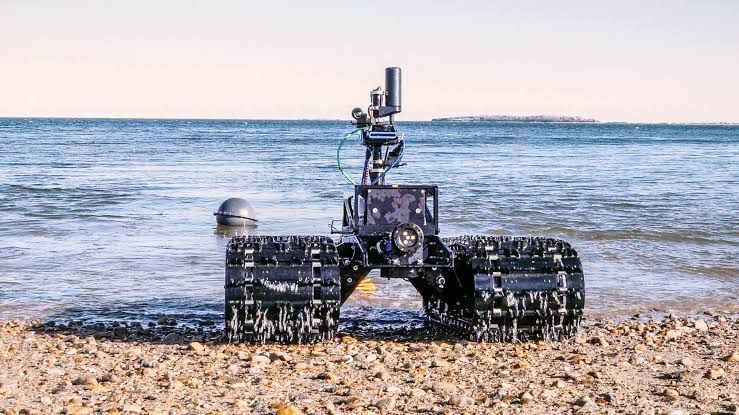
The Greensea IQ Bayonet 250 is an amphibious Autonomous Underwater Ground Vehicle designed to operate on the seabed, through the surf zone, and onto the shore. It is used for littoral mine countermeasures, detection of unexploded ordnance, seabed survey, and other missions in areas where free-swimming underwater vehicles can be difficult to operate.
The Bayonet 250 is part of a three-model family that shares common software and control systems. It occupies the middle position between the smaller Bayonet 150 and the larger Bayonet 350 and is intended to combine two-person portability with increased payload capacity and operation in heavier surf conditions.
The United States Marine Corps is fielding Bayonet 250 vehicles under the Littoral Explosive Ordnance Neutralization, or LEON, family of systems. The program uses unmanned equipment to survey, detect, reacquire, and neutralize explosive hazards in shallow water, the surf zone, and beach approaches while reducing the need to expose personnel directly to those hazards.
Marine Corps procurement
In October 2024, the United States Marine Corps awarded Greensea IQ a contract valued at approximately $9 million to continue procurement of Bayonet 250 systems for the LEON program. Reporting on the procurement stated that one order included nine new vehicles, refurbishment of six earlier robots, and spare equipment. Deliveries from this batch began in late 2025. The procurement and fielding program were described by Military.com.
In July 2026, Greensea IQ received a further $3.7 million task order for four additional Bayonet 250 vehicles. The order was issued under an existing multi-year indefinite-delivery, indefinite-quantity contract and continued expansion of Marine Corps littoral mine-countermeasure capability. The award was reported by The Defense Post and Ocean Economist.
Design
The Bayonet 250 is a tracked underwater ground vehicle rather than a free-swimming autonomous underwater vehicle. It travels along the seafloor, can continue through breaking surf, and can move onto the beach. This bottom-to-shore mobility is intended to maintain vehicle control in turbulent shallow water where conventional free-swimming systems may lose effectiveness.
The vehicle is depth-rated to 100 m. Its larger footprint and heavier construction compared with the Bayonet 150 allow it to operate in rougher water and carry larger payloads. Despite its increased size, the Bayonet 250 is designed for field assembly without tools and retains two-person portability. It can also be transported using a pickup truck.
Payloads and mission equipment
The Bayonet 250 has an open modular deck that can accept mission-specific payloads. Reported equipment includes forward-looking sonar, magnetometers, sub-bottom profilers, cameras, and towed sleds. These payload options allow the platform to be configured for mine countermeasures, detection of buried unexploded ordnance, seabed survey, bathymetric and obstacle data collection, and coastal infrastructure inspection.
The Bayonet 250 product description published by BlueZone Group lists a fiber-optic gyroscope navigation system, obstacle avoidance, graphical mission planning, field-swappable battery packs, and a handheld tablet user interface. The vehicle is also designed for interoperability with mine-countermeasure and autonomy packages and can support automatic target recognition and artificial-intelligence or machine-learning software libraries.
Control and autonomy
The Bayonet family shares common software and operator interfaces. The Bayonet 250 supports autonomous mission execution as well as tethered and radio-linked control. It can operate with real-time supervision or execute missions without continuous operator control. Greensea IQ Core provides an open-architecture autonomy platform, while Bayonet Workspace supports mission planning and execution.
A remote-triggered recovery system is also listed among the Bayonet 250 features. The common control architecture across the Bayonet family allows operators trained on one model to use related vehicles without adopting a completely different interface.
Operational history
The United States Marine Corps is introducing the Bayonet 250 for explosive ordnance disposal and littoral operations. The vehicle supports missions in the transition area between deeper water and the beach, including zones affected by waves, currents, limited visibility, obstacles, mines, and unexploded ordnance.
Under the LEON concept, Bayonet vehicles can survey and classify hazards before divers, reconnaissance personnel, vehicles, or landing forces enter the area. The systems can also collect bathymetric and obstacle information for wet-gap crossings and lane-clearance operations. Their purpose is to keep personnel at greater distance from potentially explosive hazards while extending unmanned operations through the surf zone and onto the shore.
Variants
- Bayonet 150: Smaller model intended for lighter weather, smaller payloads, and missions requiring greater portability. It can be carried by two people and may be used for missions where an attritable vehicle is acceptable.
- Bayonet 250: Mid-sized workhorse of the family, combining two-person portability with increased payload capacity and the ability to operate in heavier weather and surf conditions.
- Bayonet 350: Largest Bayonet model, intended for heavier payloads and missions where greater payload capacity and more stationary survey work are required.
Operators
- United States Marine Corps: Fielding Bayonet 250 vehicles as part of the Littoral Explosive Ordnance Neutralization family of systems for mine countermeasures and explosive ordnance disposal missions in littoral environments.
Specifications (Bayonet 250)
General characteristics
- Type: Amphibious Autonomous Underwater Ground Vehicle
- Mobility: Tracked seabed and surf-zone crawler capable of moving from underwater terrain through the surf zone and onto land
- Portability: Two-person portable
- Assembly: Tool-free field assembly
- Payload arrangement: Open modular deck for mission-specific equipment
- Battery arrangement: Field-swappable battery packs, one per pontoon
Performance and navigation
- Maximum rated depth: 100 m
- Navigation: Fiber-optic gyroscope-based navigation
- Obstacle handling: Obstacle-avoidance capability
- Operating modes: Autonomous, tethered, radio-linked, real-time supervised, or unsupervised mission operation
Mission systems
- Supported payloads: Forward-looking sonar, magnetometers, sub-bottom profilers, cameras, and towed sleds
- User interface: Handheld tablet interface with graphical mission planning
- Software: Greensea IQ Core open-architecture autonomy software and Bayonet Workspace mission system
- Integration: Support for mine-countermeasure autonomy packages, automatic target recognition, and artificial-intelligence or machine-learning libraries
- Recovery: Remote-triggered recovery system
 Argentina
 Armenia
 Australia
 Austria
 Austria-Hungary
 Belgium
 Brazil
 United Kingdom
 United States
 Brunei
 Bulgaria
 Canada
 Chile
Chile China
China Colonial America
 Colombia
 Confederate States
 Croatia
 Czech
Czech Denmark
 Egypt
Egypt Finland
 France
 Georgia
 Germany
 German Imperial
 Greece
 Holland
 Hungary
 India
India Indonesia
 Iran
Iran Iraq
Iraq Ireland
 Israel
 Italy
Italy Japan
Japan Japan (1940)
 Jordan
 Kingdom of Italy
 Malaysia
 Mexico
 Myanmar
 Nazi Germany
 Netherlands
 New Zealand
 North Korea
 Norway
 Pakistan
 Peru
Peru Philippines
 Poland
 Portugal
 Prussia
 Romania
 Russia
 Saudi Arabia
 Serbia
 Singapore
 Slovakia
 Slovenia
 South Africa
 South Korea
 Soviet Union
 Spain
Spain Sweden
 Switzerland
 Syria
Syria Taiwan
 Thailand
 Turkey
 UAE
UAE Ukraine
 Vietnam
 Yugoslavia