
History
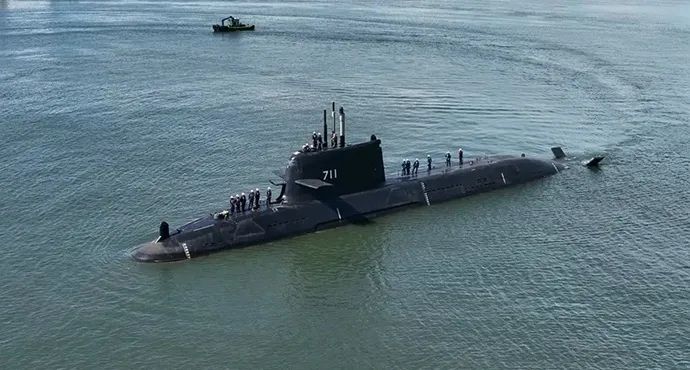
The CSBC Corporation Hai Kun (SS-711) is Taiwan's first domestically built diesel-electric attack submarine and the prototype of the Indigenous Defense Submarine program. It was launched in Kaohsiung in September 2023 and has since progressed through harbor, surface, submerged, sonar, propulsion, and weapons trials.
Hai Kun is intended to give the Republic of China Navy a modern undersea platform for sea denial, anti-surface warfare, and anti-submarine warfare around Taiwan. The program combines domestic hull construction and integration with imported combat-system, sensor, and weapon technologies.
By August 2026, Hai Kun had demonstrated major elements of its underwater combat chain, including detection, fire-control calculation, torpedo launch, and torpedo guidance, but it had not yet completed acceptance for regular operational service.
Development
Taiwan pursued new submarines for years as its frontline undersea force continued to rely on two Dutch-built Hai Lung-class boats dating from the 1980s. After efforts to obtain complete modern diesel-electric submarines from abroad did not produce a practical procurement route, the Ministry of National Defense announced in 2014 that Taiwan would develop its own submarines with foreign technical assistance. CSBC Corporation established a submarine development center in 2016, and the United States approved technology transfers in 2018 that supported the Indigenous Defense Submarine program.
In May 2019, Taiwan displayed a scale model of the selected indigenous design. Open-source reporting summarized by the Hai Kun-class overview describes the design as influenced by Taiwan's Dutch-designed submarine experience while incorporating newer systems and an X-form stern-control arrangement. Construction of the prototype proceeded at CSBC's Kaohsiung facilities. President Tsai Ing-wen opened the submarine construction facility there in November 2020, when the government described a plan for a force of eight domestically built submarines.
The United States approved a possible Foreign Military Sale in May 2020 covering 18 Mk 48 Mod 6 Advanced Technology heavyweight torpedoes and related equipment for an estimated US$180 million. These weapons were intended to provide the new submarines with a modern torpedo for both anti-surface and anti-submarine missions.
The ceremonial keel laying of the lead boat was reported in November 2021. Taiwan confirmed on 21 September 2023 that the prototype would be named Hai Kun and carry hull number SS-711. The submarine was launched on 28 September 2023, making 2023 the first year in which the exact vessel existed as a launched physical submarine. Harbor acceptance testing followed.
Testing
Testing continued through 2024 and 2025. Public reports stated that harbor acceptance work verified basic systems and that the submarine could submerge and surface during controlled testing. Integration was affected by delays to some foreign-supplied equipment, including optronic masts. In June 2025, Hai Kun began sea trials under its own power in Kaohsiung waters, testing propulsion, energy, communications, ventilation, and maneuvering systems.
During the second sea-trial period on 26 June 2025, Hai Kun experienced a hydraulic problem that affected normal rudder operation. The submarine was brought back to port with manual steering assistance and support from accompanying tugboats. The incident did not end the program, and testing resumed after corrective work.
On 29 January 2026, Hai Kun completed its first submerged sea trial. Further diving tests followed as the program moved from surface handling and shallow-water checks toward deeper submerged operation and combat-system verification. Reporting in early 2026 described repeated dives, sonar calibration, propulsion-response checks, hull-integrity checks, and submerged maneuvering as the test campaign matured.
The most important weapons milestone occurred on 6 May 2026. Naval News reported that Hai Kun launched two Mk 48 Mod 6 Advanced Technology training torpedoes from two of its six 533 mm torpedo tubes. The test checked whether the submarine's combat system could detect and track a target, generate a firing solution, launch the weapons, and guide them. The two torpedoes were recovered after the exercise.
Taiwan's Military News Agency separately confirmed that the torpedo exercise validated detection, calculation, launching, and torpedo-guidance functions. A Reuters report published by the Taipei Times also described the event as the submarine's maiden torpedo firing and identified the combat system as supplied by Lockheed Martin. The same report gave the prototype's program price as NT$49.36 billion.
Later reporting by Army Recognition described the torpedo firing as a transition from proving basic underwater operation to validating the integrated functions needed to attack a target. By 19 August 2026, however, Hai Kun was still undergoing testing and system verification and had not yet entered regular naval service.
Design
Hai Kun is a conventionally powered diesel-electric attack submarine. Diesel generators recharge battery banks, while electric propulsion allows comparatively quiet submerged operation at low speed. Public reporting does not identify a confirmed air-independent propulsion system, so the submarine must periodically recharge its batteries, which limits submerged endurance compared with submarines equipped with AIP or nuclear propulsion.
The design is reported to use a hybrid double-single-hull arrangement with a light outer hull and X-form stern control surfaces. The X-shaped arrangement is intended to improve control and maneuverability underwater. Many detailed performance characteristics remain classified, and published figures for displacement, speed, and range are estimates rather than official specifications.
Sensors and combat system
Open reporting describes bow-mounted and flank sonar arrays used for underwater detection, with passive sonar playing an important role in the submarine's intended ambush and sea-denial missions. Passive sonar allows the crew to listen for acoustic signatures without transmitting an active sonar signal that could reveal the submarine's position.
The combat system integrates detection, target tracking, fire-control calculation, weapon launch, and torpedo guidance. The May 2026 firing exercise was significant because it tested this sequence as an integrated chain rather than only demonstrating the mechanical operation of a torpedo tube.
Armament
Hai Kun has six 533 mm torpedo tubes. Taiwan plans to arm its indigenous submarines with U.S.-supplied Mk 48 Mod 6 Advanced Technology heavyweight torpedoes, a weapon intended for both anti-surface and anti-submarine warfare. The May 2026 trial used two training Mk 48 Mod 6AT torpedoes.
Program status
Hai Kun is the prototype for Taiwan's planned indigenous submarine force. CSBC has been responsible for pressure-hull construction, assembly, equipment installation, integration, and testing, while selected foreign systems and technical support have contributed to sensors, combat systems, and weapons.
The long-term plan described in the available sources is for eight domestically produced submarines. Follow-on boats are intended to incorporate lessons learned from the prototype and to expand the number of submarines available for patrols, training, maintenance rotation, and wartime sea-denial missions.
For Taiwan, the operational concept emphasizes denying or complicating hostile naval movement near the island rather than matching a larger navy ship for ship. A concealed submarine armed with heavyweight torpedoes can threaten surface combatants, amphibious ships, transports, and hostile submarines while forcing opposing forces to devote ships, aircraft, helicopters, and sensors to anti-submarine warfare.
The program's schedule has slipped from earlier delivery targets. Naval News reported in May 2026 that CSBC had moved its delivery objective to July 2026 after delays involving foreign-made subsystems. Subsequent August 2026 reporting still described Hai Kun as being in testing and acceptance, so the available sources do not support describing the vessel as fully operational.
Specifications (Hai Kun SS-711)
General characteristics
- Type: Diesel-electric attack submarine
- Builder: CSBC Corporation, Taiwan
- Hull number: SS-711
- Length: approximately 79.25 m
- Displacement: open-source estimates place the submarine at approximately 2,460 to 2,950 tonnes, while other reporting gives a rounded submerged estimate of about 2,500 to 3,000 tonnes
- Hull arrangement: reported hybrid double-single hull with a light outer hull
- Stern controls: X-form rudders
- Propulsion: diesel-electric, with diesel generators charging batteries for electric underwater propulsion
Performance
- Surface speed: approximately 8 knots, open-source estimate
- Submerged speed: approximately 17 knots, open-source estimate
- Range: up to about 11,000 km, open-source estimate
Armament
- Torpedo tubes: six 533 mm tubes
- Torpedoes: Mk 48 Mod 6 Advanced Technology heavyweight torpedoes planned for service; two training weapons were fired during the May 2026 trial
 Argentina
 Armenia
 Australia
 Austria
 Austria-Hungary
 Belgium
 Brazil
 United Kingdom
 United States
 Brunei
 Bulgaria
 Canada
 Chile
Chile China
China Colonial America
 Colombia
 Confederate States
 Croatia
 Czech
Czech Denmark
 Egypt
Egypt Finland
 France
 Georgia
 Germany
 German Imperial
 Greece
 Holland
 Hungary
 India
India Indonesia
 Iran
Iran Iraq
Iraq Ireland
 Israel
 Italy
Italy Japan
Japan Japan (1940)
 Jordan
 Kingdom of Italy
 Malaysia
 Mexico
 Myanmar
 Nazi Germany
 Netherlands
 New Zealand
 North Korea
 Norway
 Pakistan
 Peru
Peru Philippines
 Poland
 Portugal
 Prussia
 Romania
 Russia
 Saudi Arabia
 Serbia
 Singapore
 Slovakia
 Slovenia
 South Africa
 South Korea
 Soviet Union
 Spain
Spain Sweden
 Switzerland
 Syria
Syria Thailand
 Turkey
 UAE
UAE Ukraine
 Vietnam
 Yugoslavia