
History
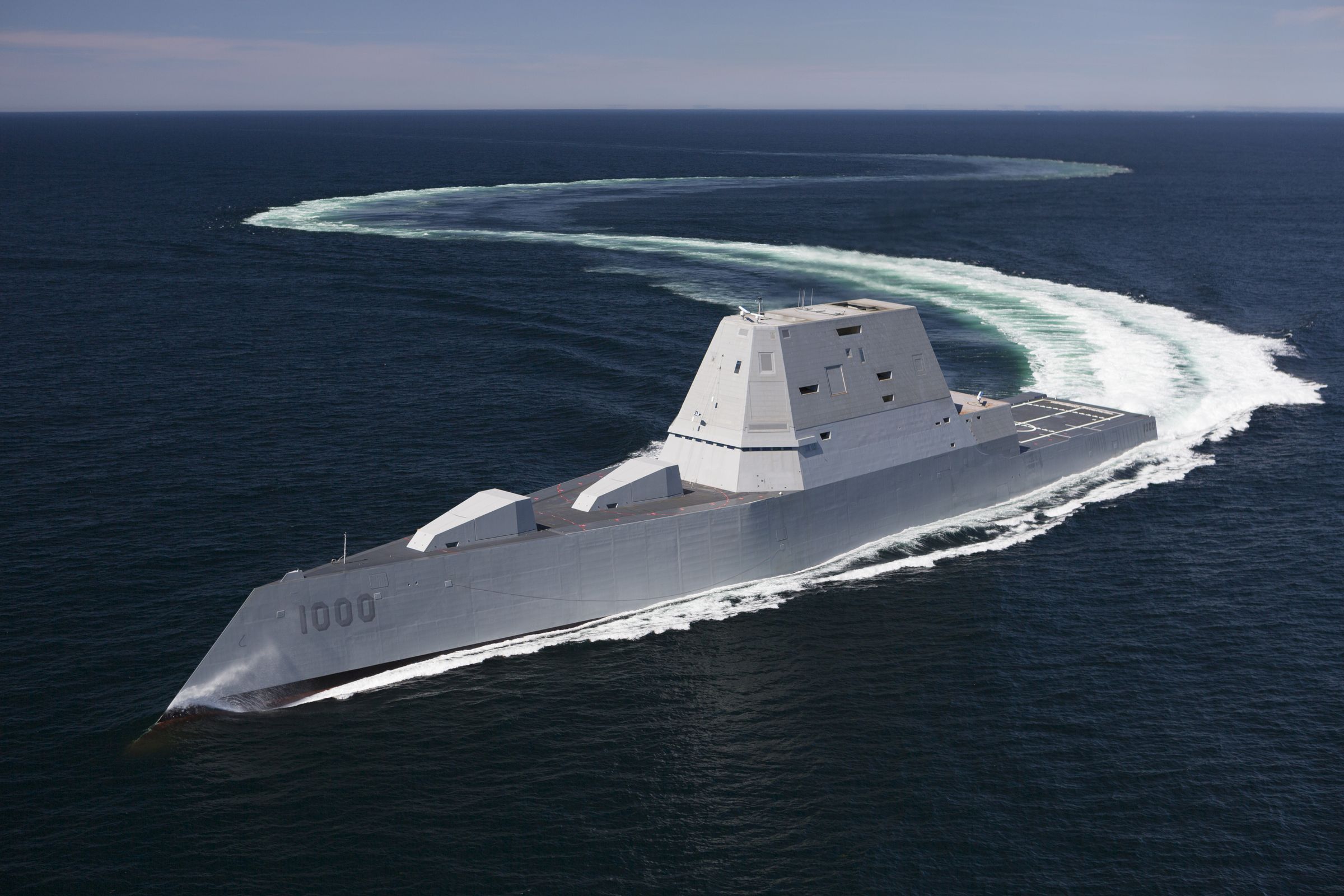
The Zumwalt class is a three-ship class of United States Navy guided-missile destroyers developed as large, low-observable surface combatants. The ships combine a wave-piercing tumblehome hull, integrated electric power, advanced sensors, peripheral missile launch cells, and extensive automation.
The class originated from the DD-21 and later DD(X) programs, which emphasized long-range land attack and naval gunfire support. The original plan for 32 ships was progressively reduced as development costs increased, and the program was ultimately limited to three destroyers.
The Navy later redirected the class toward new strike missions. In 2022 it decided to integrate Conventional Prompt Strike hypersonic missiles, replacing the original gun-centered concept with a long-range missile capability.
Development and construction
The DD-21 program was reorganized as DD(X) after changes to the broader Surface Combatant for the 21st Century effort. The design incorporated a large number of technologies that required development, including the Advanced Gun System, Integrated Power System, Peripheral Vertical Launch System, Total Ship Computing Environment, automated damage-control systems, and the tumblehome hull.
The Navy initially intended to acquire 32 destroyers. The planned quantity was reduced as the cost of new technologies increased. By 2008, Navy officials were arguing for additional Arleigh Burke-class destroyers instead of further DDG-1000 procurement. The program was eventually restricted to three ships.
General Dynamics Bath Iron Works became responsible for design, construction, integration, testing, and delivery of the DDG-1000 class. Huntington Ingalls Industries also participated in major structural work on the first ships. The U.S. Navy fact file identifies General Dynamics Bath Iron Works as the class builder and Raytheon as the prime contractor for the Zumwalt mission system.
Construction of USS Zumwalt began in February 2009. Its keel was laid in November 2011, and the ship was launched in October 2013. USS Zumwalt was commissioned on October 15, 2016, and the Navy accepted final delivery on April 24, 2020.
USS Michael Monsoor, DDG-1001, was commissioned in January 2019. The third ship, Lyndon B. Johnson, DDG-1002, was christened in April 2019. The Navy accepted completion of its Bath Iron Works production and test activity in November 2021 before the ship moved to Pascagoula for combat-system installation and activation. A July 2026 program report stated that two Zumwalt-class destroyers had been delivered and that the third was scheduled for 2028.
Advanced Gun System and mission change
The original combat concept centered on two 155 mm Advanced Gun Systems and the Long Range Land Attack Projectile. The guided projectile was intended to provide long-range naval gunfire support at ranges reported at about 154 km. Each gun could fire at up to 10 rounds per minute.
The reduction of the Zumwalt program from dozens of ships to only three sharply reduced the expected ammunition purchase. The estimated unit cost of the specialized LRLAP subsequently increased to roughly $800,000 to $1 million, and the Navy cancelled procurement. Because the Advanced Gun System was specifically designed around LRLAP, the ships lost the principal ammunition required for their original naval gunfire-support mission.
By 2022, the Navy had selected Conventional Prompt Strike as a new major weapon for the class. CPS is a boost-glide hypersonic system using a two-stage booster to place a high-speed glide vehicle on its trajectory. The Navy planned substantial structural modifications to the destroyers for installation of the new launch equipment.
Design
Hull and low-observable features
The Zumwalt class uses a distinctive wave-piercing tumblehome hull whose sides slope inward above the waterline. The hull form and angular superstructure were selected in part to reduce radar reflections compared with conventional flared hull forms. The large deckhouse encloses many sensors, antennas, and electronic systems that would otherwise create additional radar-reflective surfaces.
The official Navy dimensions are 610 ft in length and 80.7 ft in beam, with a displacement listed at 15,995 metric tons. The ships are substantially larger than the Arleigh Burke class but were designed around extensive automation to limit crew requirements.
Integrated Power System
DDG-1000 is the first U.S. Navy surface combatant to employ the class's Integrated Power System architecture. Electrical power generated by the ship's turbine generators can be allocated among propulsion, ship services, sensors, and combat-system loads instead of being divided between separate propulsion and service-power systems.
The propulsion system uses all-electric drive with two main turbine generators, two auxiliary turbine generators, and two 33.6 MW Advanced Induction Motors. The architecture was intended to provide substantial electrical flexibility for existing systems and future high-energy equipment.
Combat system and sensors
The class uses the Total Ship Computing Environment Infrastructure to integrate sensors, weapons, communications, and ship-control functions. Extensive automation allows personnel to supervise multiple systems from common workstations and contributes to the comparatively small crew for a ship of this size.
The primary radar is the AN/SPY-3 Multi-Function Radar, an X-band active electronically scanned array. An S-band SPY-4 volume-search radar was originally intended to form a dual-band system with SPY-3, but the SPY-4 installation was removed from the DDG-1000 design as a cost-reduction measure. The SPY-3 system was subsequently adapted to perform additional search functions.
Underwater sensors associated with the class include the AN/SQS-60 mid-frequency sonar, AN/SQS-61 high-frequency sonar, and AN/SQR-20 multifunction towed array. The destroyers do not depend on hull-mounted torpedo tubes for submarine engagement and can employ vertical-launch anti-submarine weapons and embarked aviation.
Peripheral Vertical Launch System
The Zumwalt class carries the Mk 57 Peripheral Vertical Launch System. Rather than concentrating the missile battery in large central groups, the launch modules are distributed along the ship's periphery. The arrangement is intended to direct the effects of a launch-cell explosion outward and to limit damage to adjacent missile cells.
The class has 80 Mk 57 launch cells. The Navy lists Tomahawk cruise missiles, Evolved Sea Sparrow Missiles, Standard Missiles, and Vertical Launch Anti-Submarine Rockets among the weapons associated with the system.
Secondary armament and aviation
The class is equipped with two 30 mm close-in gun systems. The ships also have a large flight deck and enclosed aviation facilities. The U.S. Navy lists one MH-60R helicopter as the standard aircraft complement.
Operational history
After final delivery, USS Zumwalt continued developmental and integrated at-sea testing. It also participated in fleet exercises and conducted an initial employment from August through November 2022. The ship was assigned to the U.S. Pacific Fleet and Surface Development Squadron One.
USS Michael Monsoor has also conducted at-sea test events, survivability testing, deck-landing qualifications, and participation in major exercises. The first two ships have therefore served both as operational combatants and as platforms for development of tactics and new capabilities.
CPS modernization program status
The Navy's plan to install Conventional Prompt Strike missiles on all three Zumwalt-class destroyers has required removal or modification of major forward structures and installation of new launch tubes. Earlier Navy planning expected CPS to be fielded on the class in fiscal year 2025, but subsequent work encountered delays.
A July 2026 report citing government auditors stated that the Zumwalt CPS installation effort was approximately two years behind schedule. Missile flight testing previously scheduled for 2025 had been moved to 2027. The reported causes included ship modification complexity, CPS production difficulties, rising costs, and reliability and sustainment problems associated with class-unique destroyer systems.
One modernization effort required more cabling work than initially expected after additional cables were removed from the forward section during preparation for CPS launch-tube installation. Government auditors also identified difficulties sustaining the class's radar, combat, network, and power systems and obtaining some spare parts.
CPS production has faced separate industrial problems, including heat-resistant coating issues, substandard components, limited production capacity, and complex manufacturing instructions. The reported production rate was six or seven missiles per year compared with a desired rate of 12. The July 2026 report also stated that the estimated cost of 224 missiles had risen to $41 billion from a 2020 Navy estimate of $31 billion for 262 missiles.
Ships in class
- USS Zumwalt (DDG-1000): lead ship of the class, commissioned in 2016 and finally delivered in 2020. It has served as the principal platform for developmental testing and the initial CPS modernization effort.
- USS Michael Monsoor (DDG-1001): second ship of the class, commissioned in 2019 and used for fleet exercises and additional class testing.
- Lyndon B. Johnson (DDG-1002): third and final ship. A July 2026 report stated that its delivery was scheduled for 2028.
Operators
- United States Navy: sole operator of the three-ship Zumwalt class. Two ships had been delivered by July 2026, while the third was scheduled for delivery in 2028.
Specifications (Zumwalt class)
General characteristics
- Type: Guided-missile destroyer
- Builder: General Dynamics Bath Iron Works
- Length: 185.9 m (610 ft)
- Beam: 24.6 m (80.7 ft)
- Displacement: 15,995 metric tons
- Crew: 197 sailors
Propulsion and performance
- Propulsion: Integrated electric power system with all-electric drive
- Main propulsion motors: Two 33.6 MW Advanced Induction Motors
- Electrical generation: Two main turbine generators and two auxiliary turbine generators
- Speed: More than 30 knots
Sensors and combat systems
- Primary radar: AN/SPY-3 Multi-Function Radar
- Combat-system architecture: Total Ship Computing Environment Infrastructure
- Sonar: AN/SQS-60, AN/SQS-61, and AN/SQR-20 systems
Armament
- Missile launch system: 80 Mk 57 Peripheral Vertical Launch System cells
- Supported missile types listed by the Navy: Tomahawk, Evolved Sea Sparrow Missile, Standard Missile, and Vertical Launch Anti-Submarine Rocket
- Close-in guns: Two 30 mm gun systems
- Original main guns: Two 155 mm Advanced Gun Systems, developed for the cancelled Long Range Land Attack Projectile
- Planned modernization: Conventional Prompt Strike hypersonic missile launch capability; installation and testing remained delayed as of July 2026
Aviation
- Aircraft: One MH-60R helicopter
- Facilities: Flight deck and enclosed hangar
Related equipment
- Arleigh Burke class: U.S. Navy guided-missile destroyer class whose continued procurement replaced the larger planned Zumwalt production run.
- Virginia-class attack submarine: another planned naval platform for Conventional Prompt Strike missiles.
- Long Range Hypersonic Weapon: U.S. Army land-based counterpart associated with the joint hypersonic missile effort.
 Argentina
 Armenia
 Australia
 Austria
 Austria-Hungary
 Belgium
 Brazil
 United Kingdom
 Brunei
 Bulgaria
 Canada
 Chile
Chile China
China Colonial America
 Colombia
 Confederate States
 Croatia
 Czech
Czech Denmark
 Egypt
Egypt Finland
 France
 Georgia
 Germany
 German Imperial
 Greece
 Holland
 Hungary
 India
India Indonesia
 Iran
Iran Iraq
Iraq Ireland
 Israel
 Italy
Italy Japan
Japan Japan (1940)
 Jordan
 Kingdom of Italy
 Malaysia
 Mexico
 Myanmar
 Nazi Germany
 Netherlands
 New Zealand
 North Korea
 Norway
 Pakistan
 Peru
Peru Philippines
 Poland
 Portugal
 Prussia
 Romania
 Russia
 Saudi Arabia
 Serbia
 Singapore
 Slovakia
 Slovenia
 South Africa
 South Korea
 Soviet Union
 Spain
Spain Sweden
 Switzerland
 Syria
Syria Taiwan
 Thailand
 Turkey
 UAE
UAE Ukraine
 Vietnam
 Yugoslavia