
History
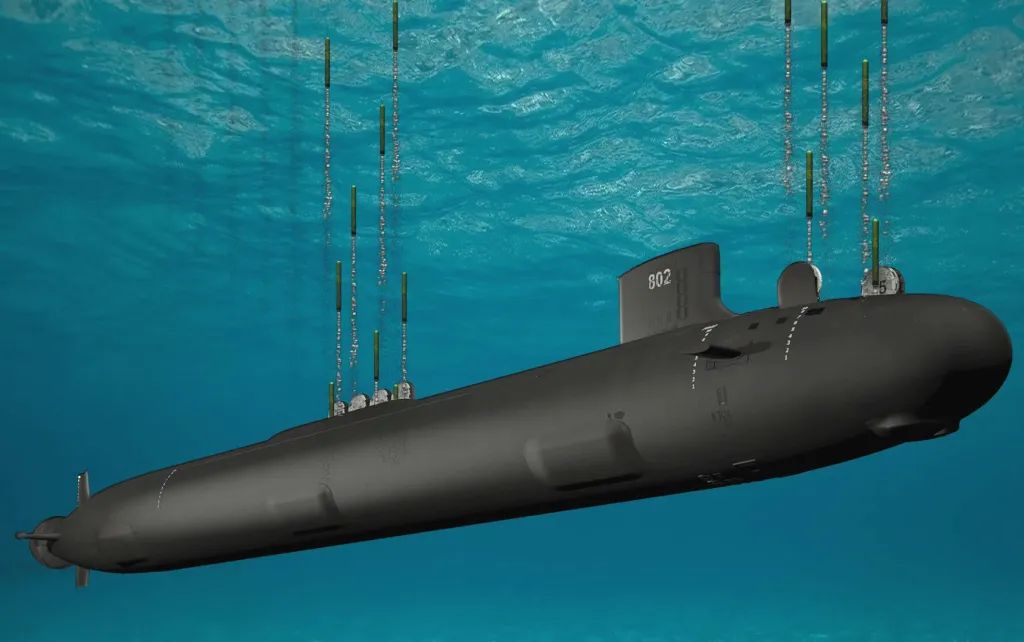
The Virginia-class Block V Seabed Operations Submarine is a planned specialized U.S. Navy nuclear-powered submarine intended for subsea and seabed warfare missions. It is a unique late-Block V configuration derived from the Virginia-class attack submarine design.
Unlike most Block V submarines, the specialized boat will not carry the standard Virginia Payload Module, or VPM. The U.S. Navy confirmed in 2026 that a later Block V submarine will instead be configured as a Subsea and Seabed Warfare focused platform.
The program is intended to provide a new platform for highly specialized work on or near the ocean floor. Public descriptions associate the mission with intelligence activities and operations involving objects or infrastructure on the seabed, but detailed systems and capabilities remain undisclosed.
Development
General Dynamics Electric Boat publicly discussed the specialized configuration in 2022. Company president Kevin Graney said Electric Boat was developing a seabed warfare variant designed to interact with the seafloor. He explained that the design would use the existing Virginia-class hull form while adapting space associated with the VPM concept for the new mission.
A rendering shown during the 2022 presentation depicted an additional structure beneath the central portion of the hull in approximately the same area occupied by the VPM on standard Block V submarines. The source did not identify the equipment contained within this structure, and the final configuration has not been publicly detailed.
The Congressional Research Service subsequently documented the program as the Modified VIRGINIA Class Subsea and Seabed Warfare, or Mod VA SSW, configuration. The Navy's FY2024 budget submission requested procurement of one Virginia-class submarine in this special configuration. The estimated procurement cost in that budget was $5.3569 billion for the Mod VA SSW boat. The congressional report also described the program as a single late-Block V submarine and noted that Electric Boat regarded the arrangement phase as particularly complex. The supporting report is available from the Congressional Research Service.
In August 2026, the Navy announced that nineteen planned Virginia-class submarines equipped with the VPM across Blocks V and VI would be reclassified as guided-missile submarines. The first VPM platform, hull 803, was then estimated for delivery in fiscal year 2029. The announcement is available from the U.S. Navy.
The Navy separately confirmed that two Block V submarines would be built without VPMs. The first is the future USS Oklahoma, SSN-802. The second non-VPM submarine will be the specialized SSW platform. The Navy had not publicly identified which individual submarine would receive this configuration as of August 2026. Because USS Arizona, hull 803, is the first VPM-equipped Block V boat, the specialized SSW submarine must be one of the later Block V hulls. This confirmation was reported by TWZ.
The Navy expected Block V Virginia-class submarines to be delivered between 2028 and 2034. The exact delivery year of the SSW-configured boat had not been disclosed within the available material.
Design
The specialized submarine uses the Virginia-class nuclear-powered attack submarine design as its basis. The Virginia class was developed for missions including anti-submarine and anti-surface warfare, land attack, intelligence, surveillance and reconnaissance, special operations support, and mine warfare. Official class information is published by the U.S. Navy.
Baseline Virginia-class features
Virginia-class submarines use nuclear propulsion with one reactor driving one shaft. The design employs two photonics masts in place of traditional optical periscopes and places the control room one deck below the sail. The class also incorporates modular construction, open-architecture systems, and provisions for introducing new payloads and equipment during its service life.
Beginning with Block III, the class replaced the original twelve individual vertical-launch tubes with two large-diameter Virginia Payload Tubes in the bow. Each tube can accommodate six Tomahawk missiles using Multiple All-up Round Canisters. The class also retains four torpedo tubes for Mk 48 Advanced Capability torpedoes.
Seabed warfare configuration
The principal publicly confirmed distinction of the SSW configuration is the absence of the four-tube Virginia Payload Module fitted amidships on most Block V submarines. Standard VPM-equipped boats receive an approximately 84-foot hull section containing four large-diameter payload tubes. Each VPM tube is designed to carry seven Tomahawk missiles or support other advanced payloads.
Electric Boat stated that the SSW design would repurpose elements of the VPM concept for seabed missions. The public rendering showed a pronounced structure beneath the hull in the VPM area, but the Navy and builders have not disclosed the detailed layout, sensors, handling equipment, underwater vehicles, auxiliary propulsion systems, or other mission hardware of the specialized boat. Features known to be installed on USS Jimmy Carter therefore cannot be assumed to be present on the Virginia-class SSW submarine.
Program status
The SSW submarine remains a future specialized Block V platform. The exact hull has not been publicly named, and available sources do not provide a confirmed launch, delivery, commissioning, or operational date for the individual boat.
The program nevertheless has a documented procurement history. A Modified VIRGINIA Class Subsea and Seabed Warfare submarine appeared in the Navy's FY2024 budget submission, and by 2026 the Navy had publicly confirmed that a later Block V boat would be built without the VPM specifically to serve as an SSW-focused platform.
The project is closely associated with the Navy's need to retain specialized seabed capabilities as USS Jimmy Carter ages. Jimmy Carter, commissioned in 2005, is the third Seawolf-class submarine and incorporates a 100-foot Multi-Mission Platform hull extension for additional payloads and classified research and warfighting capabilities.
Specifications (Virginia-class Block V SSW configuration)
General characteristics
- Type: Specialized nuclear-powered Virginia-class submarine for subsea and seabed warfare.
- Block: Block V.
- Program designation: Modified VIRGINIA Class Subsea and Seabed Warfare, also described as an SSW-focused platform.
- Builders: General Dynamics Electric Boat and HII Newport News Shipbuilding are the two prime contractors for the Virginia-class program.
- Propulsion: One nuclear reactor driving one shaft, according to the published Virginia-class baseline.
- Midbody configuration: No standard Virginia Payload Module; specialized seabed-warfare equipment is planned in its place.
Armament and payload
- Bow payload system: The Virginia-class design from SSN-784 onward uses two large-diameter Virginia Payload Tubes in the bow.
- Torpedo armament: Mk 48 Advanced Capability torpedoes are carried by the Virginia class through four torpedo tubes.
- Seabed mission systems: Detailed equipment, payloads, sensors, and handling systems have not been publicly disclosed.
Related equipment
- USS Jimmy Carter: A specially modified Seawolf-class submarine with a 100-foot Multi-Mission Platform. It currently provides specialized capabilities associated with classified undersea and seabed missions and is the clearest publicly identified predecessor in mission role.
- USS Parche: A specially modified Sturgeon-class attack submarine that performed specialized undersea missions before being inactivated in 2004.
- Virginia-class Block V VPM submarine: The standard Block V configuration uses an additional amidships Virginia Payload Module with four large-diameter payload tubes. The SSW submarine is specifically distinguished by omitting this module.
 Argentina
 Armenia
 Australia
 Austria
 Austria-Hungary
 Belgium
 Brazil
 United Kingdom
 Brunei
 Bulgaria
 Canada
 Chile
Chile China
China Colonial America
 Colombia
 Confederate States
 Croatia
 Czech
Czech Denmark
 Egypt
Egypt Finland
 France
 Georgia
 Germany
 German Imperial
 Greece
 Holland
 Hungary
 India
India Indonesia
 Iran
Iran Iraq
Iraq Ireland
 Israel
 Italy
Italy Japan
Japan Japan (1940)
 Jordan
 Kingdom of Italy
 Malaysia
 Mexico
 Myanmar
 Nazi Germany
 Netherlands
 New Zealand
 North Korea
 Norway
 Pakistan
 Peru
Peru Philippines
 Poland
 Portugal
 Prussia
 Romania
 Russia
 Saudi Arabia
 Serbia
 Singapore
 Slovakia
 Slovenia
 South Africa
 South Korea
 Soviet Union
 Spain
Spain Sweden
 Switzerland
 Syria
Syria Taiwan
 Thailand
 Turkey
 UAE
UAE Ukraine
 Vietnam
 Yugoslavia