
History
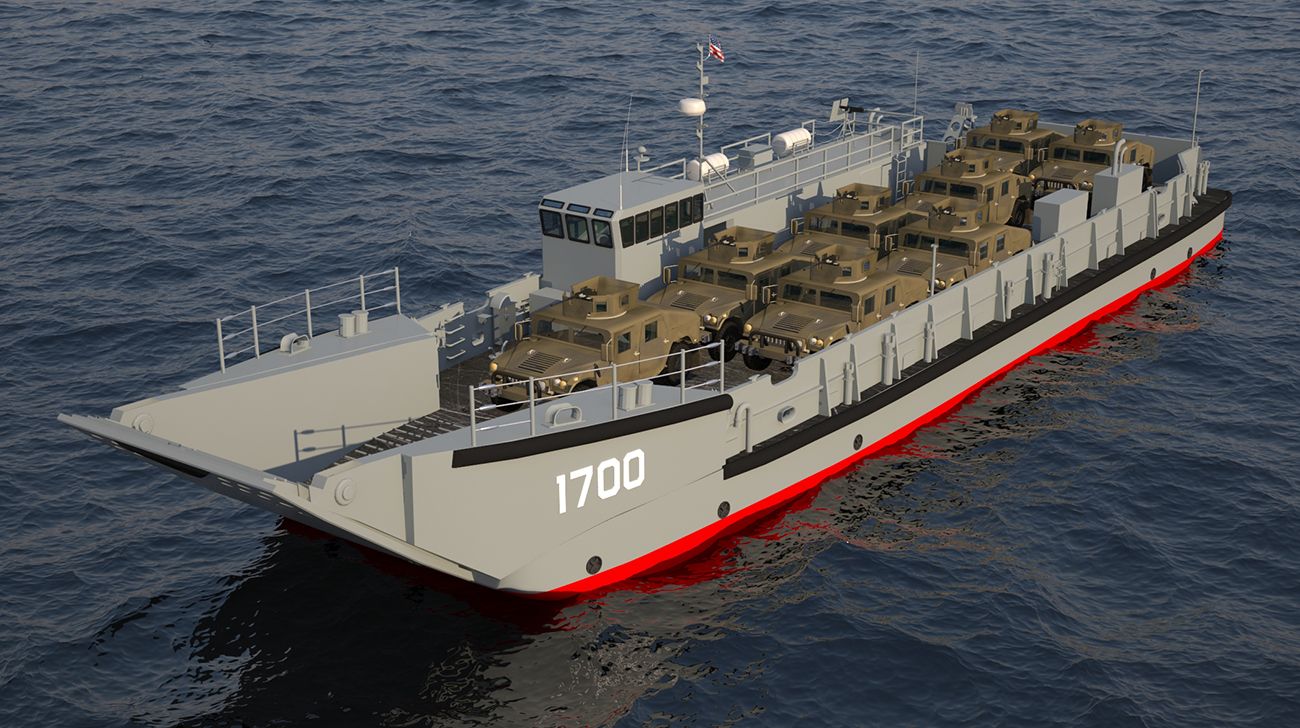
The LCU 1700 class is a United States Navy landing craft utility design intended to transport personnel, vehicles, equipment and cargo between amphibious ships and shore locations and between shore points. The steel-hulled craft is designed for expeditionary and amphibious operations.
The program was initiated to modernize the Navy's landing craft utility fleet. Swiftships received an initial design and construction contract in March 2018, while Austal USA later joined the program as an additional builder.
LCU 1710, the first LCU 1700-class vessel delivered by Austal USA, was launched in August 2025 and delivered to the U.S. Navy on August 14, 2026. It was also the first steel ship that Austal USA delivered to the Navy.
Development and construction
Swiftships received an $18 million contract in March 2018 for design and construction of the first LCU 1700 vessel. The contract included options for additional craft. In April 2020, the Navy awarded Swiftships a $59 million contract modification covering additional LCU construction.
In September 2023, Austal USA received a $91.5 million contract to design and construct three LCU 1700-class vessels, with options for nine additional vessels and associated support services. Austal began construction of its first craft in Mobile, Alabama, in April 2024.
Austal launched LCU 1710 in August 2025. Before delivery, the vessel completed acceptance trials in which major systems and equipment were tested for operational performance, reliability and compliance with Navy requirements. The U.S. Navy Board of Inspection and Survey evaluated the vessel during the trials.
During testing, LCU 1710 demonstrated that it could get underway without tug or pilot assistance. It also demonstrated operation with a reduced crew of 14. Austal delivered the vessel to the U.S. Navy on August 14, 2026.
Design
The LCU 1700 class uses a steel hull and a roll-on/roll-off configuration intended for the movement of heavy vehicles, personnel and cargo. Bow and stern ramps allow vehicles to enter and leave the deck and permit landing craft to operate at undeveloped shore locations. The ramp arrangement is also designed to allow multiple craft to connect and form a temporary causeway.
The class measures approximately 42.3 m in length and 9.4 m in beam. Published technical information gives a draft of approximately 1.6 m and a full-load displacement of about 428 long tons.
The vessels are designed to carry tracked and wheeled vehicles, troops and cargo from ship to shore, shore to shore and back to amphibious ships. Published sources give different maximum payload and personnel figures. Naval Technology reports capacity for 170 short tons of cargo, two M1A1 tanks, 350 combat troops or 400 persons, while another published report gives a payload figure of 150 short tons. These figures should therefore be treated as configuration-dependent or source-dependent rather than combined into a single maximum load.
Propulsion
The craft uses two Caterpillar C18 diesel engines driving twin shafts through Kort nozzles. Published secondary sources disagree on the rated output of the engines, reporting values between 500 and 750 hp per engine. Naval Technology specifies 600 bhp per engine at 1,800 rpm. Because of this disagreement, engine output should not be treated as a single independently confirmed value.
The reported maximum speed is 11 knots. The class is credited with a range of approximately 1,200 nautical miles at 8 knots. Naval Technology reports a fuel capacity of 3,500 US gallons, approximately 13,249 litres, and a potable-water capacity of 1,000 US gallons, approximately 3,785 litres.
Navigation and communications
Published descriptions list a commercial navigation radar, military communications equipment and an amphibious assault direction system. Other reported equipment includes VHF radio, a fluxgate compass, fathometer and gyro compass.
Armament
The LCU 1700 design incorporates weapon mounts for crew-operated defensive weapons. Naval Technology reports provision for four weapon positions, including the M2HB .50-calibre machine gun.
Program status
LCU 1710 became the first Austal-built LCU 1700-class vessel delivered to the U.S. Navy in August 2026. Austal's contract covers three vessels with options for nine more, while additional LCU 1700 craft are associated with earlier Swiftships contracts. The class is intended to provide the Navy with a modern heavy transport connector for amphibious and expeditionary operations.
Operators
- United States Navy: Operator of the LCU 1700 class. LCU 1710 was delivered in August 2026 as the first completed Austal-built vessel of the class.
Specifications (LCU 1710)
General characteristics
- Type: Landing craft utility
- Hull: Steel
- Length: Approximately 42.3 m (139 ft)
- Beam: Approximately 9.4 m (31 ft)
- Draft: Approximately 1.6 m (5.3 ft)
- Full-load displacement: Approximately 428 long tons
- Reduced operating crew demonstrated during trials: 14
- Propulsion: Two Caterpillar C18 diesel engines, twin shafts and Kort nozzles
- Electrical generation: Two Caterpillar C4.4 generators rated at 99 ekW each
- Fuel capacity: Approximately 13,249 litres (3,500 US gal)
- Potable water: Approximately 3,785 litres (1,000 US gal)
Performance
- Maximum speed: 11 knots
- Range: Approximately 1,200 nautical miles at 8 knots
Transport capacity
- Cargo: Up to 170 short tons according to Naval Technology
- Vehicle load: Up to two M1A1 Abrams tanks according to Naval Technology
- Personnel: Up to 350 combat troops or 400 persons according to Naval Technology
Armament
- Weapon positions: Provision for up to four crew-operated weapons, including M2HB .50-calibre machine guns
 Argentina
 Armenia
 Australia
 Austria
 Austria-Hungary
 Belgium
 Brazil
 United Kingdom
 Brunei
 Bulgaria
 Canada
 Chile
Chile China
China Colonial America
 Colombia
 Confederate States
 Croatia
 Czech
Czech Denmark
 Egypt
Egypt Finland
 France
 Georgia
 Germany
 German Imperial
 Greece
 Holland
 Hungary
 India
India Indonesia
 Iran
Iran Iraq
Iraq Ireland
 Israel
 Italy
Italy Japan
Japan Japan (1940)
 Jordan
 Kingdom of Italy
 Malaysia
 Mexico
 Myanmar
 Nazi Germany
 Netherlands
 New Zealand
 North Korea
 Norway
 Pakistan
 Peru
Peru Philippines
 Poland
 Portugal
 Prussia
 Romania
 Russia
 Saudi Arabia
 Serbia
 Singapore
 Slovakia
 Slovenia
 South Africa
 South Korea
 Soviet Union
 Spain
Spain Sweden
 Switzerland
 Syria
Syria Taiwan
 Thailand
 Turkey
 UAE
UAE Ukraine
 Vietnam
 Yugoslavia