
History
The Boeing Harpoon Coastal Defense System (HCDS) is a U.S.-developed road-mobile missile system that adapts the Harpoon weapon family for land-based coastal defense. It is intended to engage hostile surface vessels from dispersed positions ashore and to protect coastal assets and strategic waterways.
The contemporary HCDS combines mobile missile launchers with command, radar and support elements. Taiwan is procuring the system with RGM-84L-4 Harpoon Block II missiles for integration into its coastal anti-ship defenses.
Taiwan reportedly received its first HCDS equipment in October 2025 and began deploying additional launchers, command vehicles and radar systems in 2026. The U.S. Navy also conducted an integrated developmental firing of the system in July 2026 before publicly announcing the successful test in August.
Development and procurement
Taiwan submitted a request in October 2020 for a large land-based Harpoon package that included more than 400 missiles, 100 launchers, radar equipment and support items. A 2023 production contract awarded to Boeing covered 400 RGM-84L-4 Harpoon Block II Update missiles and HCDS-related equipment. A contemporary account of the contract is available from Rivista Italiana Difesa.
Taiwan's procurement comprises 400 RGM-84L-4 Harpoon Block II missiles, 100 transport and launch vehicles and 25 radar vehicles. The package also includes four training missiles, storage containers, spare parts, maintenance equipment, training equipment and other support components. Published cost figures differ. Naval News described the 2023 procurement as worth up to $2.3 billion, while Militarnyi reported that the overall Taiwanese program exceeds $2.85 billion. The supplied sources do not reconcile the difference in scope or accounting.
According to Militarnyi, Taiwan received its first coastal Harpoon systems in October 2025. By August 2026, launchers, command vehicles and radar systems were being delivered to Littoral Combat Command units and prepared for operation. Taiwan plans to complete deliveries by the end of 2028.
Testing
The complete HCDS reached a major developmental milestone at Point Mugu Sea Range, California, in July 2026. During Developmental Test 1, a Harpoon missile was launched from land and successfully engaged a target vessel operating in near-shore and littoral waters. The test involved U.S. Navy organizations and Boeing and was intended to validate the system's ability to engage maritime threats.
The successful test was publicly announced in late August 2026. Further developmental trials were planned after the initial firing. A detailed contemporary description of the configuration and test is also provided by Army Recognition.
Design
System architecture
HCDS is organized as a mobile coastal-defense system rather than a fixed missile installation. Its combat elements include transport and launch vehicles, command vehicles and radar vehicles. The mobile architecture allows firing units to disperse along road networks, occupy temporary launch positions and relocate after an engagement.
The command-and-control architecture supports engagement planning, target-data processing, missile mission-data preparation, launch authorization and firing control. Target information can be supplied through the system's radar and wider maritime surveillance network. After launch, the Harpoon missile uses onboard navigation and terminal guidance rather than continuous command guidance from the launcher.
Launcher
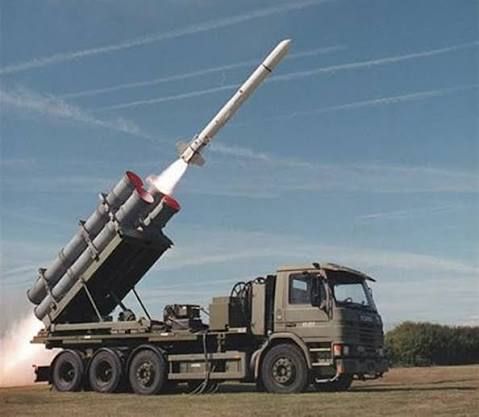
The launcher is carried by a four-axle 8×8 heavy tactical truck. Public imagery from the 2026 developmental test showed a rear-mounted launcher carrying four cylindrical Harpoon missile canisters. The launcher incorporates the canister support structure, elevation mechanism, electrical interfaces and equipment required to prepare and fire the missiles.
The vehicle has been described as resembling the Oshkosh Heavy Expanded Mobility Tactical Truck family, and Taiwanese imagery has shown Harpoon equipment on an Oshkosh truck. However, the supplied U.S. developmental-test information does not formally identify the exact launcher-truck model, so no specific HEMTT designation can be confirmed.
Missile
Taiwan's HCDS procurement specifies the RGM-84L-4 Harpoon Block II. For land launch, the missile uses a solid-propellant booster to accelerate away from the launcher before transitioning to its turbojet cruise propulsion system.
Harpoon Block II uses GPS-aided inertial navigation during the midcourse phase and an active radar seeker for terminal guidance. In the anti-ship role it approaches at low altitude using a sea-skimming flight profile. The missile can perform terminal sea-skimming or pop-up maneuvers. Block II was also developed with a land-strike capability against designated aimpoints, although the principal demonstrated HCDS mission in the supplied material is engagement of surface vessels.
Radar and command vehicles
Taiwan's procurement includes 25 radar vehicles as well as separate command vehicles. These elements provide surface-target detection and the command functions required to prepare engagements. The supplied information does not identify the radar model, radar frequency, detection range, command-vehicle designation or communications suite.
Program status
By August 2026, Taiwan had begun deploying HCDS equipment to Littoral Combat Command units. At least several launchers and a radar vehicle had arrived, and Taiwanese forces were preparing the equipment for operation. The delivery program is planned to continue through the end of 2028.
The Harpoon systems are intended to complement Taiwan's domestically produced Hsiung Feng II and Hsiung Feng III anti-ship missiles. Taiwan is also constructing additional coastal missile positions and bases, including facilities in Tainan, Kaohsiung and Pingtung, with part of the new infrastructure scheduled for completion by 2027.
No combat use of the contemporary HCDS configuration is confirmed in the supplied sources. Its principal publicly described live-fire event remains the July 2026 developmental test in California.
Operators
- Taiwan: Procurement includes 400 RGM-84L-4 Harpoon Block II missiles, 100 transport and launch vehicles and 25 radar vehicles. Equipment is being delivered to Littoral Combat Command units, with completion planned by the end of 2028.
Specifications (Taiwan HCDS with RGM-84L-4 Harpoon Block II)
General characteristics
- Type: Road-mobile coastal anti-ship missile system
- Missile: RGM-84L-4 Harpoon Block II
- Launcher configuration: Four missile canisters on an 8×8 heavy tactical truck
- Missile length: Approximately 4.63 m in surface-launch configuration
- Missile diameter: 343 mm
- Boosted missile weight: Approximately 680 kg
- Warhead: 227 kg penetration high-explosive blast warhead
- Cruise propulsion: Turbojet
- Launch propulsion: Solid-propellant booster
Performance
- Speed: High subsonic
- Published Block II surface-launch range: More than 124 km (67 nautical miles)
Guidance
- Midcourse guidance: GPS-aided inertial navigation
- Terminal guidance: Active radar homing
- Anti-ship flight profile: Low-level sea-skimming with terminal sea-skim or pop-up options
 Argentina
 Armenia
 Australia
 Austria
 Austria-Hungary
 Belgium
 Brazil
 United Kingdom
 Brunei
 Bulgaria
 Canada
 Chile
Chile China
China Colonial America
 Colombia
 Confederate States
 Croatia
 Czech
Czech Denmark
 Egypt
Egypt Finland
 France
 Georgia
 Germany
 German Imperial
 Greece
 Holland
 Hungary
 India
India Indonesia
 Iran
Iran Iraq
Iraq Ireland
 Israel
 Italy
Italy Japan
Japan Japan (1940)
 Jordan
 Kingdom of Italy
 Malaysia
 Mexico
 Myanmar
 Nazi Germany
 Netherlands
 New Zealand
 North Korea
 Norway
 Pakistan
 Peru
Peru Philippines
 Poland
 Portugal
 Prussia
 Romania
 Russia
 Saudi Arabia
 Serbia
 Singapore
 Slovakia
 Slovenia
 South Africa
 South Korea
 Soviet Union
 Spain
Spain Sweden
 Switzerland
 Syria
Syria Taiwan
 Thailand
 Turkey
 UAE
UAE Ukraine
 Vietnam
 Yugoslavia