
History
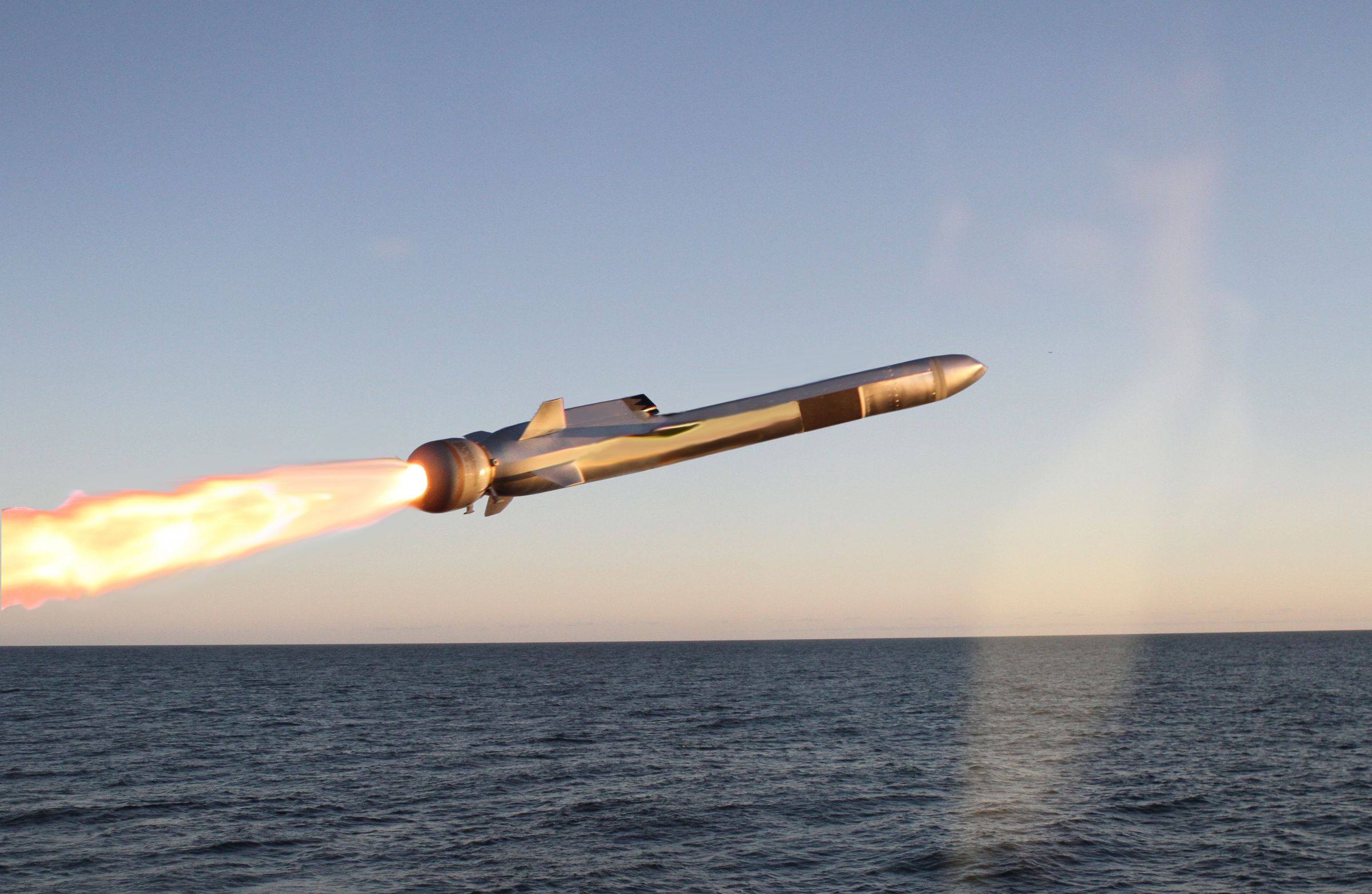
The Kongsberg Naval Strike Missile, commonly abbreviated NSM, is a Norwegian high-subsonic cruise missile developed by Kongsberg Defence & Aerospace for attacks against surface ships and selected land targets. It can be deployed from warships and mobile coastal defence systems and uses passive terminal guidance based on an imaging infrared seeker.
NSM was developed as the successor to Norway's Penguin anti-ship missile. The program produced a compact missile intended for operations in open water, littoral environments, and areas where a flight route may pass close to land. Its design combines sea-skimming flight, terrain-following navigation, a low-observable airframe, and terminal manoeuvring intended to complicate interception.
The missile entered service in 2012 and has subsequently been adopted by several NATO and partner navies. Its operational use has expanded from Norwegian ships and Polish coastal batteries to additional naval and land-based applications, including the United States and Australia.
Development and introduction
The initial serial-production contract for the Naval Strike Missile was signed in June 2007. Development testing continued through the following years, with a major milestone completed at Point Mugu in June 2011. Norway announced a second phase of development in April 2011. According to the available historical record, the Royal Norwegian Navy conducted its first NSM firing on 10 October 2012 from the Skjold-class vessel HNoMS Glimt.
Norway conducted the first test firing of an NSM carrying a live warhead against a target vessel on 5 June 2013. The target was the decommissioned Oslo-class frigate HNoMS Trondheim, which was struck successfully. Poland also established a coastal missile division equipped with NSM in 2013, using mobile launchers, radar, command, and fire-control vehicles.
During RIMPAC 2014, the Royal Norwegian Navy frigate Fridtjof Nansen fired an NSM during a sinking exercise, with the missile impacting and detonating as intended. The United States tested NSM from the littoral combat ship USS Coronado on 24 September 2014. Kongsberg and Raytheon later promoted the missile for the U.S. Navy's Over-the-Horizon Weapon System requirement.
On 31 May 2018, the U.S. Navy selected NSM as its over-the-horizon anti-ship weapon for littoral combat ships. In U.S. service, the missile received the designation RGM-184A. The missile has also been integrated into other U.S. naval and expeditionary applications.
The Kongsberg product information describes NSM as a multi-platform precision-strike weapon capable of attacking targets at sea and on land. Kongsberg currently publishes a range greater than 300 km, a missile weight of 407 kg, a length of 3.96 m, and high-subsonic speed.
Australian integration
Australia integrated NSM into the Royal Australian Navy's surface combatant fleet as part of an effort to improve long-range maritime strike capability. During RIMPAC 2024, the Hobart-class destroyer HMAS Sydney achieved a major integration milestone by firing the missile during the exercise.
HMAS Sydney conducted another NSM live firing during RIMPAC 2026 off Hawaii. According to the Australian Department of Defence, Sydney fired an NSM against the decommissioned Ticonderoga-class cruiser USS Mobile Bay during a multinational sinking exercise. It was the second time the Royal Australian Navy had fired NSM during a RIMPAC exercise.
After the NSM strike, Australian MH-60R Seahawk helicopters engaged the target with AGM-114 Hellfire missiles. The event demonstrated the integration of the missile into HMAS Sydney's combat system and the Royal Australian Navy's ability to coordinate surface and aviation weapons during a complex live-fire engagement. The supplied source package also documents this RIMPAC 2026 firing.
Design
Airframe and flight profile
NSM uses a compact airframe designed for low-altitude, high-subsonic flight. Kongsberg emphasizes the missile's low observable characteristics, sea-skimming capability, manoeuvrability, and ability to follow routes close to terrain and land masses. Mission planning can exploit geography so that the missile approaches a target from a selected direction rather than flying only a direct straight-line route.
The missile can perform advanced terminal manoeuvres during the final approach. These manoeuvres, combined with a low-altitude profile, are intended to make tracking and interception more difficult for shipboard air-defence systems. Kongsberg states that the missile remains passive during its terminal engagement process, reducing the need for active radar emissions from the missile itself.
Propulsion
The missile uses a solid-propellant rocket booster for launch. After the booster has completed its function, a turbojet sustainer provides propulsion during cruise. Published technical references identify the sustainer as the Microturbo TRI-40 turbojet. The missile flies at high-subsonic speed; Kongsberg's current public technical data describes its speed simply as high subsonic.
Navigation and guidance
Published descriptions of NSM list GPS-aided inertial navigation, terrain-reference navigation, and a laser altimeter for the cruise phase. These systems allow the missile to follow a planned low-altitude route over water and near terrain. During the terminal phase, the missile uses an imaging infrared seeker rather than an active radar seeker.
The imaging infrared seeker supports autonomous target recognition. Kongsberg states that the seeker can detect, recognize, and select the intended target. This allows the terminal guidance system to distinguish the planned target from other objects in the surrounding scene. The passive infrared seeker also avoids continuous radar transmission from the missile during its final approach.
Warhead
Public specifications describe NSM as carrying a 120 kg penetrating blast and controlled-fragmentation warhead with a titanium casing. The warhead is intended to produce internal blast and fragmentation effects after impact. Technical descriptions also identify a programmable multipurpose fuze designed to optimize the detonation point for the selected target.
Launch systems
The ship-launched NSM is carried in protective launch canisters installed on the vessel. The same missile family is also used in mobile coastal defence systems. A coastal battery can combine launcher vehicles with fire-control, command, communications, and surveillance elements selected for the operator's requirements.
The NSM system description identifies ship-launched and coastal-defence configurations and describes the coastal system as including a Fire Distribution Centre, an optional surveillance and tracking radar, and canister-protected launcher fire units.
Operational history
Norway was the first operator of the Naval Strike Missile, introducing it on Fridtjof Nansen-class frigates and Skjold-class vessels. Poland adopted the weapon for land-based coastal defence, establishing mobile batteries that combined NSM launchers with command, fire-control, and radar vehicles.
The United States evaluated NSM aboard USS Coronado in 2014 and selected the missile for the U.S. Navy's Over-the-Horizon Weapon System program in 2018. The missile is designated RGM-184A in U.S. service. U.S. forces also employ NSM in an expeditionary land-based anti-ship role.
Other navies have adopted or selected NSM as part of their surface-warfare modernization programs. The available operator information identifies Australia, Germany, the Netherlands, Norway, Poland, the United Kingdom, and the United States as users. Additional countries have selected the system for future or expanding service.
Australia's RIMPAC 2026 firing provided a recent example of operational integration. HMAS Sydney launched NSM against USS Mobile Bay during a multinational sinking exercise before embarked Australian helicopters continued the engagement with Hellfire missiles. The Australian Department of Defence described the firing as a demonstration of the destroyer's enhanced maritime strike capability.
Historical development and operator information is also summarized in the Naval Strike Missile reference history. A separate NSM technical overview records the missile's Norwegian origin, 2012 introduction, guidance arrangement, propulsion concept, and use from naval and coastal platforms.
Variants
- NSM Ship Launched: Ship-based version for anti-surface and land-attack missions. It is carried in deck-mounted launch canisters and has been integrated on several classes of surface combatants.
- NSM Coastal Defence System: Land-based configuration using mobile launchers with command, fire-control, communications, and optional surveillance radar elements. Poland was an early operator of this configuration.
Operators
- Australia: Royal Australian Navy. NSM has been integrated into the surface combatant fleet, including Hobart-class destroyer HMAS Sydney, which fired the weapon during RIMPAC 2024 and again during RIMPAC 2026.
- Germany: Identified in current reference material as an NSM user.
- Netherlands: Identified in current reference material as an NSM user.
- Norway: Royal Norwegian Navy. Original operator, using the missile from Fridtjof Nansen-class frigates and Skjold-class vessels.
- Poland: Uses NSM in a mobile coastal-defence role, with land-based launchers and associated command and radar vehicles.
- United Kingdom: Royal Navy. Current reference material identifies the United Kingdom as an operator, and a 2025 live firing is reported in the available technical source.
- United States: U.S. Navy and U.S. Marine Corps applications. The U.S. designation is RGM-184A.
Specifications (Naval Strike Missile)
General characteristics
- Type: Anti-ship and land-attack cruise missile
- Manufacturer: Kongsberg Defence & Aerospace
- Length: 3.96 m with launch booster
- Weight: 407 kg according to current Kongsberg technical data
- Width: Approximately 700 mm with wings stowed
- Wingspan: Approximately 1.36 m with wings deployed
- Warhead: Titanium-cased penetrating blast and controlled-fragmentation warhead
- Warhead weight: 120 kg
- Propulsion: Solid rocket launch booster and turbojet sustainer
Performance
- Speed: High subsonic
- Range: Greater than 300 km according to current Kongsberg technical data
- Flight profile: Low-altitude flight with sea-skimming capability and terminal manoeuvring
Published range figures have changed over time. Older public sources cited approximately 185 km or more than 200 km, while Kongsberg's current product data states a range greater than 300 km. These figures should therefore be understood as reflecting different published configurations or successive public disclosures rather than a single constant figure across the program's history.
Guidance
- Mid-course navigation: GPS-aided inertial navigation with terrain-reference navigation
- Altitude control: Laser altimeter
- Terminal guidance: Imaging infrared seeker
- Targeting feature: Autonomous target recognition
Launch platforms
- Naval: Surface ships equipped with NSM launch canisters
- Land: Mobile coastal-defence launcher vehicles
Related equipment
The Joint Strike Missile is an air-launched development related to NSM. It was designed for fixed-wing aircraft and for internal carriage by the F-35. Although it shares technology and design heritage with NSM, it is a separate air-launched weapon rather than the ship- and coastal-launched Naval Strike Missile covered in this article.
 Argentina
 Armenia
 Australia
 Austria
 Austria-Hungary
 Belgium
 Brazil
 United Kingdom
 United States
 Brunei
 Bulgaria
 Canada
 Chile
Chile China
China Colonial America
 Colombia
 Confederate States
 Croatia
 Czech
Czech Denmark
 Egypt
Egypt Finland
 France
 Georgia
 Germany
 German Imperial
 Greece
 Holland
 Hungary
 India
India Indonesia
 Iran
Iran Iraq
Iraq Ireland
 Israel
 Italy
Italy Japan
Japan Japan (1940)
 Jordan
 Kingdom of Italy
 Malaysia
 Mexico
 Myanmar
 Nazi Germany
 Netherlands
 New Zealand
 North Korea
 Pakistan
 Peru
Peru Philippines
 Poland
 Portugal
 Prussia
 Romania
 Russia
 Saudi Arabia
 Serbia
 Singapore
 Slovakia
 Slovenia
 South Africa
 South Korea
 Soviet Union
 Spain
Spain Sweden
 Switzerland
 Syria
Syria Taiwan
 Thailand
 Turkey
 UAE
UAE Ukraine
 Vietnam
 Yugoslavia