
History
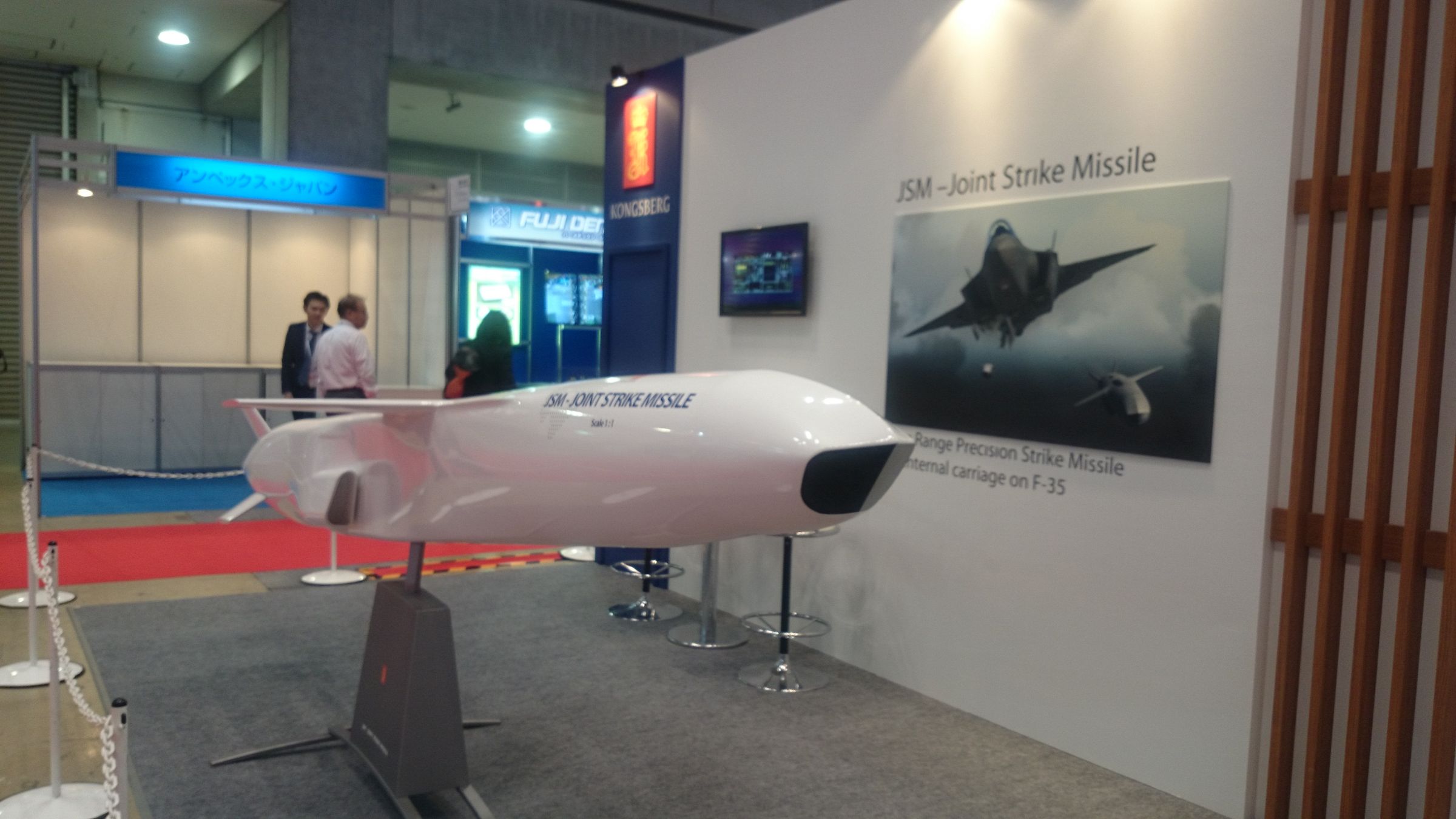
The Kongsberg Joint Strike Missile, or JSM, is a Norwegian air-launched precision-guided cruise missile developed for attacks against maritime and land targets. It is derived from the Naval Strike Missile and was shaped for internal carriage by the F-35A and F-35C while retaining a long-range stand-off strike role.
Development began in 2008 under Norwegian funding and management. The program adapted Naval Strike Missile technology to aircraft launch, added land-attack capability, and incorporated a compact airframe, passive terminal guidance, autonomous target recognition, and a two-way data link.
The missile entered series production in 2021 and entered operational service with the Royal Norwegian Air Force in April 2025. By 2026, several F-35 operators had selected or ordered the weapon, while Germany was also examining the JSM as a possible future anti-ship weapon for its P-8A Poseidon maritime patrol aircraft.
Development and testing
Kongsberg Defence & Aerospace developed the JSM from the Naval Strike Missile to meet Norwegian requirements for an air-launched weapon capable of striking ships and land targets. The missile's dimensions were tailored for the internal weapons bays of the conventional take-off F-35A and carrier-capable F-35C.
Testing during the 2010s evaluated the missile's flight characteristics, guidance, and aircraft integration. In November 2015, an F-16 Fighting Falcon completed a live-fire JSM test at the Utah Test and Training Range. A successful live drop from an F-35A followed in 2021, demonstrating mechanical, electrical, and software integration with the fighter.
Series production began in 2021. Norway officially received its first operational Joint Strike Missiles on 28 April 2025 at Ørland Air Station, marking the missile's transition into operational service. Additional information on the missile and its development is available from the JSM technical profile.
International procurement
Japan became an early customer for the JSM for its F-35A fleet. Deliveries began in March 2026, although Japanese F-35A aircraft still required software modifications before the missile could enter active service on that platform.
Germany selected the JSM for its F-35A fleet and placed an initial order in 2025. A follow-on order worth NOK 3.5 billion was announced in May 2026. According to Janes, Germany was the fifth country to select the missile after Norway, Japan, Australia, and the United States.
Separately, the German Navy began considering whether the JSM could eventually be integrated with the P-8A Poseidon. In July 2026, the Commander of German Naval Aviation identified the missile as a possible candidate for restoring an organic anti-ship strike capability. The proposal remained at the evaluation stage, and the JSM had not been integrated or certified on the P-8A. Any such configuration would require separation testing, software qualification, mission-system modifications, and weapons certification. The proposal was described in reports by Aviation Week and Army Recognition.
Design
Airframe and carriage
The JSM uses a compact, low-observable airframe derived from the Naval Strike Missile. It is approximately 4.0 m long and has a launch mass of about 416 kg. Its stowed width is approximately 0.48 m and its height is about 0.52 m. Folding aerodynamic surfaces deploy after launch.
The missile was specifically dimensioned for internal carriage by the F-35A and F-35C. Internal carriage allows those aircraft to retain their low-observable configuration while carrying a long-range anti-ship and land-attack weapon. The missile can also be carried externally by compatible aircraft. The F-35B cannot carry the JSM internally because of the different internal arrangement of the short take-off and vertical landing variant.
Guidance
Midcourse navigation combines inertial navigation and GPS-assisted flight control with terrain-reference navigation and pre-programmed mission planning. The missile can follow planned routes and use low-altitude flight profiles over land or water.
For terminal guidance, the JSM uses a passive imaging infrared seeker with autonomous target recognition. The system is intended to identify and discriminate designated targets without requiring an active radar seeker. Reported guidance features also include passive radio-frequency sensing and a two-way data link that can support mission updates and target reassignment after launch.
Flight profile and propulsion
The missile is powered by a Williams International F-415 small turbofan and is designed for high-subsonic flight at an estimated speed of about Mach 0.9. Low-altitude sea-skimming and terrain-following profiles are intended to reduce exposure to radar and air defenses.
Published range figures vary with flight profile. Sources describe a range greater than 300 km, while higher-altitude profiles can extend beyond 555 km. A continuous low-altitude profile has been associated with a substantially shorter range of about 185 km. These figures should therefore be understood as profile-dependent rather than as a single fixed maximum range.
Warhead
The JSM carries an approximately 120 kg multi-purpose warhead intended for maritime and land targets. Reported fuze options include impact and time-delay modes, allowing the weapon to attack different target structures and selected aim points.
Program status
The JSM entered series production in 2021 and operational service with Norway in April 2025. Norway, Japan, Australia, the United States, and Germany have selected or ordered the missile for F-35 operations. Germany placed a follow-on order in May 2026, while Japanese deliveries began in March 2026.
Germany's separate interest in fitting the JSM to the P-8A Poseidon remained a capability evaluation in 2026 rather than an approved integration program. No operator had fielded the JSM on the P-8A at that time.
Variants
- Joint Strike Missile: Air-launched production configuration for anti-ship and land-attack missions, optimized for internal carriage by the F-35A and F-35C.
- JSM-SL: Proposed submarine-launched adaptation considered for torpedo-tube employment. The available sources describe it as a proposed development rather than an operational variant.
- VL-JSM: Studied vertical-launch adaptation intended for launch from systems such as the Mark 41 Vertical Launching System. It did not become an operational production variant.
Specifications (Joint Strike Missile)
General characteristics
- Type: Air-launched precision-guided cruise missile
- Developer: Kongsberg Defence & Aerospace
- Country of development: Norway
- Length: Approximately 4.0 m
- Stowed width: Approximately 0.48 m
- Height: Approximately 0.52 m
- Launch mass: Approximately 416 kg
- Warhead mass: Approximately 120 kg
- Engine: Williams International F-415 small turbofan
Performance
- Speed: High subsonic, approximately Mach 0.9
- Range: More than 300 km depending on flight profile
- Extended-range profile: More than 555 km reported for higher-altitude profiles
- Low-altitude profile: Approximately 185 km reported for continuous low-level flight
Guidance and targeting
- Midcourse guidance: GPS and inertial navigation with terrain-reference navigation
- Terminal seeker: Imaging infrared
- Targeting: Autonomous target recognition
- Additional guidance features: Passive RF sensing and two-way data link
Launch platforms
- F-35A Lightning II: Internal or external carriage
- F-35C Lightning II: Internal or external carriage
- F-16 Fighting Falcon: External carriage and test platform
 Argentina
 Armenia
 Australia
 Austria
 Austria-Hungary
 Belgium
 Brazil
 United Kingdom
 United States
 Brunei
 Bulgaria
 Canada
 Chile
Chile China
China Colonial America
 Colombia
 Confederate States
 Croatia
 Czech
Czech Denmark
 Egypt
Egypt Finland
 France
 Georgia
 Germany
 German Imperial
 Greece
 Holland
 Hungary
 India
India Indonesia
 Iran
Iran Iraq
Iraq Ireland
 Israel
 Italy
Italy Japan
Japan Japan (1940)
 Jordan
 Kingdom of Italy
 Malaysia
 Mexico
 Myanmar
 Nazi Germany
 Netherlands
 New Zealand
 North Korea
 Pakistan
 Peru
Peru Philippines
 Poland
 Portugal
 Prussia
 Romania
 Russia
 Saudi Arabia
 Serbia
 Singapore
 Slovakia
 Slovenia
 South Africa
 South Korea
 Soviet Union
 Spain
Spain Sweden
 Switzerland
 Syria
Syria Taiwan
 Thailand
 Turkey
 UAE
UAE Ukraine
 Vietnam
 Yugoslavia