
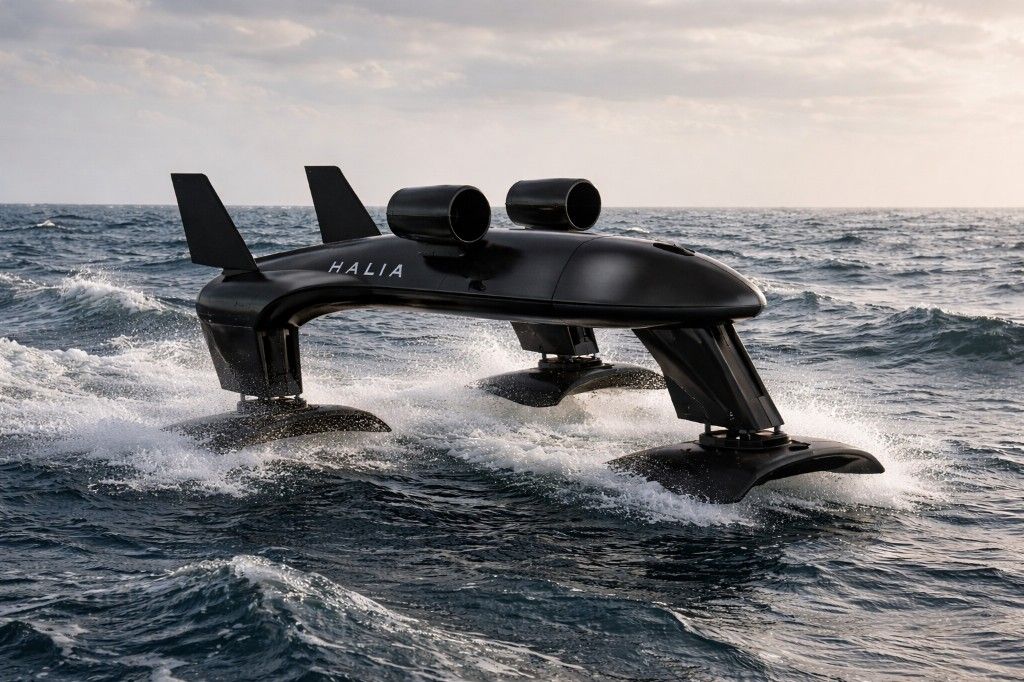
History
LeVanta Tech HALIA is an unmanned maritime system designed to alternate between persistent operation on the water and rapid airborne repositioning. The company describes the concept as a Float-Fly-Float platform intended primarily for anti-submarine warfare, mine countermeasures, maritime surveillance, intelligence, surveillance and reconnaissance, and communications relay missions.
HALIA uses a low floating profile and a water-to-air transition architecture called HoverFoil. The system is intended to remain on the sea surface with its propulsion motors off, accelerate across the water when relocation is required, take off without a runway or catapult, fly to another area, and land on the water again.
The program remains in prototype development. LeVanta Tech identifies HALIA as a Technology Readiness Level 6 concept prototype under testing and states that float, takeoff, flight and water-landing events have been demonstrated, while repeated mission cycles and operation in more demanding sea conditions remain subjects of continuing validation.
Development
According to Autonomy Global, LeVanta Tech completed the first HALIA prototype in 2023. The system was conceived to combine characteristics normally divided between unmanned aircraft and unmanned surface systems. It is intended to remain at sea for long periods while retaining the ability to move rapidly between distant locations by air.
LeVanta Tech developed HoverFoil as the central transition technology. The company states that the architecture reduces drag while HALIA accelerates across the water and enables launch without a runway, catapult or large support ship. The technology is associated with US Patent 12,221,210 B2.
LeVanta Tech has received Phase II Small Business Innovation Research support associated with the program. The company reports a US Air Force Phase II award valued at $1.8 million and a US Navy Phase II award valued at $1.4 million. The manufacturer also reports a memorandum of understanding with Ukraine. In October 2025, The Defense Post reported an agreement involving LeVanta Tech and Ukrainian Defense Industry for joint research, development and testing, with possible future production activity in Ukraine.
Testing and demonstrations
Prototype testing has covered HALIA's principal operating phases. LeVanta Tech states that the system has demonstrated floating, water-surface acceleration, takeoff, flight and water landing. A transition from floating to airborne operation in less than 60 seconds has also been demonstrated according to the company's published test information.
In August 2026, LeVanta Tech demonstrated HALIA at ANTX Coastal Trident. The demonstration was presented as showing how the platform could connect air, surface, subsea and seabed assets over long distances. Photographs from the event showed a dark, angular vehicle floating with most of its hull close to or below the waterline.
Design
Float-Fly-Float architecture
HALIA is built around four operating phases described by LeVanta Tech as Float, Skate, Fly and Float Again. During the Float phase, the vehicle remains low on the water with its propulsion motors off to conserve energy. The manufacturer states that approximately 0.3 m of the body remains above the water when floating.
During the Skate phase, HALIA accelerates across the water using the HoverFoil transition system. It then enters the Fly phase and becomes an airborne unmanned vehicle for rapid repositioning. After reaching another operating area, the system is designed to perform a controlled water landing and return to floating operation.
The current prototype has a low-profile composite body. LeVanta Tech presents the absence of hot exhaust during motors-off floating and the limited exposed hull area as features intended to reduce visual and radar detectability. These characteristics are design claims rather than independently published signature measurements.
Payloads and mission systems
LeVanta Tech gives the current HALIA configuration a modeled payload target of 8.2 kg. The payload space is intended to accept different mission packages rather than a single fixed sensor installation. The manufacturer lists intelligence, surveillance and reconnaissance sensors, communications relay equipment, anti-submarine warfare sensors, sonar equipment and other mission-specific payloads as possible configurations.
For anti-submarine warfare, the company describes a concept in which HALIA flies to a search area, lands on the water and lowers a sonar system from the vehicle. It can then listen for underwater contacts with its propulsion motors stopped, transmit contact information through a datalink, relaunch and move ahead of a predicted contact track before landing again. This is a proposed operational concept and should not be interpreted as confirmation of an operationally deployed anti-submarine capability.
For mine countermeasures, HALIA is intended to fly rapidly to a suspected mine area, conduct distributed searches and relay detected threats while keeping crewed vessels farther from the danger area. LeVanta Tech also describes multi-vehicle employment and possible expendable neutralization missions, although these remain proposed applications of the developing platform.
Deployment
HALIA is designed for expeditionary operation without fixed launch infrastructure. LeVanta Tech states that it can be deployed from small surface craft and handled by a two-person team. Water launch and water recovery are intended to eliminate the need for a runway or catapult.
BAVOVNA describes the system as a sea-air hybrid operating in open-ocean, coastal and littoral environments. Its published description is broadly consistent with LeVanta Tech's Float-Skate-Fly operating concept and prototype status.
Program status
HALIA is not presented by LeVanta Tech as an operational production system. The company identifies the program as TRL 6 and describes the existing vehicle as a concept prototype in testing at Diamondhead, Mississippi.
The current development effort is focused on progressing from individual demonstrated float, transition, flight and landing events toward repeated mission cycles and a wider sea-state test envelope. The manufacturer lists operation in 1.8 m swells as a target rather than a fully validated production specification.
LeVanta Tech's published endurance, flight speed, flight range and payload figures are largely engineering or modeled targets. Actual performance is expected to depend on payload, sea conditions, communications activity and the frequency of airborne repositioning.
Variants
- HALIA-S: A smaller battery-powered version reported by The Defense Post in 2025.
- HALIA-M: A larger version described by The Defense Post as using a hybrid-electric configuration.
- HALIA-X: The largest version reported in 2025, described as using jet fuel and intended for substantially greater payload and range than the smaller HALIA models.
Publicly reported figures for the HALIA-S, HALIA-M and HALIA-X differ substantially from the specifications currently published by LeVanta Tech for its prototype. They should therefore be treated as descriptions of proposed or separate configurations rather than combined with the current prototype specification.
Specifications (HALIA current prototype targets)
General characteristics
- Type: Float-and-fly unmanned maritime system
- Technology readiness: TRL 6 concept prototype in testing
- Payload: 8.2 kg modeled target
- Deployment: Small-boat deployable, designed for two-person handling
- Launch: Water takeoff without runway or catapult
- Recovery: Water landing
- Floating profile: Approximately 0.3 m of body above the water according to the manufacturer
Performance
- Sea persistence: More than 30 days modeled target in motors-off float mode
- Flight speed: More than 161 km/h modeled target
- Flight range: Approximately 222 km modeled target
- Float-to-air transition: Less than 60 seconds demonstrated in prototype testing
- Sea-state objective: Operation in swells up to approximately 1.8 m is a target test envelope
Mission equipment
- Payload architecture: Mission-configurable
- Supported concepts: ISR sensors, communications relay equipment, anti-submarine warfare sensors and sonar payloads
- Primary planned roles: Anti-submarine warfare, mine countermeasures, maritime domain awareness, ISR and communications relay
LeVanta Tech publishes the current performance values as modeled targets rather than final production guarantees. The manufacturer's current technical and program information is available from the LeVanta Tech HALIA page.
 Argentina
 Armenia
 Australia
 Austria
 Austria-Hungary
 Belgium
 Brazil
 United Kingdom
 Brunei
 Bulgaria
 Canada
 Chile
Chile China
China Colonial America
 Colombia
 Confederate States
 Croatia
 Czech
Czech Denmark
 Egypt
Egypt Finland
 France
 Georgia
 Germany
 German Imperial
 Greece
 Holland
 Hungary
 India
India Indonesia
 Iran
Iran Iraq
Iraq Ireland
 Israel
 Italy
Italy Japan
Japan Japan (1940)
 Jordan
 Kingdom of Italy
 Malaysia
 Mexico
 Myanmar
 Nazi Germany
 Netherlands
 New Zealand
 North Korea
 Norway
 Pakistan
 Peru
Peru Philippines
 Poland
 Portugal
 Prussia
 Romania
 Russia
 Saudi Arabia
 Serbia
 Singapore
 Slovakia
 Slovenia
 South Africa
 South Korea
 Soviet Union
 Spain
Spain Sweden
 Switzerland
 Syria
Syria Taiwan
 Thailand
 Turkey
 UAE
UAE Ukraine
 Vietnam
 Yugoslavia