
History
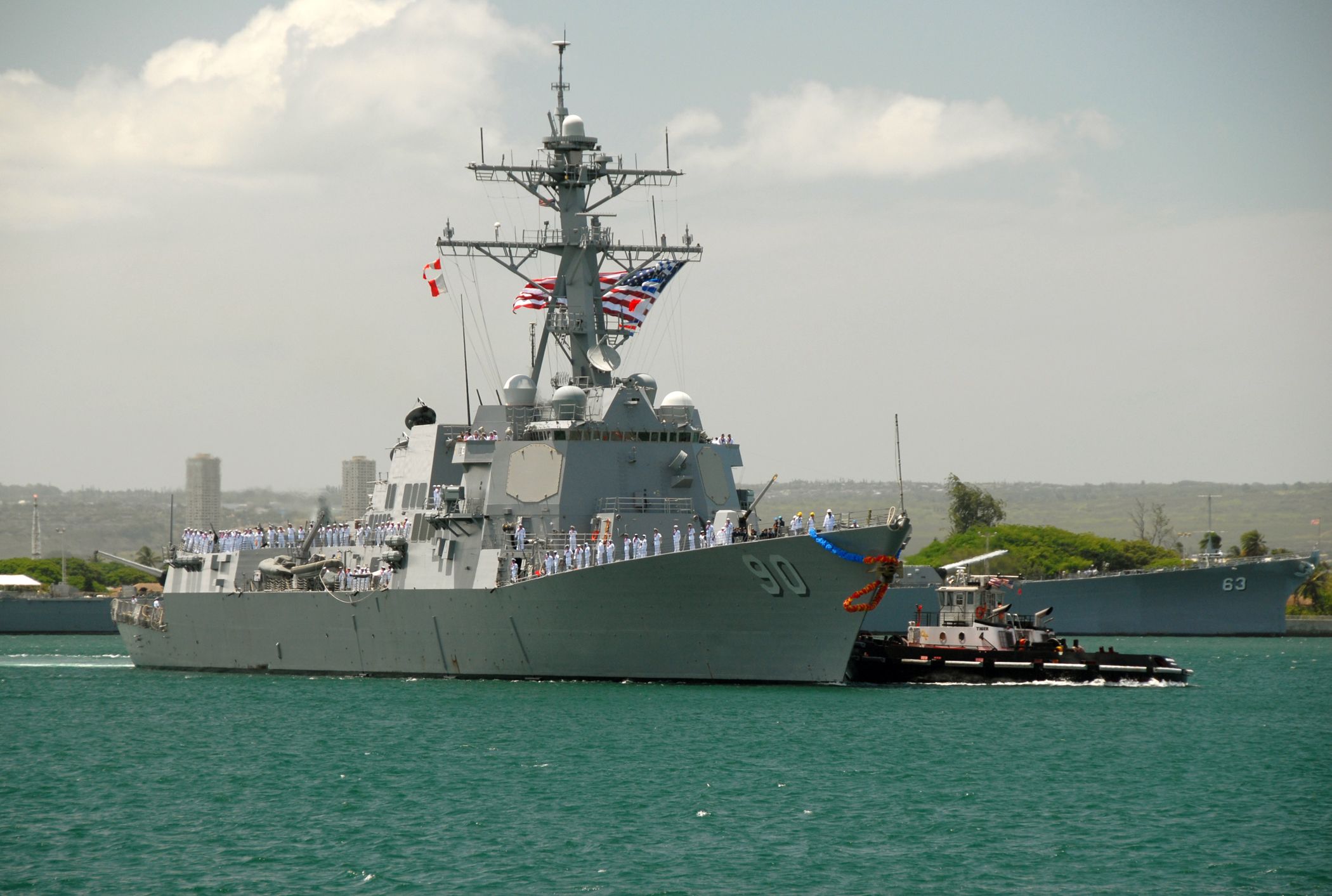
USS Chafee (DDG-90) is a Flight IIA Arleigh Burke-class Aegis guided-missile destroyer of the United States Navy. The ship was built by Bath Iron Works and named for John Lester Hubbard Chafee, a Marine veteran of Guadalcanal who later served as Secretary of the Navy and as a United States senator.
Chafee was laid down on 12 April 2001, launched on 2 November 2002, and commissioned on 18 October 2003 at Newport, Rhode Island. The destroyer subsequently served with the U.S. Pacific Fleet and has operated with the Nimitz Carrier Strike Group.
In September 2026, Chafee participated in U.S. Navy experimentation with unmanned surface vessels by refueling the medium unmanned surface vessel Seahawk at sea. The operation formed part of broader efforts to develop methods for sustaining unmanned vessels during extended operations.
Early service
Chafee departed Pearl Harbor on 20 May 2005 for its maiden deployment with the Nimitz Carrier Strike Group. The deployment supported U.S. operations associated with the Global War on Terrorism.
On 9 April 2007, Chafee again departed Pearl Harbor with the Nimitz Carrier Strike Group for operations that included the U.S. Fifth Fleet area. On 1 June 2007, the destroyer used its main gun against suspected Al-Qaeda members in the Puntland region of Somalia who were wanted in connection with the 1998 United States embassy bombings. Chafee returned to Pearl Harbor on 22 September 2007 after a 167-day Western Pacific and Middle East deployment.
Later activities
On 10 December 2020, Chafee conducted the first reported test firing of a Tomahawk Block V missile from the ship. The destroyer also participated in the 2022 Rim of the Pacific exercise.
On 11 September 2026, Chafee refueled the medium unmanned surface vessel Seahawk at sea. The procedure required personnel to board Seahawk while conducting the refueling operation. It followed an earlier 2026 astern-refueling test involving Seahawk and the fleet replenishment oiler USNS Guadalupe. The September event was the second U.S. Navy attempt during the year to conduct this type of at-sea sustainment of an unmanned vessel.
Design
USS Chafee is a Flight IIA member of the Arleigh Burke class and is configured as an Aegis guided-missile destroyer. It has a displacement of approximately 9,300 t (9,200 long tons), an overall length of 155.30 m (509 ft 6 in), a beam of 20 m (66 ft), and a draft of 9.4 m (31 ft).
Propulsion
The propulsion system consists of four General Electric LM2500-30 gas turbines driving two shafts. Total rated power is 75 MW (100,000 shp). The ship is capable of speeds exceeding 30 knots (56 km/h; 35 mph).
Personnel and aviation facilities
The ship has a complement of approximately 350 officers and enlisted personnel. Its aviation capability includes two MH-60R Seahawk helicopters.
Operational history
Chafee remains in active U.S. Navy service as a Pacific Fleet destroyer operating from Naval Station San Diego. Its documented activities have included carrier strike group deployments, missile testing, multinational exercises, and experimentation supporting the integration and sustainment of unmanned surface vessels.
The 2026 refueling of Seahawk demonstrated the use of a crewed destroyer to support an unmanned vessel while underway. Seahawk and its related Sea Hunter prototype have been used for research into how medium unmanned surface vessels can be integrated into fleet operations. Because the refueling procedure still requires personnel aboard the unmanned vessel, the method retains personnel-safety and vessel-design constraints that future unmanned sustainment concepts are intended to reduce.
Specifications (USS Chafee DDG-90)
General characteristics
- Class and type: Arleigh Burke-class Flight IIA Aegis guided-missile destroyer
- Displacement: approximately 9,300 t (9,200 long tons)
- Length: 155.30 m (509 ft 6 in)
- Beam: 20 m (66 ft)
- Draft: 9.4 m (31 ft)
- Complement: approximately 350 officers and enlisted personnel
Propulsion and performance
- Powerplant: four General Electric LM2500-30 gas turbines
- Propulsion: two shafts
- Power: 75 MW (100,000 shp)
- Speed: more than 30 knots (56 km/h; 35 mph)
Aviation
- Aircraft carried: two MH-60R Seahawk helicopters
 Argentina
 Armenia
 Australia
 Austria
 Austria-Hungary
 Belgium
 Brazil
 United Kingdom
 Brunei
 Bulgaria
 Canada
 Chile
Chile China
China Colonial America
 Colombia
 Confederate States
 Croatia
 Czech
Czech Denmark
 Egypt
Egypt Finland
 France
 Georgia
 Germany
 German Imperial
 Greece
 Holland
 Hungary
 India
India Indonesia
 Iran
Iran Iraq
Iraq Ireland
 Israel
 Italy
Italy Japan
Japan Japan (1940)
 Jordan
 Kingdom of Italy
 Malaysia
 Mexico
 Myanmar
 Nazi Germany
 Netherlands
 New Zealand
 North Korea
 Norway
 Pakistan
 Peru
Peru Philippines
 Poland
 Portugal
 Prussia
 Romania
 Russia
 Saudi Arabia
 Serbia
 Singapore
 Slovakia
 Slovenia
 South Africa
 South Korea
 Soviet Union
 Spain
Spain Sweden
 Switzerland
 Syria
Syria Taiwan
 Thailand
 Turkey
 UAE
UAE Ukraine
 Vietnam
 Yugoslavia