
History
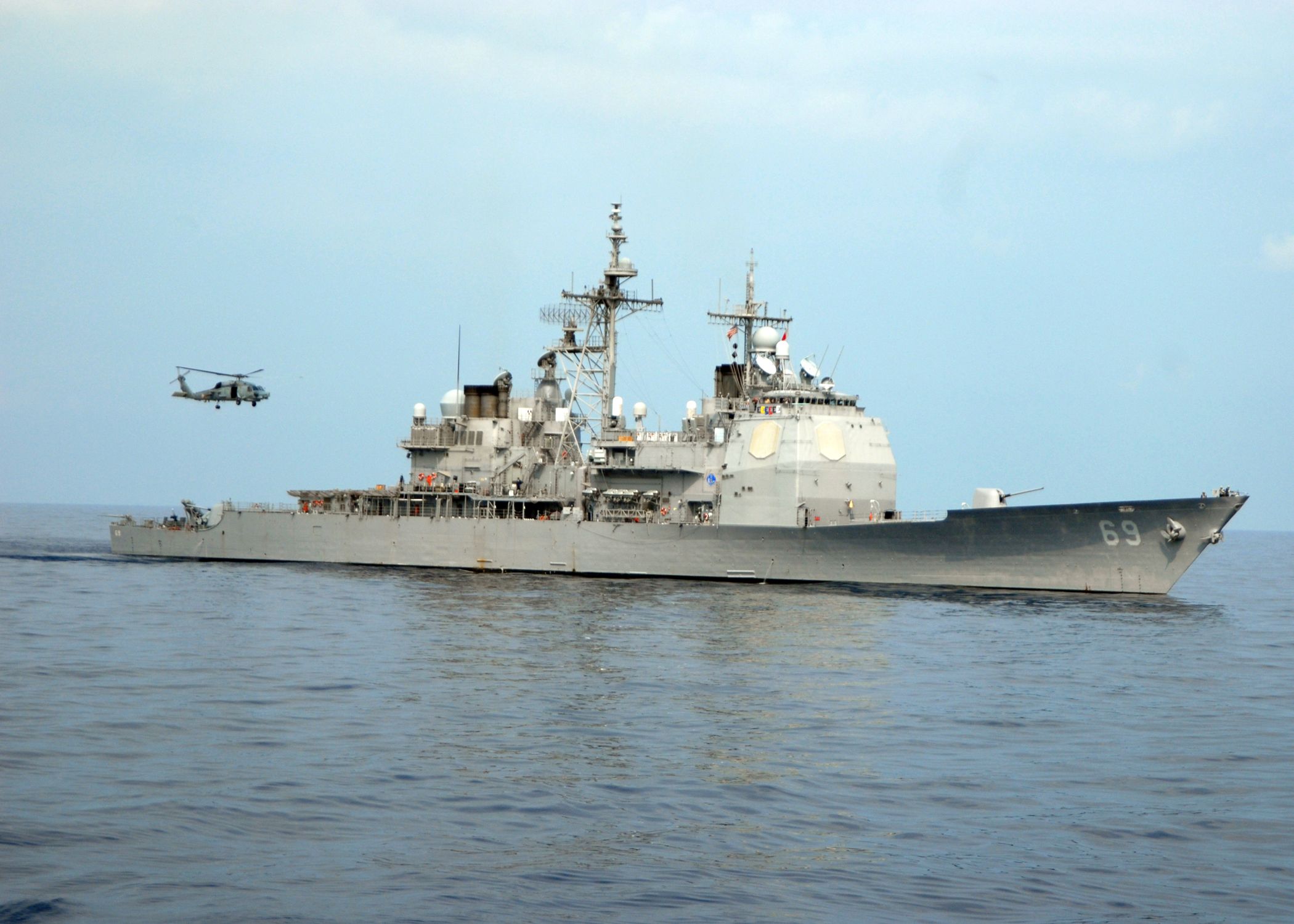
USS Vicksburg (CG-69) was a Ticonderoga-class guided-missile cruiser of the United States Navy. Built by Ingalls Shipbuilding at Pascagoula, Mississippi, the ship entered service in 1992 and operated with U.S. carrier groups, NATO forces, and other naval formations before its final deployment in 2014–2015.
Vicksburg belonged to the later, vertical-launch-system-equipped group of Ticonderoga-class cruisers. Its Aegis Combat System, large missile battery, naval guns, anti-submarine equipment, and embarked helicopters allowed it to perform fleet air defense, surface warfare, land attack, anti-submarine warfare, and command-and-control missions.
The ship entered a prolonged modernization program in 2016. Despite expenditure exceeding $750 million, structural, sonar, combat-system-integration, and other technical problems prevented its return to operational deployment. Vicksburg was decommissioned in 2024 and transferred for dismantling in 2026.
Construction and commissioning
The ship was ordered on 25 February 1988 and was originally planned under the name Port Royal before being renamed Vicksburg while under construction. Its keel was laid at Ingalls Shipbuilding on 30 May 1990. Vicksburg was launched on 7 September 1991, acquired by the Navy in September 1992, and commissioned on 14 November 1992.
The name honored the Battle and Siege of Vicksburg during the American Civil War. The cruiser followed an earlier U.S. Navy warship named Vicksburg and carried the motto Key to Victory.
Early deployments
Vicksburg made its first major deployment in 1994 with the USS Saratoga battle group. In the Mediterranean and Adriatic regions it supported operations associated with Deny Flight and Provide Promise off Montenegro and participated in the NATO exercise Dynamic Impact 94. The cruiser subsequently operated in the Florida Straits during Operation Able Vigil and took part in Operation Uphold Democracy.
During a deployment that ended in March 1996, Vicksburg supported Operation Southern Watch and conducted more than 85 maritime interdiction boardings connected with enforcement of sanctions against Iraq. The ship deployed with the USS John F. Kennedy battle group in 1997 and again in 2002.
Networked warfare testing
Vicksburg participated in the development of networked naval air defense through Cooperative Engagement Capability testing. In May 2000, Vicksburg and USS Hué City conducted live-fire trials against five targets under demanding electronic-countermeasure conditions. The testing included engage-on-remote techniques in which targeting information from one ship could support an engagement by another ship.
This work reflected the broader evolution of the Aegis architecture from individual ship defense toward distributed engagement using shared sensor and targeting information.
Operations in the 2000s
During its 2002 deployment, Vicksburg supported Operation Enduring Freedom. On 16 June 2002, an embarked SH-60B helicopter was launched off Oman to evacuate mariners from the vessel al Murthada after they had spent eight days adrift.
Vicksburg returned to the Middle East on a surge deployment in 2006 and operated in the Persian Gulf with the Dwight D. Eisenhower group in 2009. In 2010 it deployed to Northern Europe and participated in multinational exercises. The cruiser accompanied USS Enterprise during the aircraft carrier's final deployment in 2012.
Final deployment
Vicksburg began its final deployment on 4 December 2014. During the deployment it served as flagship of Standing NATO Maritime Group 2, operated in the Black Sea in March 2015, and participated in Joint Warrior 15-1 and the anti-submarine warfare exercise Dynamic Mongoose.
The ship returned to Naval Station Mayport on 11 July 2015. Although Vicksburg remained in commission for almost nine more years, it did not return to operational deployment after that date.
Modernization
Vicksburg entered the Navy's cruiser modernization process on 1 July 2016. BAE Systems received an initial modernization contract valued at up to $42.9 million in 2017. The work was intended to update the ship's weapons, engineering equipment, communications, crew spaces, propulsion systems, and combat-system infrastructure.
In January 2020, BAE Systems received a modernization-period contract with options bringing its potential cumulative value to approximately $175.1 million. Planned work included the gas-turbine propulsion system, weapons and engineering equipment, habitability spaces, communications systems, the Consolidated Afloat Network Enterprise System, and installation of a new Aegis combat system. The modernization was then expected to allow Vicksburg to return to the fleet after completion.
By May 2022, the modernization program was described as approximately 85 percent complete. That percentage did not represent equivalent operational readiness. Significant portions of the ship still required completion or repair, including elements of the combat information center and sonar system.
The sonar dome became one of the most serious unresolved problems. Installation work damaged one pressurized sonar window, while another window failed pressure testing because air escaped around large degaussing-system cables. Rework did not restore the sonar dome to an operational condition, and another dry-docking period would have been required.
By September 2023, estimates for completing the modernization ranged from approximately $100 million to $120 million, with the lower estimate excluding the additional dry-docking needed for sonar repairs. A senior fleet official considered the cruiser significantly farther from completion than the nominal 85 percent figure suggested, and combat-information-center consoles remained disconnected and unusable.
Modernization expenditure reached $745.05 million through 30 September 2023. Additional fiscal-year 2024 obligations increased the total to approximately $754.1 million. The Navy also calculated that retaining the ship would require another $64 million in fiscal year 2024 and approximately $524 million over the following five-year defense planning period.
As the modernization effort stalled, Vicksburg was used as a source of parts for other Ticonderoga-class cruisers. By September 2023, equipment was being removed to support USS Gettysburg and other ships. By April 2024, gun barrels and substantial topside equipment had also been removed.
Decommissioning and disposal
The Navy concluded that Vicksburg's age, legacy sensors, hull condition, mechanical and electrical reliability, and remaining repair requirements made further investment uneconomic relative to the combat value expected from an extended service life. The cruiser was decommissioned on 28 June 2024 after more than 31 years in commission and was struck from the Naval Vessel Register in July 2024.
In September 2024, the former Vicksburg was towed from Norfolk to the Naval Inactive Ship Maintenance Facility in Philadelphia. On 30 September 2026, it departed Philadelphia under tow for Brownsville, Texas, where it was to be dismantled. The transfer ended an unsuccessful modernization effort that had occupied the ship's final years without returning it to fleet operations.
Design
USS Vicksburg was part of the later Ticonderoga-class configuration equipped with the Mk 41 vertical launching system. The first five ships of the class used Mk 26 twin-arm missile launchers, while ships from USS Bunker Hill onward received two Mk 41 vertical launch systems. This increased the nominal missile capacity and allowed a broader range of weapons to be carried.
The Ticonderoga design was derived from the Spruance-class destroyer hull but incorporated the large Aegis combat system, extensive radar installations, additional weapons, and command facilities. The resulting cruiser displaced roughly 9,600 long tons at full load. As the class aged, successive additions of radar, computing, communications, electronic-warfare, and weapons equipment increasingly consumed available weight, electrical-power, and cooling margins.
Propulsion
Vicksburg used four General Electric LM2500 gas turbines. The machinery gave the cruiser a maximum stated speed of approximately 32.5 knots. The gas-turbine arrangement supported the high speed required for operations with carrier groups and other fast naval formations.
Aegis combat system
The ship was equipped with the Aegis Combat System and AN/SPY-1 family phased-array radar. Large fixed radar arrays on the forward and aft deckhouses provided continuous surveillance coverage and were integrated with fire-control equipment and missile weapons.
Fire control included SPG-62 radar equipment. The combat system was designed to detect, track, prioritize, and engage multiple threats and supported the cruiser's principal role in area air defense. Vicksburg's participation in Cooperative Engagement Capability trials also demonstrated the use of shared targeting data between ships.
Missile systems
Vicksburg carried two 61-cell Mk 41 vertical launching systems, providing a total of 122 launch cells. Depending on configuration and mission requirements, the system could support combinations of Standard surface-to-air missiles, Tomahawk land-attack cruise missiles, Evolved Sea Sparrow Missiles, and vertical-launch anti-submarine rockets. Later Standard Missile types associated with the class included weapons used for extended-range air defense and ballistic-missile-defense missions.
The cruiser also carried Harpoon anti-ship missiles in deck-mounted launchers, providing a dedicated surface-strike capability separate from the vertical launching system.
Guns and close-in defense
Vicksburg carried two 127 mm Mk 45 naval guns, one forward and one aft. These weapons could be used against surface targets and for naval gunfire support. Two Phalanx close-in weapon systems provided short-range defense against missiles and aircraft that penetrated the ship's outer defensive layers.
Anti-submarine warfare
The ship's anti-submarine warfare equipment included the SQQ-89 sonar suite and six 324 mm torpedo tubes arranged as two triple launchers. Vertical-launch anti-submarine rockets could also be carried in the Mk 41 system.
A stern aviation facility provided hangar space for two helicopters. Later configurations of the class could operate MH-60R Seahawk helicopters, while Vicksburg earlier operated SH-60B Seahawk aircraft. The helicopters extended the ship's surveillance, targeting, and anti-submarine reach beyond the range of its hull-mounted sensors.
Operational history
Vicksburg's operational career was concentrated between its 1992 commissioning and its return from the final deployment in July 2015. During that period the cruiser operated in the Mediterranean, Adriatic, Black Sea, Persian Gulf, Arabian Sea, northern European waters, and the western Atlantic.
The ship supported operations associated with Deny Flight, Provide Promise, Able Vigil, Uphold Democracy, Southern Watch, and Enduring Freedom. It also operated repeatedly with U.S. carrier battle groups and carrier strike groups and participated in NATO exercises and standing naval forces.
Vicksburg's service also included extensive maritime-security and interdiction work. Its Aegis system made it particularly valuable for fleet air defense and command-and-control duties, while its missile, gun, sonar, torpedo, and aviation systems gave it substantial multi-mission capability.
After July 2015, the cruiser never completed another operational deployment. Its remaining years were dominated by layup, modernization, repair work, incomplete combat-system integration, equipment removal, and eventual retirement.
Operators
- United States Navy: USS Vicksburg served from its commissioning on 14 November 1992 until decommissioning on 28 June 2024. Its final operational deployment ended in July 2015.
Specifications (USS Vicksburg CG-69)
General characteristics
- Type: Ticonderoga-class guided-missile cruiser
- Builder: Ingalls Shipbuilding, Pascagoula, Mississippi
- Launched: 7 September 1991
- Commissioned: 14 November 1992
- Decommissioned: 28 June 2024
- Displacement: approximately 9,600 long tons, about 9,800 metric tonnes, full load
- Length: 173 m
- Beam: 16.8 m
- Draft: approximately 10.2 m
- Complement: approximately 330 personnel, including about 30 officers and 300 enlisted sailors
Propulsion and performance
- Propulsion: four General Electric LM2500 gas turbines
- Maximum speed: approximately 32.5 knots
Sensors and combat systems
- Combat system: Aegis Combat System
- Primary radar: AN/SPY-1 family phased-array radar
- Fire-control radar: SPG-62
- Sonar: SQQ-89 sonar suite
- Networking: Cooperative Engagement Capability associated with later operational and test configurations
Armament
- Vertical launch system: two 61-cell Mk 41 launchers, 122 cells total
- Missile capability: combinations of Standard surface-to-air missiles, Tomahawk cruise missiles, Evolved Sea Sparrow Missiles, and vertical-launch anti-submarine rockets, depending on configuration
- Anti-ship missiles: Harpoon missiles in deck-mounted launchers
- Naval guns: two 127 mm Mk 45 guns
- Close-in defense: two Phalanx close-in weapon systems
- Torpedoes: six 324 mm torpedo tubes in two triple launchers
Aviation
- Aircraft capacity: two Seahawk helicopters
- Aviation facilities: flight deck and enclosed hangars
 Argentina
 Armenia
 Australia
 Austria
 Austria-Hungary
 Belgium
 Brazil
 United Kingdom
 Brunei
 Bulgaria
 Canada
 Chile
Chile China
China Colonial America
 Colombia
 Confederate States
 Croatia
 Czech
Czech Denmark
 Egypt
Egypt Finland
 France
 Georgia
 Germany
 German Imperial
 Greece
 Holland
 Hungary
 India
India Indonesia
 Iran
Iran Iraq
Iraq Ireland
 Israel
 Italy
Italy Japan
Japan Japan (1940)
 Jordan
 Kingdom of Italy
 Malaysia
 Mexico
 Myanmar
 Nazi Germany
 Netherlands
 New Zealand
 North Korea
 Norway
 Pakistan
 Peru
Peru Philippines
 Poland
 Portugal
 Prussia
 Romania
 Russia
 Saudi Arabia
 Serbia
 Singapore
 Slovakia
 Slovenia
 South Africa
 South Korea
 Soviet Union
 Spain
Spain Sweden
 Switzerland
 Syria
Syria Taiwan
 Thailand
 Turkey
 UAE
UAE Ukraine
 Vietnam
 Yugoslavia