
History
The K3 SCOUT is a modular uncrewed surface vessel developed by the United Kingdom's Kraken Technology Group, based in Fareham. The platform was designed as a low-signature, high-speed USV capable of rapid reconfiguration across a range of maritime mission profiles. Serial production commenced in April 2026 at Blohm+Voss in Hamburg, operated under the Rheinmetall Kraken joint venture between Kraken Technology Group and Germany's Rheinmetall Naval Systems. Approximately twenty vessels were introduced with Royal Marines elements in March 2026 as part of the Royal Navy's Project Beehive, and the platform was publicly presented at Eurosatory in June 2026.
In July 2026, Kraken Technology Group and Capewell, supported by the Royal Navy through Project Beehive, demonstrated the first extracted-load airdrop of a USV from an A400M military transport aircraft, conducting multiple drops from 1,300 ft into waters up to Sea State 4. On 5 October 2026, Kraken and Saab UK unveiled a maritime counter-drone configuration pairing the K3 SCOUT with Saab's Giraffe 1X three-dimensional radar to create an autonomous early-warning node for maritime drone detection. Saab stated the combined capability was developed in fewer than seven months.
Design
Hull and structure
The K3 SCOUT employs a composite hull with a reduced-signature design. The vessel measures 8.4 m in length with a 1.93 m beam and a 0.8 m draft, and has a maximum displacement of 2,500 kg. The modular payload bay provides 600 kg of usable volume for mission-specific sensors, effectors, or logistics equipment. Standardised components and modular mounting systems allow payload reconfiguration in minutes rather than days, even when the vessel is forward-deployed.
Powerplant and propulsion
Propulsion is provided by an inboard diesel engine driving a stern drive. The K3 SCOUT reaches a maximum speed of 55 knots with a range of 650 nautical miles at 25 knots. Mission endurance extends to 30 days, depending on the operational profile and payload configuration.
Autonomy and avionics
The vessel runs on the Auterion operating system with open interfaces for autonomy integration. Operating modes range from supervised autonomy to remote piloting, with a human-on-the-loop oversight model. Autonomous navigation handles route holding, collision avoidance, and mission execution. The open architecture permits integration of third-party sensors and systems without structural redesign. Optional equipment includes electro-optical sensors, radar, sonar, a user-defined C5ISR fit, and a pilot module for manned operation. Automated launch and recovery systems support deployment from both shore-based and sea-based assets, and the platform is transportable by air, land, and sea with minimal preparation.
Operational history
Under Project Beehive, the Royal Navy acquired approximately twenty K3 SCOUT vessels, introducing them with the Coastal Forces Squadron and 47 Commando Royal Marines in March 2026. The platform is positioned to support distributed maritime operations, extending surveillance, force protection, and electronic-warfare coverage beyond the reach of crewed warships. The K3 SCOUT has participated in NATO Baltic Task Force X experimentation, where autonomous maritime systems were evaluated within networked multinational operational environments.
In August 2026, a routine cyber vulnerability assessment identified that third-party camera components aboard K3 SCOUT vessels were transmitting automated heartbeat communications to an external IP address. A joint investigation by the Ministry of Defence and Kraken Technology Group found no evidence that operational data or classified information had been transmitted externally. Internet connectivity was removed from the affected camera systems and identified vulnerabilities were closed.
On 5 October 2026, Kraken Technology Group and Saab UK demonstrated a K3 SCOUT configured as a forward radar picket, integrating the Giraffe 1X radar in the vessel's modular payload bay. The configuration enables detection and tracking of low, slow, and small airborne targets from a mobile, uncrewed platform. The system is intended as a sensor and early-warning node rather than an armed counter-UAS platform; it does not carry an onboard effector. Kraken and Saab conducted sea trials in UK waters to assess radar performance under maritime conditions. Multiple vessels operating as a distributed network are intended to extend the surveillance perimeter around naval formations and strategic maritime sites.
Operators
- United Kingdom – Royal Navy and Royal Marines; approximately 20 vessels under Project Beehive, in service from March 2026.
Specifications (K3 SCOUT)
General characteristics
- Length overall: 8.4 m
- Beam overall: 1.93 m
- Draft: 0.8 m
- Max displacement: 2,500 kg
- Payload: 600 kg
- Structure: Composite
- Crew: Autonomous (uncrewed)
- Operating depth: Surface
Performance
- Maximum speed: 55 kt
- Range: 650 NM at 25 kt
- Endurance: 30 days (mission-dependent)
Powerplant
- Engine: Inboard diesel
- Propulsion: Stern drive
Related equipment
- Kraken K5 KRAKEN – Larger uncrewed surface vessel in the Kraken Technology platform family.
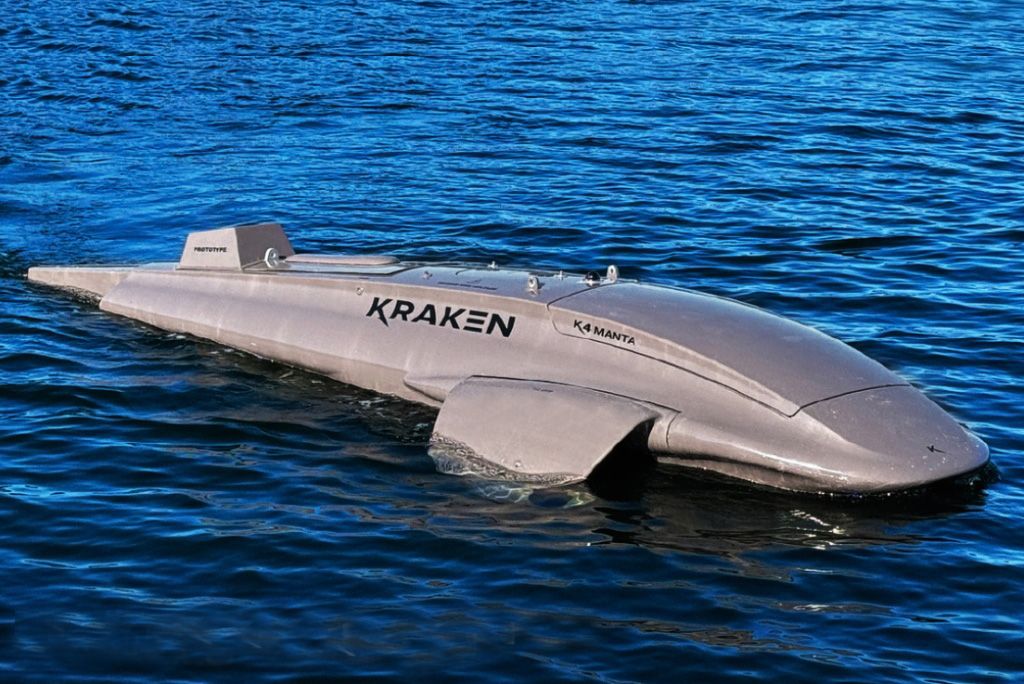
- Kraken K4 MANTA – Uncrewed surface vessel in the Kraken Technology platform family.
- Saab Giraffe 1X – Three-dimensional counter-drone radar integrated into the K3 SCOUT payload bay for maritime air-surveillance missions.
 Argentina
 Armenia
 Australia
 Austria
 Austria-Hungary
 Belgium
 Brazil
 United States
 Brunei
 Bulgaria
 Canada
 Chile
 China
 Colonial America
 Colombia
 Confederate States
 Croatia
 Czech
 Denmark
 Egypt
 Finland
 France
 Georgia
 Germany
 German Imperial
 Greece
 Holland
 Hungary
 India
 Indonesia
 Iran
 Iraq
 Ireland
 Israel
 Italy
 Japan
 Japan (1940)
 Jordan
 Kingdom of Italy
 Malaysia
 Mexico
 Myanmar
 Nazi Germany
 Netherlands
 New Zealand
 North Korea
 Norway
 Pakistan
 Peru
 Philippines
 Poland
 Portugal
 Prussia
 Romania

 Russia
 Saudi Arabia
 Serbia
 Singapore
 Slovakia
 Slovenia
 South Africa
 South Korea
 Soviet Union
 Spain
 Sweden
 Switzerland
 Syria
 Taiwan
 Thailand
 Turkey
 UAE
 Ukraine
 Vietnam
 Yugoslavia