
History
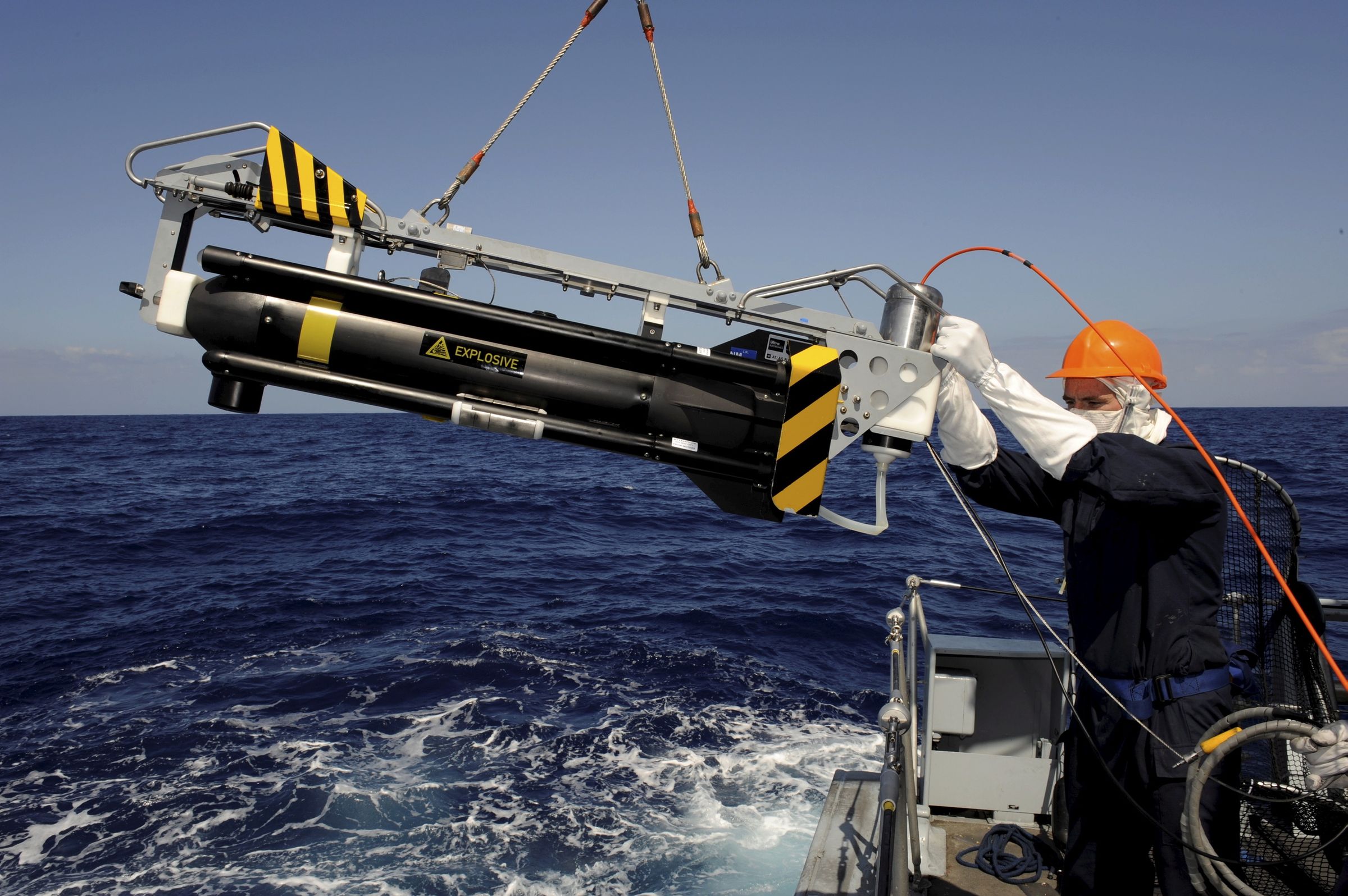
The SeaFox is a family of remotely operated underwater vehicles manufactured by the German company Atlas Elektronik for the detection, identification, and neutralization of naval mines. Developed on the expendable mine disposal vehicle principle, the system offers rapid deployment with minimal preparation and is compatible with a wide range of naval platforms, including dedicated mine countermeasures vessels, surface combatants, small boats, and helicopters.
In 2001, the Royal Navy leased SeaFox vehicles for use aboard HMS Bangor and HMS Blyth during mine-clearing operations off Iraq as part of Operation Telic; the Bangor also deployed them off Libya in 2011. In January 2006, the UK Ministry of Defence awarded a contract to Ultra Electronics and ATLAS to procure SeaFox units for the Royal Navy's Hunt-class and Sandown-class mine countermeasures vessels. In December 2011, the Royal Thai Navy ordered three SeaFox units from Atlas Elektronik. In February 2012, the US Navy contracted Lockheed Martin to adapt the SeaFox system for the MH-53E Dragon mine-hunting helicopter and the Avenger-class MCM vessel; in October 2012 the Naval Surface Weapons Center ordered additional vehicles, which were deployed in the Persian Gulf that year. In October 2015, the NSWC commissioned Atlas North America to procure further SeaFox vehicles.
In October 2026, Ukrainian Navy sailors practiced mine detection and destruction using SeaFox drones during training in the United Kingdom under Operation Interflex Maritime, with British mine-warfare specialists evaluating crews from Ukrainian mine countermeasures vessels. Exercises aboard the Sandown-class minehunter Cherkasy included deployment of the SeaFox I to locate a training mine on the seabed, rehearsal of the destruction procedure using a training variant without explosives, and a final detonation by the expendable SeaFox C guided remotely to the target. The training prepared Ukrainian crews for the expected long-term mine-clearing effort in the Black Sea following the conclusion of active hostilities.
Specifications
Length is 1.31 m and diameter 0.39 m per manufacturer data; one reference lists the length as 1.2 m. Weight is 43 kg per manufacturer specifications, while other sources give approximately 40 kg. Maximum operating depth is 300 m. The manufacturer states a speed better than 5 knots, while other technical references list a maximum of 6 knots. The fiber-optic control cable is approximately 3,000 m in length. Maximum endurance is 100 minutes depending on mission conditions; operational range is quoted as 1,200 m depending on acoustic and current conditions, while one reference lists 1 km.
Propulsion comprises four independent reversible motors and a vertical hover thruster, all battery-powered. The SeaFox C and COBRA variants use non-rechargeable LiSO2 batteries; the SeaFox I and T variants use rechargeable NiMH batteries. Navigation employs transponder/responder-aided dead reckoning with a pressure sensor. The vehicle carries a target-seeking sonar and a video camera with a high-intensity searchlight, providing a live feed to the operator. The complete system includes a console, a launcher, and the vehicles, and is deployed using a crane or launch mechanism fitted to the host platform.
Variants
SeaFox C — Expendable mine disposal vehicle. Uses onboard homing sonar to relocate a previously identified mine, then destroys it with a built-in large-caliber shaped charge. Warhead mass is given as 1.4 kg in one reference and approximately 1.5 kg in another. The vehicle is destroyed along with the target upon detonation.
SeaFox I — Reusable mine identification and inspection vehicle. Fitted with a ballast weight in place of a warhead. Used to inspect and classify suspected mines and to train field personnel.
SeaFox T — Training variant of the SeaFox C, used to train onboard naval crews in operating the combat vehicle without risk of loss.
SeaFox COBRA — Equipped with the COBRA explosive ordnance disposal tool. Provides remote RF-coded initiation with a range of up to 1.5 km for commercial use and up to 22 km for military use. Target attachment is achieved via nail units, a harpoon for soft-skinned targets, or magnetic grabs.
Operators
SeaFox systems are in service with the navies of the United States, United Kingdom, Estonia, Finland, Germany, the Netherlands, Sweden, Belgium, Ukraine, Romania, and Thailand.
 Argentina
 Armenia
 Australia
 Austria
 Austria-Hungary
 Belgium
 Brazil
 United Kingdom
 United States
 Brunei
 Bulgaria
 Canada
 Chile
 China
 Colonial America
 Colombia
 Confederate States
 Croatia
 Czech
 Denmark
 Egypt
 Finland
 France
 Georgia
 German Imperial
 Greece
 Holland
 Hungary
 India
 Indonesia
 Iran
 Iraq
 Ireland
 Israel
 Italy
 Japan
 Japan (1940)
 Jordan
 Kingdom of Italy
 Malaysia
 Mexico
 Myanmar
 Nazi Germany
 Netherlands
 New Zealand
 North Korea
 Norway
 Pakistan
 Peru
 Philippines
 Poland
 Portugal
 Prussia
 Romania

 Russia
 Saudi Arabia
 Serbia
 Singapore
 Slovakia
 Slovenia
 South Africa
 South Korea
 Soviet Union
 Spain
 Sweden
 Switzerland
 Syria
 Taiwan
 Thailand
 Turkey
 UAE
 Ukraine
 Vietnam
 Yugoslavia