
History
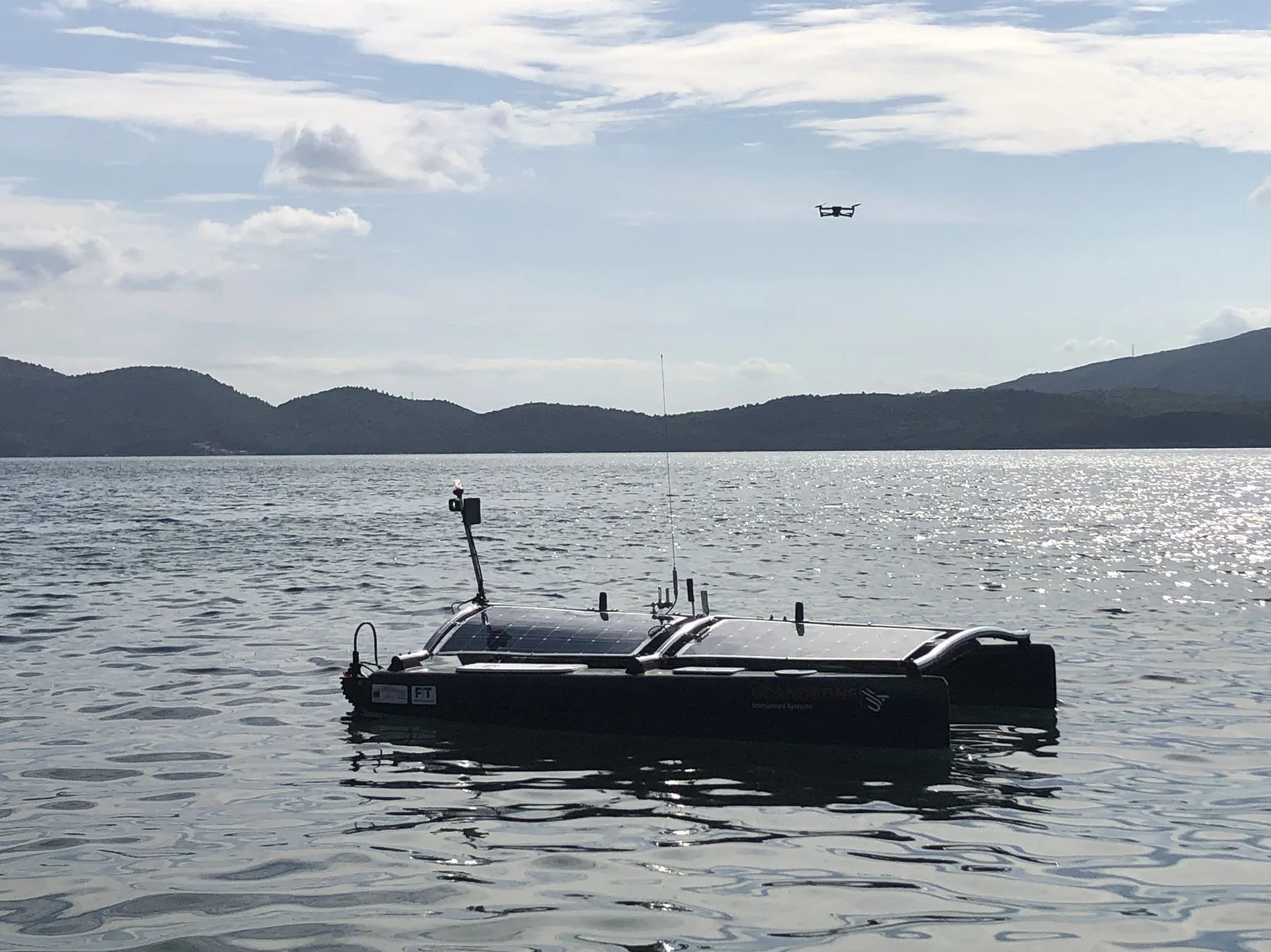
UCANDRONE ARGO is a Greek unmanned surface vessel developed for autonomous mine countermeasures. The platform combines seabed search and mine detection with the ability to deploy expendable unmanned underwater vehicles for mine neutralization.
ARGO uses a compact twin-hull configuration, electric propulsion, onboard sensing, artificial-intelligence software, and networked command-and-control functions. It can operate autonomously, under remote control, as a single vessel, or as part of a coordinated group of unmanned vessels.
The system is intended to reduce the exposure of personnel and crewed vessels during mine-clearance missions. It can also support coastal reconnaissance, force protection, and monitoring of critical maritime infrastructure.
Development and trials
ARGO was engineered by UCANDRONE, a Greek unmanned-systems manufacturer within EFA GROUP. The vessel was first showcased in operational conditions during the NEMO Trials in 2024.
In 2026, ARGO participated in the Hellenic Navy's UVEX 1/26 exercise. During the exercise, the vessel used its onboard sensor suite to detect and classify mock sea mines and then autonomously deployed a mini-Kamikaze UUV for target neutralization. The event demonstrated the integrated sequence from mine search and classification to deployment of the underwater neutralization vehicle.
Design
Hull and propulsion
ARGO has a lightweight composite twin-hull structure. It measures 3 m in length, 1.7 m in beam, and 0.35 m in draft. The vessel weighs 82 kg and can carry a payload of up to 105 kg.
The platform uses electric propulsion supported by solar panels. Its compact dimensions and reduced visual, acoustic, and thermal signatures are intended for operations in shallow coastal waters, ports, naval bases, rivers, confined waterways, and areas around critical maritime infrastructure.
Autonomy and command system
ARGO can conduct autonomous missions or operate by long-range remote control. Its communications and command functions are integrated with the SCYTALYS MIMS Tactical Situation Awareness and command-and-control system. The vessel can operate independently or as part of a coordinated multi-vessel swarm deployed from a mothership.
The design allows ARGO to be deployed from naval, auxiliary, or commercial vessels. Its distributed operating concept is intended to permit multiple unmanned vessels to search larger maritime areas while limiting the number of personnel directly exposed to mine hazards.
Sensors
The mine-detection configuration includes a multibeam hydrographic sonar, LiDAR, a sound velocity sensor, surface and subsurface optical surveillance equipment, and a Forward Obstacle Avoidance Sonar. These sensors are integrated with onboard artificial-intelligence software for detection, recognition, classification, and identification of underwater objects.
Mine-neutralization payload
ARGO can carry and deploy up to eight UCANDRONE mini-Kamikaze UUVs for mine neutralization. Each UUV is 0.6 m long and 0.3 m wide, weighs 5.8 kg, and carries a 3 kg munition payload.
The UUV can dive to 31 m, reach 10 knots, and operate for up to seven hours using lithium-ion batteries. Guidance can be provided through a fiber-optic connection or through a data link supported by a surface buoy with an antenna. An onboard camera provides real-time underwater imagery for man-in-the-loop control. The UUV is designed to navigate toward a designated target, loiter in the target area, and detonate on impact.
Program status
ARGO had reached trial and exercise use by 2026. Its 2024 NEMO Trials appearance established an earlier demonstrated physical configuration, while the 2026 UVEX 1/26 exercise demonstrated the integration of mine detection, target classification, and deployment of an expendable UUV against mock mines. The supplied information does not establish regular operational service or production quantities.
Specifications (ARGO USV)
General characteristics
- Type: unmanned surface vessel for mine countermeasures
- Hull form: twin-hull composite design
- Length: 3 m
- Beam: 1.7 m
- Draft: 0.35 m
- Weight: 82 kg
- Payload capacity: up to 105 kg
- Propulsion: electric propulsion supported by solar panels
Mission systems
- Mine-detection sensors: multibeam hydrographic sonar, LiDAR, sound velocity sensor, surface and subsurface optical surveillance system, and Forward Obstacle Avoidance Sonar
- Autonomy: onboard AI-supported autonomous operation
- Remote control: long-range remote operation through the SCYTALYS MIMS Tactical Situation Awareness and command-and-control system
- Cooperative operation: standalone missions or coordinated multi-vessel swarm operation
Mine-neutralization payload
- Carried UUVs: up to eight mini-Kamikaze unmanned underwater vehicles
- UUV role: expendable mine neutralization
 Argentina
 Armenia
 Australia
 Austria
 Austria-Hungary
 Belgium
 Brazil
 United Kingdom
 United States
 Brunei
 Bulgaria
 Canada
 Chile
Chile China
China Colonial America
 Colombia
 Confederate States
 Croatia
 Czech
Czech Denmark
 Egypt
Egypt Finland
 France
 Georgia
 Germany
 German Imperial
 Holland
 Hungary
 India
India Indonesia
 Iran
Iran Iraq
Iraq Ireland
 Israel
 Italy
Italy Japan
Japan Japan (1940)
 Jordan
 Kingdom of Italy
 Malaysia
 Mexico
 Myanmar
 Nazi Germany
 Netherlands
 New Zealand
 North Korea
 Norway
 Pakistan
 Peru
Peru Philippines
 Poland
 Portugal
 Prussia
 Romania
 Russia
 Saudi Arabia
 Serbia
 Singapore
 Slovakia
 Slovenia
 South Africa
 South Korea
 Soviet Union
 Spain
Spain Sweden
 Switzerland
 Syria
Syria Taiwan
 Thailand
 Turkey
 UAE
UAE Ukraine
 Vietnam
 Yugoslavia