
History
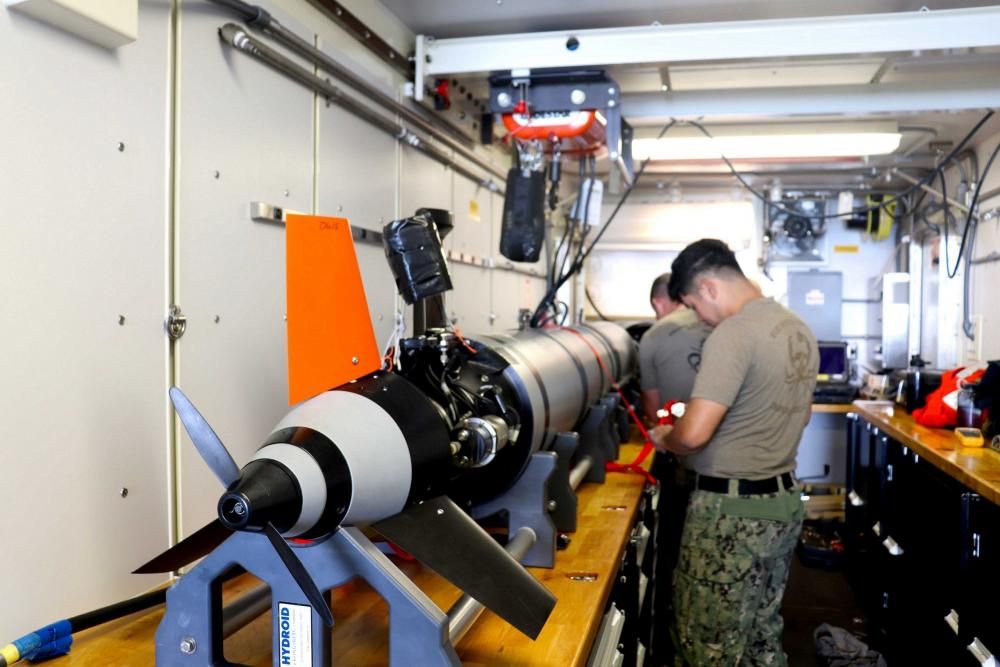
The Hydroid MK 18 Mod 2 Kingfish is a U.S. Navy autonomous unmanned underwater vehicle developed for expeditionary mine countermeasures. Based on the REMUS 600 architecture, it is designed to search, classify, and map naval mines while allowing personnel and supporting vessels to remain outside individual mine-search tracks.
The U.S. Navy began production of the MK 18 Mod 2 in 2012 and deployed the first Kingfish vehicles to the Middle East in July of that year. More than 90 vehicles were delivered before production ended on February 3, 2023, while sensor and payload modernization continued under separate upgrade work.
In September 2026, Iran claimed that it had recovered a U.S. MK 18 Mod 2 Kingfish in the Strait of Hormuz. U.S. Central Command rejected the assertion and stated that U.S. operational drone assets remained under positive control, leaving the claimed capture disputed.
Development and deployment
A specific U.S. Fifth Fleet mine-countermeasure requirement was raised in December 2011. The resulting Kingfish capability was based on the larger REMUS 600 platform and provided greater area coverage, endurance, and payload capacity than the earlier MK 18 Mod 1 Swordfish.
Before deployment, the system underwent a 15-day mock operation off Panama City Beach. More than 30 sorties were conducted from waters over 20 nautical miles offshore, with three or four vehicles operating for approximately eight hours per day. The test area reproduced environmental conditions relevant to sonar performance in the Persian Gulf, including temperature, salinity, depth, and water clarity.
The first wave of MK 18 Mod 2 vehicles reached the Middle East in July 2012 for search, classify, and map missions. Additional vehicles arrived in the U.S. Fifth Fleet area in February 2013, followed by another deployment in October 2013. Early operations used contractor crews under U.S. Navy explosive-ordnance-disposal and mine-countermeasure command arrangements before the system transitioned toward military operation.
Program-of-record production was conducted through Hydroid beginning in 2012. Huntington Ingalls Industries later acquired Hydroid. More than 90 MK 18 Mod 2 vehicles were delivered to the U.S. Navy before production concluded in February 2023.
A support contract awarded in 2019 had an initial value of $15.8 million and could reach $84 million with options. In April 2021, Hydroid received a further $74.7 million contract for Increment II payload upgrades scheduled through April 2026. This modernization concentrated on improved mine detection and localization in mud, sand, and turbid water, including the detection of buried targets.
In July 2022, the U.S. Navy selected Leidos to develop Viperfish as the next-generation Medium Unmanned Undersea Vehicle for expeditionary mine-countermeasure missions. Viperfish is intended to provide increased capabilities over the MK 18 Mod 2.
Strait of Hormuz claim
On September 27, 2026, Iran announced that it had captured an MK 18 Mod 2 Kingfish in the Strait of Hormuz. Iranian authorities initially identified the vehicle as a REMUS 600 before describing it as the U.S. Navy Kingfish derivative. Iran stated that specialists were examining the vehicle and attempting to extract stored data.
The claim was disputed by U.S. Central Command, which maintained that U.S. operational drone assets remained under positive control. Iran also claimed that electronic warfare had been used to obtain the vehicle, but the available evidence does not establish how or whether a Kingfish was recovered. A functioning Kingfish normally performs submerged missions primarily through autonomous navigation and acoustic communications, while GPS, satellite, and radio links are used after surfacing.
Design
Vehicle
The MK 18 Mod 2 Kingfish is a battery-electric autonomous underwater vehicle derived from the REMUS 600. It is approximately 3.5 m long, has a diameter of 0.324 m, and has a reported mass of approximately 240 to 272 kg. Its 600 m depth rating reflects the REMUS 600-class pressure hull and operating envelope.
The vehicle is too heavy for routine manual handling and normally requires dedicated launch-and-recovery equipment. It can be deployed from an approximately 11 m rigid-hull inflatable boat configured for Kingfish operations. A single boat can carry two MK 18 Mod 2 vehicles, allowing separate search sectors, sequential sorties, or continued operations while one vehicle is being serviced. Kingfish can also be handled by crane from larger ships and has operated with vessels including Independence-class littoral combat ships.
Mine-countermeasure mission
Kingfish is designed to search, classify, and map mine threats before crewed forces enter suspected minefields. Its mission set includes the detection of floating, moored, bottom, and buried mines. Operators program waypoints and survey tracks before launch, after which the vehicle follows the mission autonomously and returns for recovery and data processing.
The principal sensor is a side-looking sonar system that surveys strips of seabed on both sides of the vehicle's programmed track. The Small Synthetic Aperture Sonar Module configuration provides a wider sonar swath, higher-resolution imagery, and improved detection of targets buried in sand or mud.
Additional equipment includes a downward-looking camera, conductivity-temperature-depth sensor, Acoustic Doppler Current Profiler, beam attenuation meter, fluorometer, turbidity sensor, and pencil-beam obstacle-avoidance sonar. The exact sensor fit can vary with mission configuration and modernization state.
Navigation and communications
Navigation combines inertial equipment, a compass, Doppler velocity measurements, acoustic navigation data, and P-code GPS. GPS is principally available when the vehicle is at the surface. Underwater communications use an acoustic modem, while surfaced communications can use Iridium satellite connectivity and radio.
High-resolution sonar data is stored aboard the vehicle because an underwater acoustic link cannot efficiently transmit the full volume of imagery generated during a survey. After recovery, stored sonar, navigation, and environmental information can be transferred for mine-warfare analysis and mission planning.
Power and performance
The Kingfish uses rechargeable battery-electric propulsion. Mission endurance and range depend on the installed battery sections, payload, sensor activity, speed, and mission profile, so the system does not have one fixed range or endurance figure applicable to every configuration. Survey operations normally emphasize relatively low speed to maximize sonar coverage and endurance, with typical mission speeds in the approximately 3 to 5 kt range.
Program status
Production of the MK 18 Mod 2 ended on February 3, 2023, after more than 90 vehicles had been delivered to the U.S. Navy. The system remained part of the Navy's Expeditionary Mine Countermeasures capability while Increment II sensor modernization work continued through a program scheduled into 2026.
The MK 18 family has supported U.S. Fifth Fleet mine-countermeasure operations since July 2012. The selection of the Viperfish Medium Unmanned Undersea Vehicle in 2022 established the planned successor path for the expeditionary mine-countermeasure mission.
Variants
- MK 18 Mod 2 Kingfish: U.S. Navy mine-countermeasure unmanned underwater vehicle based on the REMUS 600 and configured for search, classification, and mapping missions.
- Small Synthetic Aperture Sonar Module configuration: Kingfish sensor configuration providing increased sonar swath width, higher-resolution imagery, and buried-target detection.
- Increment II: Payload modernization intended to improve mine detection and localization in mud, sand, and turbid water, including buried targets.
Operators
- United States Navy: More than 90 MK 18 Mod 2 vehicles were delivered between the start of production in 2012 and its completion in February 2023. The system forms part of the Navy's expeditionary mine-countermeasure capability.
Specifications (MK 18 Mod 2 Kingfish)
General characteristics
- Type: Autonomous unmanned underwater vehicle for expeditionary mine countermeasures
- Length: Approximately 3.5 m
- Diameter: 0.324 m
- Mass: Approximately 240 to 272 kg
- Operating depth: Up to 600 m
- Power: Rechargeable battery-electric system
- Typical deployment: Dedicated launch-and-recovery equipment, including operation from approximately 11 m rigid-hull inflatable boats
Performance
- Typical survey speed: Approximately 3 to 5 kt
- Range and endurance: Configuration-dependent, varying with battery capacity, payload, sensor use, speed, and mission profile
Sensors and mission equipment
- Primary mine-search sensor: Side-looking sonar with synthetic-aperture sonar capability
- SSAM capability: Wider sonar swath, higher-resolution imagery, and buried-target detection
- Additional sensors: Downward-looking camera, conductivity-temperature-depth sensor, Acoustic Doppler Current Profiler, beam attenuation meter, fluorometer, turbidity sensor, and obstacle-avoidance sonar
- Navigation: Inertial navigation equipment, compass, Doppler velocity measurements, acoustic navigation inputs, and P-code GPS
- Communications: Acoustic modem underwater; Iridium satellite communications and radio when surfaced
Related equipment
- REMUS 600: Commercial autonomous underwater vehicle architecture on which the MK 18 Mod 2 Kingfish is based.
- MK 18 Mod 1 Swordfish: Earlier U.S. Navy mine-countermeasure UUV based on the smaller REMUS 100 platform.
- Viperfish: Next-generation Medium Unmanned Undersea Vehicle selected by the U.S. Navy in 2022 to provide increased expeditionary mine-countermeasure capability.
 Argentina
 Armenia
 Australia
 Austria
 Austria-Hungary
 Belgium
 Brazil
 United Kingdom
 Brunei
 Bulgaria
 Canada
 Chile
Chile China
China Colonial America
 Colombia
 Confederate States
 Croatia
 Czech
Czech Denmark
 Egypt
Egypt Finland
 France
 Georgia
 Germany
 German Imperial
 Greece
 Holland
 Hungary
 India
India Indonesia
 Iran
Iran Iraq
Iraq Ireland
 Israel
 Italy
Italy Japan
Japan Japan (1940)
 Jordan
 Kingdom of Italy
 Malaysia
 Mexico
 Myanmar
 Nazi Germany
 Netherlands
 New Zealand
 North Korea
 Norway
 Pakistan
 Peru
Peru Philippines
 Poland
 Portugal
 Prussia
 Romania
 Russia
 Saudi Arabia
 Serbia
 Singapore
 Slovakia
 Slovenia
 South Africa
 South Korea
 Soviet Union
 Spain
Spain Sweden
 Switzerland
 Syria
Syria Taiwan
 Thailand
 Turkey
 UAE
UAE Ukraine
 Vietnam
 Yugoslavia