
History
The REMUS 600 is a medium autonomous underwater vehicle developed in the United States for extended underwater survey, mine-countermeasures, search, mapping, and oceanographic missions. It was conceived as a larger and longer-endurance member of the REMUS family, combining greater operating depth and payload capacity with software and electronic systems derived from the smaller REMUS 100.
The first REMUS 600 was developed at the Woods Hole Oceanographic Institution in 2003 with funding from the U.S. Office of Naval Research. The design was subsequently manufactured commercially by Hydroid, which later became part of Huntington Ingalls Industries.
The vehicle is rated for operations to 600 m and can be configured with different sensor payloads. REMUS 600 derivatives have been particularly important in naval mine countermeasures, where autonomous vehicles can search and map potentially hazardous areas without placing a crewed platform directly over suspected mines.
Development
The REMUS 600 was created to meet a requirement for greater endurance, payload capacity, and operating depth than the REMUS 100 could provide. The design retained proven software and electronic subsystems from the smaller vehicle while adopting a larger modular body capable of carrying additional batteries and mission equipment.
The modular architecture allows sections of the vehicle to be changed or reconfigured for different missions. Sensor arrangements have included side-scan sonar, synthetic aperture sonar, cameras, magnetometers, and environmental instruments. The exact length, weight, endurance, and range can therefore vary with the battery and payload configuration.
Military development led to specialized mine-countermeasures configurations. The U.S. Navy's Mk 18 Mod 2 Kingfish is based on the REMUS 600 platform and uses underwater sensors to search for and classify mine-like objects. More than 90 Mk 18 Mod 2 vehicles had been delivered to U.S. Navy Expeditionary Mine Countermeasures units by the time production of that configuration was completed in 2023.
Huntington Ingalls Industries later introduced the REMUS 600M, a mine-countermeasures configuration retaining the 600 m depth rating. A newer REMUS 620 design was subsequently introduced in a similar size class with updated systems and greater stated endurance.
Design
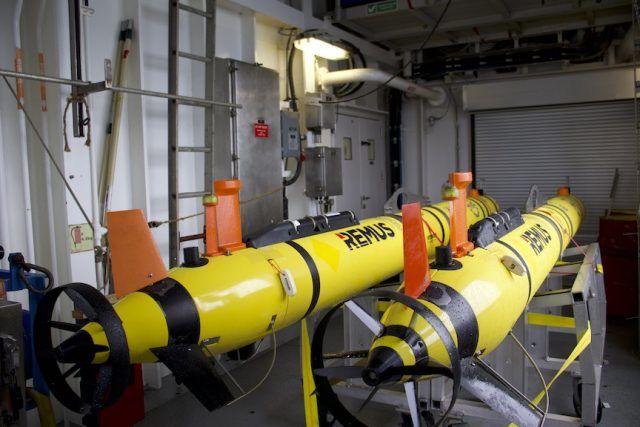
REMUS 600 has a cylindrical, torpedo-like body with control surfaces and a rear propeller. Its modular construction permits battery and payload sections to be exchanged according to mission requirements. This arrangement allows the same basic vehicle to support hydrographic survey, seabed mapping, mine reconnaissance, target search, environmental data collection, and other underwater tasks.
Navigation and control
The vehicle is designed to execute preprogrammed missions autonomously. Underwater navigation can combine an inertial navigation system, Doppler velocity measurements, and acoustic navigation. GPS positioning is available when the vehicle is at the surface.
Acoustic communications can provide limited underwater communication with operators, including mission-control functions such as redirection or abort commands. Surface communications can provide additional connectivity when the vehicle is no longer submerged. Mission data generated by high-volume sensors such as sonar can be stored aboard the vehicle for recovery after the mission.
Sensors
REMUS 600 can accept different sensor modules. Side-scan sonar can be used for broad-area searches and identification of mine-like objects. Synthetic aperture sonar configurations provide higher-resolution imagery over comparatively wide swaths and can support target classification and reacquisition.
Specialized configurations have also incorporated magnetometers, electronic still cameras, dual-frequency side-scan sonar, and environmental sensors. The modular arrangement means that the equipment installed on one REMUS 600 cannot be assumed to be present on another vehicle.
For synthetic aperture sonar work, REMUS 600 has been configured with independently controlled fins for pitch, yaw, and roll control. Additional forward fins can provide greater control of vehicle attitude and track alignment during detailed sonar surveys.
Power and endurance
Battery capacity can be varied by configuration. A long-endurance REMUS 600 configuration has been described with two 5.4 kWh lithium-ion battery trays. Endurance, range, and speed depend on battery installation, sensor load, mission profile, and vehicle configuration.
The original REMUS 600 configuration has demonstrated mission endurance approaching 70 hours, a maximum speed of up to 5 knots, and a range of up to 286 nautical miles. The later REMUS 600M mine-countermeasures configuration has been specified differently, including endurance of up to 24 hours at 3 knots and a range of up to 72 nautical miles at that speed. These figures represent different configurations and should not be treated as directly interchangeable.
Operational history
A mine-detection derivative of the REMUS 600 was deployed by the U.S. Navy to the Fifth Fleet area in 2012 for mine-countermeasures operations in the Persian Gulf. The Mk 18 family subsequently became part of the Navy's expeditionary mine-countermeasures capability.
REMUS vehicles can be launched and recovered from relatively small craft, while exercises and development work have also demonstrated deployment from larger naval vessels and helicopters. A submarine-related configuration known as Yellow Moray was operated from a Virginia-class submarine torpedo tube during U.S. Navy testing in 2025, demonstrating another potential method of deploying a REMUS-family medium UUV.
On September 27, 2026, Iran's Islamic Revolutionary Guard Corps Navy stated that it had captured a REMUS 600 in the Strait of Hormuz. Iranian authorities claimed that the vehicle had been conducting a reconnaissance mission and that intelligence and electronic-warfare measures were involved in its seizure. The vehicle was subsequently shown in Iranian imagery and was said to have been transferred to specialists for examination.
The United States had not publicly confirmed the ownership or loss of that specific REMUS 600 in the information available following the announcement. The exact vehicle configuration, installed payload, mission, and circumstances of its recovery therefore remained unconfirmed. Public information also did not establish whether electronic interference caused the loss, whether the vehicle malfunctioned, or whether it was recovered after surfacing or drifting.
The September incident followed an Iranian claim earlier in the same month involving an Anduril Dive-LD autonomous underwater vehicle near the entrance to the Strait of Hormuz. The United States acknowledged the earlier loss but stated that the Dive-LD had malfunctioned before recovery. That earlier case does not establish the cause of the reported REMUS 600 loss.
A captured REMUS 600 could potentially contain stored mission routes, navigation settings, sonar imagery, and other mission data, depending on its configuration and the condition of its onboard storage. However, possession of a REMUS 600 alone does not establish access to classified systems or reveal the precise equipment carried by a particular vehicle.
Variants
- REMUS 600: Original modular autonomous underwater vehicle developed for extended-endurance operations to depths of 600 m.
- Mk 18 Mod 2 Kingfish: U.S. Navy mine-countermeasures derivative of the REMUS 600 used for detection and classification of mine-like objects.
- REMUS 600M: Later mine-countermeasures configuration with a 600 m depth rating and published performance figures based on its standard sensor configuration.
Operators
- United States Navy: Operates the REMUS 600-derived Mk 18 Mod 2 Kingfish for expeditionary mine-countermeasures missions.
- Woods Hole Oceanographic Institution: Developed the original REMUS 600 and has operated vehicles for underwater research and technology development.
- Japan Maritime Self-Defense Force: Uses REMUS 600 vehicles under the OZZ-2/4 designation in mine-countermeasures applications.
Specifications (REMUS 600)
General characteristics
- Diameter: 32.4 cm (12.75 in)
- Weight: approximately 240 kg (530 lb) for the original configuration
- Maximum operating depth: 600 m (1,969 ft)
- Configuration: modular battery and sensor sections
Performance
- Maximum speed: up to 5 knots
- Mission endurance: nearly 70 hours in a long-endurance configuration
- Maximum stated range: up to 286 nautical miles in a long-endurance configuration
Mission equipment
- Navigation: inertial navigation, Doppler velocity measurement, acoustic navigation, and surface GPS positioning
- Sensor options: side-scan sonar, synthetic aperture sonar, cameras, magnetometers, and environmental sensors depending on configuration
- Communications: acoustic underwater communications with additional communication options available at the surface
Related equipment
- REMUS 100: Smaller REMUS-family autonomous underwater vehicle whose software and electronic subsystems formed part of the technical basis for REMUS 600.
- REMUS 620: Newer medium unmanned underwater vehicle introduced by Huntington Ingalls Industries in a similar size class with updated electronics and increased stated endurance.
 Argentina
 Armenia
 Australia
 Austria
 Austria-Hungary
 Belgium
 Brazil
 United Kingdom
 Brunei
 Bulgaria
 Canada
 Chile
Chile China
China Colonial America
 Colombia
 Confederate States
 Croatia
 Czech
Czech Denmark
 Egypt
Egypt Finland
 France
 Georgia
 Germany
 German Imperial
 Greece
 Holland
 Hungary
 India
India Indonesia
 Iran
Iran Iraq
Iraq Ireland
 Israel
 Italy
Italy Japan
Japan Japan (1940)
 Jordan
 Kingdom of Italy
 Malaysia
 Mexico
 Myanmar
 Nazi Germany
 Netherlands
 New Zealand
 North Korea
 Norway
 Pakistan
 Peru
Peru Philippines
 Poland
 Portugal
 Prussia
 Romania
 Russia
 Saudi Arabia
 Serbia
 Singapore
 Slovakia
 Slovenia
 South Africa
 South Korea
 Soviet Union
 Spain
Spain Sweden
 Switzerland
 Syria
Syria Taiwan
 Thailand
 Turkey
 UAE
UAE Ukraine
 Vietnam
 Yugoslavia