


History
Efforts to produce using existing . 50 BMG/12. The Singapore Armed Forces (SAF) has extensive access to 7x99 NATO standard ammunition, while Chartered Industries of Singapore (CIS) is simultaneously replacing the aging Browning M2HB heavy machine guns and CIS 50MG air-cooled heavy machine guns that are already in widespread use. In form, scope and function, the CIS 50MG does most of what the M2HB has been very good at over the years, although the CIS 50MG is a modern alternative in the same weapon class, using a unique dual-feed ammo mechanism.
The ammunition mechanism allows the operator to quickly switch between different ammunition types in flight. The CIS 50MG also provides Singapore with an in-house solution that reduces its reliance on foreign military products, allowing it to keep pace with other regional superpowers in the China-led Asia-Pacific arms race.
Design of the CIS 50MG began in 1983, culminating in the production of a viable heavy machine gun system to the precise specifications of the SAF. While the Browning M2HB proved to be an excellent heavy machine gun for its time, the rifle lacked quick barrel changes and required constant adjustment and maintenance.
The CIS approach is to produce lighter systems with simpler internal functions that can prove more portable in the field while requiring less maintenance. Limited production of the new CIS product then began in 1988, and after several years of intensive testing and evaluation, the CIS 50MG officially entered service with the RSAF in 1991, directly replacing the then existing American Browning M2HB system. In 2000, Singapore-focused ST Engineering acquired the CIS, which resulted in the gun being currently associated with the brand name "ST Kinetics". The company handles all types of production for the Singapore Armed Forces, including small arms, howitzers and armoured fighting vehicles.
Production of the CIS 50MG is currently underway.
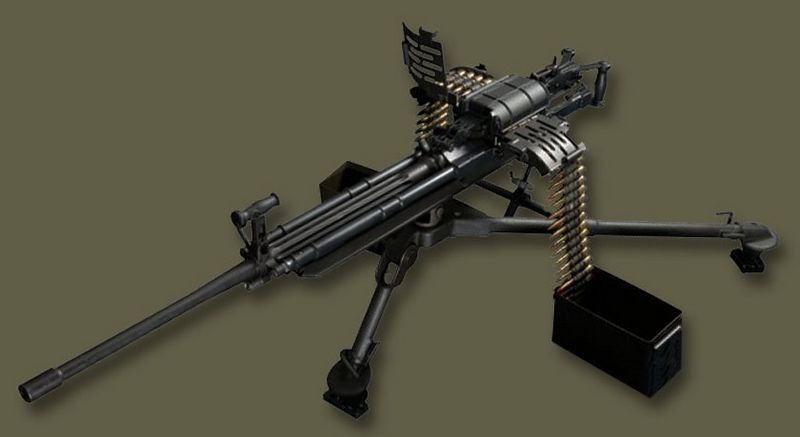
Externally, the design of the CIS 50MG has very clean lines and sharp contours, contrasting with the practical look of the Browning M2HB (whose origins date back to 1933). The receiver is a large rectangular shape located at the rear of the overall design and contains all relevant internal working components, including the firing action, chamber and trigger system. The overall weight of this receiver assembly is lower than that of the M2HB. Assuming the CIS 50MG is mounted on a springy/trainable pin or similar launcher, the rear of the receiver is a spade handle for securing a two-handed grip.
The CIS 50MG is powered by a dual feed ammunition system that also uses dual gas cylinders mounted on either side of the receiver. Each cylinder also contains its own gas piston, which is required for dual feed operation and drives individual ammunition lines to the receiver firing chamber. The dual-feed approach provides accelerated rotation of available ammunition types to meet operator needs based on available targets. The barrel protrudes slightly from the front of the receiver, features a "quick change" design, and features an integrated grip for reliable operation. A well-trained rifle team should replace heated barrels within seconds.
Replacing the barrel of an air-cooled machine gun (as opposed to water-cooled derivatives) is necessary to prevent the barrel from overheating. For this reason, spare barrels were assigned to machine gun teams. The barrel is equipped with a small but effective muzzle brake.
Sights are nothing more than iron allegro blades mounted in front of the shovel handle, behind the ammunition feed, although reflex sights or night vision sights can be mounted for accurate fire or low light situations. The gun has a barrel length of 65.7 inches, while the barrel size is 44.9 inches.
CIS 50MG for firing in . 50 BMG (Browning Machine Gun) cartridges (12.7x99 NATO) and standardized ammo belts transported from metal cases. As the weapon uses the same ammunition as the previous Browning M2HB, the CIS 50MG uses the SAF's existing stockpile of ammunition.
Ammunition types themselves are available to meet operator needs, including basic spherical cartridges as well as armor-piercing (AP) types and special Light Armor Penetrator (Saboted Light Armor Penetrator - SLAP) and traditional "blank" training ammunition. The feed consists of a single pinion system and dual chutes located above the rear of the receiver, where one ammo feed can be a "ball" and the other can feed special ammunition (such as AP) for quick movement to An ever-changing battlefield to deal with conditions. The entire action is typically gas-operated using an open, rotating bolt and has a quoted rate of fire of nearly 400 to 600 rounds per minute. The open breech is designed to avoid "boiling" the ready-to-fire cartridge in the hot combustion chamber. The CIS 50MG has fully automatic and semi-automatic firing modes, selectable via a switch near the trigger.
The muzzle velocity is about 2,900 feet per second.
In addition to the standard vehicle trunnion mounts, the CIS 50MG can be mounted on a heavy duty M3 tripod for continuous firing. In the former installation, the CIS 50MG can be installed on ships, helicopters and vehicles as required.
The CIS 40/50 Cupola Weapon Station (CWS) allows the CIS 50MG to be mounted on the roof or turret of an armored vehicle.
In addition to service in the Singapore Armed Forces, the CIS 50MG is also in limited use by the Singapore Coast Guard. The only other operator of the CIS 50MG is Indonesia, which manufactures the system under license "SMB-QCB" ("Senapan Mesim Berat-Quick Change Barrel") under the PT Pindad brand label.
Specification
Roles
- Fire Support/Suppression/Defense
Dimensions
1,670 mm (65.75 in)
1,141 mm (44.92 in)
30.00 kg
Tailgate; Front Post
Performance
Gas powered; auto fire only
2,900 feet per second (884 meters per second)
500 rounds per minute
Changes
50MG - name of the basic production series
 Argentina
 Armenia
 Australia
 Austria
 Austria-Hungary
 Belgium
 Brazil
 United Kingdom
 United States
 Brunei
 Bulgaria
 Canada
 Chile
Chile China
China Colonial America
 Colombia
 Confederate States
 Croatia
 Czech
Czech Denmark
 Egypt
Egypt Finland
 France
 Georgia
 Germany
 German Imperial
 Greece
 Holland
 Hungary
 India
India Indonesia
 Iran
Iran Iraq
Iraq Ireland
 Israel
 Italy
Italy Japan
Japan Japan (1940)
 Jordan
 Kingdom of Italy
 Malaysia
 Mexico
 Myanmar
 Nazi Germany
 Netherlands
 New Zealand
 North Korea
 Norway
 Pakistan
 Peru
Peru Philippines
 Poland
 Portugal
 Prussia
 Romania
 Russia
 Saudi Arabia
 Serbia
 Slovakia
 Slovenia
 South Africa
 South Korea
 Soviet Union
 Spain
Spain Sweden
 Switzerland
 Syria
Syria Taiwan
 Thailand
 Turkey
 UAE
UAE Ukraine
 Vietnam
 Yugoslavia