
History
IWI ARBEL is a computerized rifle fire-control system developed by Israel Weapon Industries to improve the timing of follow-up shots. The system was originally developed to help soldiers engage difficult targets that appear briefly or move rapidly, and it was later adapted for counter-small-UAV engagements.
ARBEL is integrated with an AR-15-style rifle and is intended to retain the soldier's existing rifle, ammunition and sighting equipment. For counter-drone use, the shooter remains responsible for detecting, tracking and aiming at the target while ARBEL controls the timing of follow-up shots.
IWI publicly unveiled ARBEL in April 2024 after nearly a decade of development. By 2026, the company was presenting a broader ARBEL family that included the AR rifle configuration, a kinetic counter-UAS configuration, an LMG application and the ARBEL BOOST energy system.
Development
According to IWI representative Semion Dukhan, ARBEL did not begin as a dedicated anti-drone project. Its original purpose was to help soldiers place repeated rounds on difficult targets that might emerge from cover for only a few seconds. The system was developed around computerized control of follow-up-shot timing rather than automated target recognition or automatic aiming.
The growing battlefield use of small tactical drones created another application for the same concept. Small UAVs can be difficult rifle targets because they are compact, mobile and maneuverable, and a hit may not disable one unless a critical component is damaged. IWI consequently adapted ARBEL's firing logic for kinetic counter-UAS use.
The system was publicly introduced in April 2024. A 2026 Military.com report described ARBEL as the result of nearly a decade of development and reported increasing international interest in its counter-drone role.
Design
Fire-control system
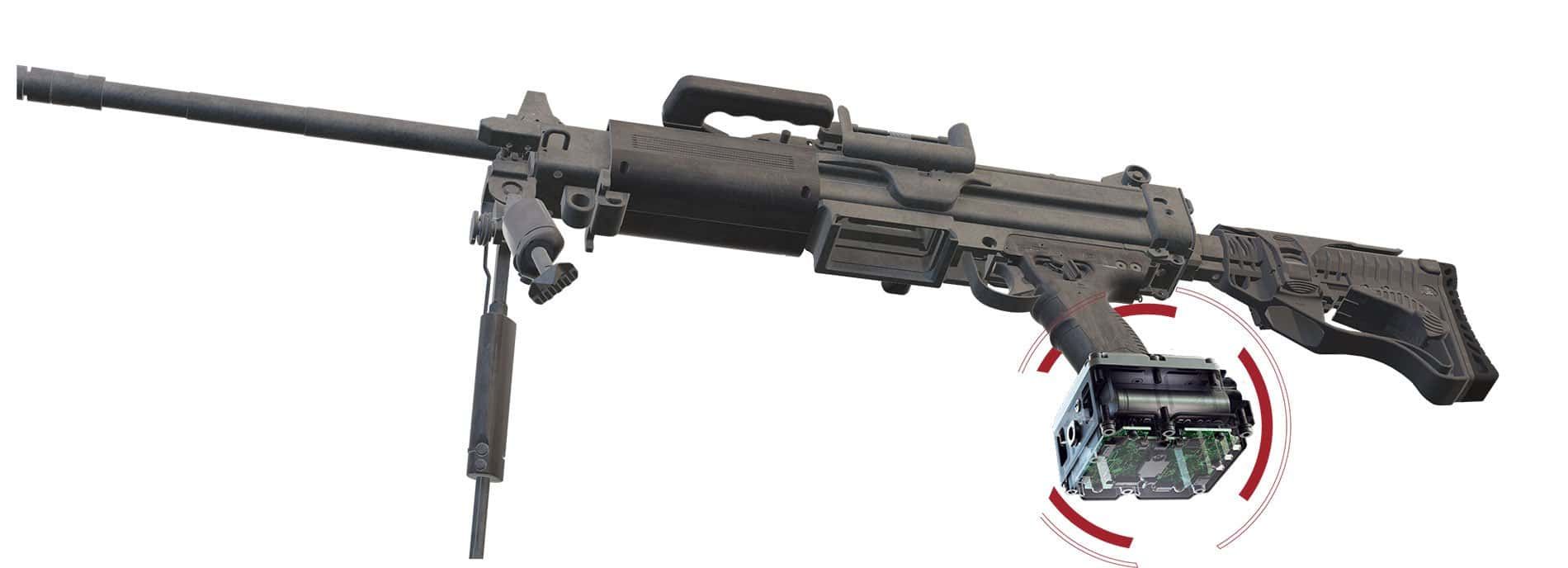
ARBEL combines a computer, movement sensors, an electronic trigger mechanism, a dedicated operating mode and a replaceable rechargeable battery. In an AR-15-style installation, the electronics and sensors are incorporated into the lower-receiver and trigger-system area, while the battery is positioned near the buffer tube and stock. A company representative stated that the equipment adds about 400 g to the rifle.
The first shot remains mechanically initiated. Pulling the trigger therefore fires the first round whether or not ARBEL assistance is active. When the shooter selects ARBEL mode and continues holding the trigger after the first shot, the electronic system controls when subsequent shots are released.
For conventional targets, movement sensors analyze rifle motion and can delay a follow-up shot until the weapon has returned to a sufficiently stable position. IWI describes this as an adaptive fire-control function intended to improve repeated-shot accuracy. The manufacturer's ARBEL product information states that the system continuously evaluates shooter and weapon movement while the trigger remains pressed.
Counter-UAS operation
The counter-drone configuration uses a firing cadence developed through testing for engagements against small moving aerial targets. Instead of requiring the shooter to make a separate trigger pull for every follow-up shot, ARBEL manages the timing of subsequent rounds while the shooter concentrates on maintaining the required aim and lead.
ARBEL does not visually identify a drone, determine its course or automatically correct the rifle's aim. Dukhan stated that aiming remains entirely the shooter's responsibility. The shooter must detect the UAV, judge its distance and direction, apply lead and keep the sights aligned. Although artificial intelligence was reportedly used during development, IWI's representative said that the operational firing function should not be described as an AI target-recognition system.
IWI advertises a maximum counter-drone engagement distance of up to 450 m in daylight and 250 m at night. These distances are manufacturer claims. Publicly available information does not provide comprehensive independent test data covering hit probability, drone speed, ammunition expenditure, weather conditions or different shooter skill levels.
Optics and rifle compatibility
ARBEL operates independently of the rifle's sighting system. It can therefore be used with iron sights and different optical devices. Reported compatible equipment includes red-dot sights, magnified optics, low-power variable optics, thermal sights and night-vision equipment.
IWI describes the ARBEL Anti-Drone System as an upgrade for standard AR-15-pattern rifles using a replacement lower-receiver arrangement. The company states that the system is intended to remain compatible with NATO and MIL-STD optics and accessories and does not require a dedicated counter-drone sight to operate.
Power and fail-safe operation
The electronic fire-control equipment is powered by a rechargeable replaceable battery. IWI's current product information states an operating time of up to 50 hours and rapid recharging. Dukhan separately told Military.com that the battery could provide about 60 hours of active ARBEL operation. The difference reflects two separate published company-associated figures rather than a single confirmed endurance value.
Loss of electrical power does not prevent the rifle from firing mechanically. If the ARBEL electronics or battery fail, the rifle can continue operating as a conventional semi-automatic weapon. The system also does not depend on transmitting radio-frequency signals for its firing function, so conventional radio-frequency jamming does not directly interrupt its trigger-control operation.
Program status
By September 2026, IWI was marketing ARBEL for both conventional precision-fire and counter-UAS applications. The company described the counter-drone version as field-tested and combat-proven, although the supplied public material does not identify the specific combat units or engagements supporting that description.
Dukhan stated that 10 to 15 European countries and about 25 countries worldwide had implemented or were implementing ARBEL. IWI did not identify those countries, so they cannot be listed as confirmed operators from the available information.
IWI presents ARBEL as a last-layer kinetic option rather than a replacement for radar, electronic warfare, jammers or dedicated air-defense weapons. Its intended role is to give an infantry soldier a counter-drone capability using a rifle already carried for the soldier's primary mission.
Variants
- ARBEL Anti-Drone System: Kinetic counter-UAS configuration for AR-15-pattern rifles. IWI claims engagement distances of up to 450 m by day and 250 m at night.
- ARBEL AR: Computerized AR-15 fire-control configuration intended to improve the timing and precision of follow-up shots against stationary and moving targets.
- ARBEL LMG: Application of the ARBEL trigger and fire-control concept to the IWI NEGEV light machine gun for improved accuracy against static and moving targets.
- ARBEL BOOST: An associated centralized battlefield energy system intended to extend equipment operating time and reduce dependence on multiple individual batteries.
Specifications (ARBEL Anti-Drone System)
General characteristics
- Manufacturer: Israel Weapon Industries
- Type: Computerized rifle fire-control and kinetic counter-UAS system
- Host platform: Standard AR-15-pattern rifle
- Additional mass: About 400 g, according to an IWI representative
- Fire-control components: Computer, weapon-movement sensors, electronic trigger mechanism and dedicated ARBEL firing mode
- First-shot operation: Mechanical
- Follow-up-shot operation: Electronically timed while ARBEL mode is selected and the trigger remains held
- Sighting compatibility: Independent of the sighting system; compatible with iron sights and optical, thermal and night-vision devices
Counter-UAS performance
- Claimed daylight engagement distance: Up to 450 m
- Claimed night engagement distance: Up to 250 m
- Target aiming: Manual; the shooter remains responsible for target detection, lead and sight alignment
- Engagement method: Rifle ammunition fired with system-controlled timing of follow-up shots
Power
- Power source: Replaceable rechargeable battery
- Manufacturer-stated operating time: Up to 50 hours
- Alternative reported figure: About 60 hours of active operation according to an IWI representative interviewed by Military.com
- Operation after power loss: Rifle remains usable as a conventional mechanically fired semi-automatic weapon
 Argentina
 Armenia
 Australia
 Austria
 Austria-Hungary
 Belgium
 Brazil
 United Kingdom
 United States
 Brunei
 Bulgaria
 Canada
 Chile
Chile China
China Colonial America
 Colombia
 Confederate States
 Croatia
 Czech
Czech Denmark
 Egypt
Egypt Finland
 France
 Georgia
 Germany
 German Imperial
 Greece
 Holland
 Hungary
 India
India Indonesia
 Iran
Iran Iraq
Iraq Ireland
 Italy
Italy Japan
Japan Japan (1940)
 Jordan
 Kingdom of Italy
 Malaysia
 Mexico
 Myanmar
 Nazi Germany
 Netherlands
 New Zealand
 North Korea
 Norway
 Pakistan
 Peru
Peru Philippines
 Poland
 Portugal
 Prussia
 Romania
 Russia
 Saudi Arabia
 Serbia
 Singapore
 Slovakia
 Slovenia
 South Africa
 South Korea
 Soviet Union
 Spain
Spain Sweden
 Switzerland
 Syria
Syria Taiwan
 Thailand
 Turkey
 UAE
UAE Ukraine
 Vietnam
 Yugoslavia