
History
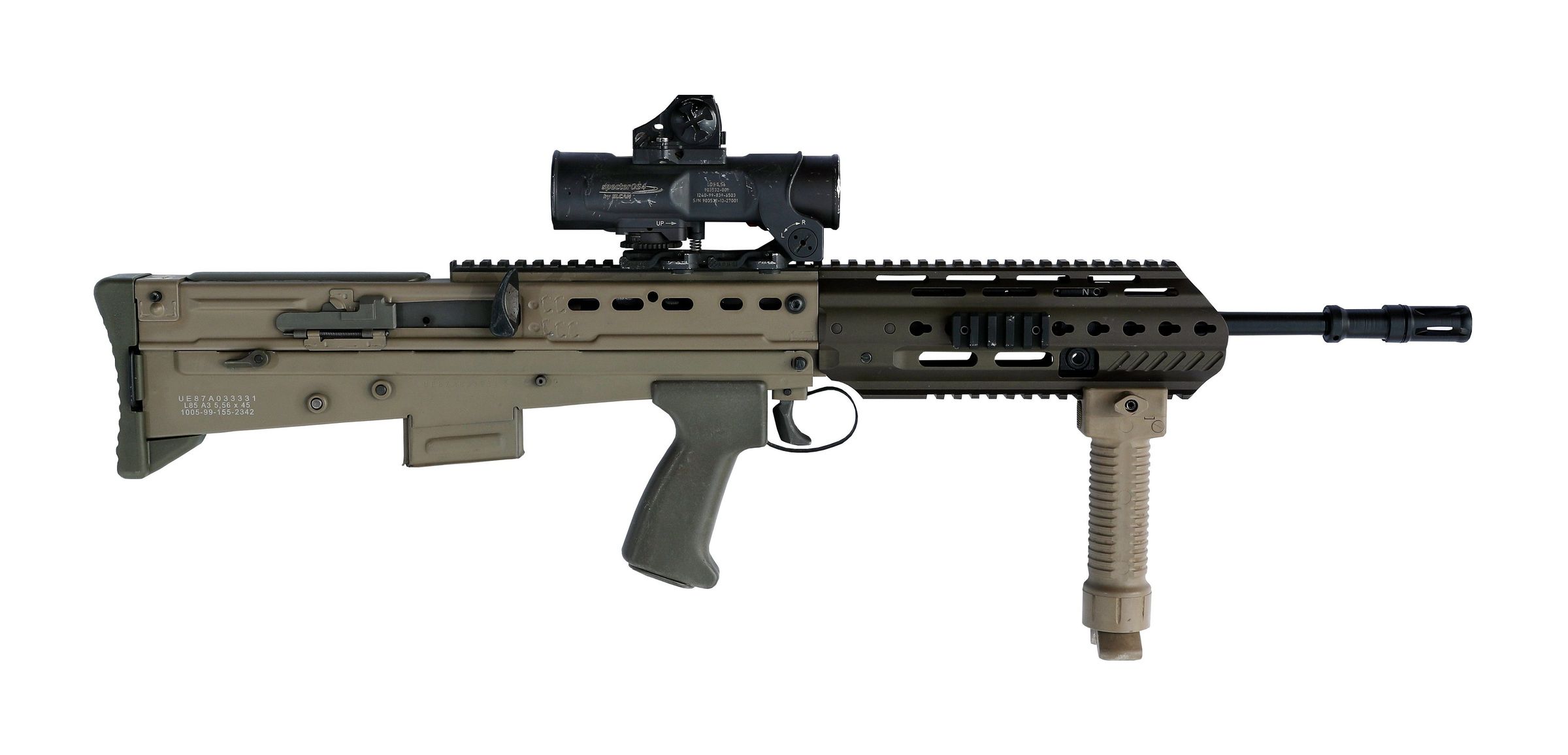
The GRAYBURN Assault Rifle is the planned successor to the United Kingdom's SA80 family of service rifles. Project GRAYBURN is being developed as a family of dismounted small arms rather than as a single finalized rifle, and no production design had been selected by September 2026.
The programme is intended to replace several SA80-derived weapons with a common architecture covering standard infantry, short-barrel, personal-defence and cadet roles. British requirements also emphasize optics, signature reduction, reliability, body-armour defeat and domestic manufacturing.
Project GRAYBURN remained in the concept phase in 2026. The planned acquisition covers approximately 150,000 to 180,000 rifles, while the programme's published contract period extends from 1 April 2028 to 31 March 2045.
In May 2025, the UK government confirmed that GRAYBURN had entered its concept phase, with an assessment phase intended to begin in 2026. By August 2026, however, the programme was still described as remaining in the concept phase.
In January 2026, the Ministry of Defence issued an industry pipeline notice defining key elements of the requirement. The programme calls for rifles to be manufactured in the United Kingdom as part of an effort to establish domestic supply capacity and a long-term relationship with the selected supplier.
The programme is intended to replace the L85A2 and L85A3 rifles, the L22 carbine and the L98 cadet rifle. The original requirement described five roles based on a common receiver, although the short Dismounted Close Combat configuration may be combined with another role, potentially reducing the final family to four principal variants.
The Ministry of Defence confirmed in September 2026 that GRAYBURN would replace the L85 and that work included options for optimizing present and future 5.56 × 45 mm capabilities. The programme has not, however, publicly fixed a final calibre. This leaves the ammunition decision connected to wider studies of lethality, body-armour defeat, ammunition weight and future small-arms technology.
Several manufacturers have publicly positioned existing or adaptable rifle families for the competition. Beretta Defence Technologies has discussed both the Beretta NARP and Sako ARG 40, while other companies associated with the programme include CZ, FN Herstal, Heckler & Koch, Knight's Armament Company, SIG Sauer and SSS Defence. These are prospective submissions rather than GRAYBURN production rifles.
Design
No definitive GRAYBURN rifle design had been selected by September 2026. The published requirement instead defines a common weapon architecture from which several configurations are expected to be produced.
Common architecture
The planned weapon family is based on a common receiver concept. Different configurations are intended to cover standard dismounted combat, short-barrel combat, personal-defence, general-service and cadet requirements. The short Dismounted Close Combat configuration may ultimately be combined with either the main Dismounted Close Combat rifle or the Personal Defence Weapon role.
The programme requires high reliability and operation across different environments and climatic conditions. Cold-weather performance is particularly relevant because the requirement covers use in all climates rather than limiting the weapon to temperate conditions.
Optics and accessories
GRAYBURN weapons are planned to be fitted with day optics and designed for rapid integration with in-line night-vision equipment. The architecture is also intended to support modern accessory integration as part of the complete individual weapon system.
Some variants are required to accept signature-reduction equipment such as suppressors and flash-reduction devices. The requirement therefore treats the rifle, sighting system, ammunition and muzzle equipment as interconnected parts of overall combat effectiveness.
Lethality and ammunition
The Ministry of Defence requires sufficient lethality against current and emerging body armour. The published requirement does not establish a final cartridge, so this objective must be considered together with calibre, ammunition construction, weapon configuration and sighting equipment.
Work announced in September 2026 included options for improving current and future 5.56 × 45 mm capabilities. At the same time, the absence of a fixed calibre in the main industry requirement leaves open the possibility of evaluating alternatives. No alternative cartridge had been confirmed for adoption.
Manufacturing and support
Domestic production is a major element of GRAYBURN. The programme calls for manufacturing in the United Kingdom to strengthen supply chains, create employment and provide an industrial base capable of supporting the rifle family through its service life.
The Ministry of Defence is also considering a strategic relationship with the successful supplier covering delivery, management, continuing development and long-term support. The stated programme period extends from 1 April 2028 to 31 March 2045.
Program status
Project GRAYBURN remained in the concept phase during 2026. No investment decision or final rifle selection had been publicly confirmed, and the rifles discussed by prospective suppliers remained candidate systems rather than adopted GRAYBURN weapons.
Production has been scheduled to begin in 2028. This is a planned milestone rather than a completed event. The programme is intended to begin delivering replacement weapons before the retirement of older SA80 configurations, although individual SA80 variants have different projected out-of-service dates.
The planned procurement quantity is approximately 150,000 to 180,000 rifles. Programme discussions have also referred to an initial requirement for the first 10,000 weapons by around 2030, placing pressure on the competition, trials, industrialization and production schedule.
Variants
- Dismounted Close Combat: Planned primary infantry configuration intended to replace the L85A3.
- Dismounted Close Combat (Short): Planned compact configuration. It may be merged with either the standard Dismounted Close Combat rifle or the Personal Defence Weapon role.
- Personal Defence Weapon: Planned compact weapon intended to replace the L22 carbine role.
- Generalist: Planned general-service configuration intended to replace the L85A2.
- Cadet rifle: Planned training configuration intended to replace the L98 Cadet GP rifle.
Specifications (Project GRAYBURN requirement)
General characteristics
- Type: Planned family of assault rifles and related individual weapons.
- Development country: United Kingdom.
- Programme phase: Concept phase in 2026.
- Planned production: Scheduled to begin in 2028.
- Planned procurement: Approximately 150,000 to 180,000 rifles.
- Programme period: 1 April 2028 to 31 March 2045.
- Architecture: Common receiver supporting several weapon configurations.
- Manufacturing: Planned UK production.
Weapon-system requirements
- Calibre: Not finally selected; 5.56 × 45 mm capabilities remain under consideration.
- Optics: Day optics with rapid integration of in-line night-vision equipment.
- Signature reduction: Required on applicable variants, including compatibility with suppressors or flash-reduction equipment.
- Lethality: Required to address current and emerging body armour.
- Reliability: Required to operate across different environments and climatic conditions.
 Argentina
 Armenia
 Australia
 Austria
 Austria-Hungary
 Belgium
 Brazil
 United States
 Brunei
 Bulgaria
 Canada
 Chile
Chile China
China Colonial America
 Colombia
 Confederate States
 Croatia
 Czech
Czech Denmark
 Egypt
Egypt Finland
 France
 Georgia
 Germany
 German Imperial
 Greece
 Holland
 Hungary
 India
India Indonesia
 Iran
Iran Iraq
Iraq Ireland
 Israel
 Italy
Italy Japan
Japan Japan (1940)
 Jordan
 Kingdom of Italy
 Malaysia
 Mexico
 Myanmar
 Nazi Germany
 Netherlands
 New Zealand
 North Korea
 Norway
 Pakistan
 Peru
Peru Philippines
 Poland
 Portugal
 Prussia
 Romania
 Russia
 Saudi Arabia
 Serbia
 Singapore
 Slovakia
 Slovenia
 South Africa
 South Korea
 Soviet Union
 Spain
Spain Sweden
 Switzerland
 Syria
Syria Taiwan
 Thailand
 Turkey
 UAE
UAE Ukraine
 Vietnam
 Yugoslavia