
History
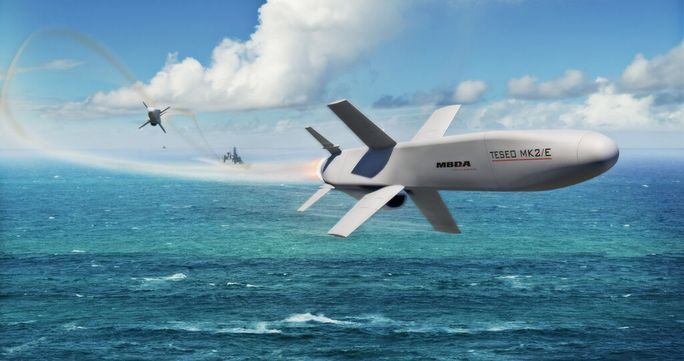
The MBDA TESEO Mk2/E is a new-generation long-range anti-ship missile developed for the Italian Navy. It is designed for shipborne employment against maritime targets and also provides a land-attack capability. The weapon combines a sea-skimming flight profile, a range exceeding 350 km, an AESA radio-frequency seeker and two-way in-flight mission control.
TESEO Mk2/E is being developed as the successor to the TESEO Mk2/A within the TESEO family, which is internationally known as OTOMAT. The first successful Mk2/E test firing took place in October 2024, followed by a major validation firing in September 2026. MBDA targets the first delivery of the production missile in 2028.
The system is intended for integration with several classes of Italian Navy surface combatants, including PPA multi-purpose combat ships, FREMM-class frigates, Horizon-class destroyers, future FREMM EVO frigates and the planned DDX destroyers. Its architecture was developed to provide long-range maritime strike while retaining the ability to attack selected land targets.
Development
The Mk2/E programme followed the Italian Navy requirement for a replacement and substantial evolution of the existing TESEO Mk2/A. Contemporary reporting placed the original development contract signature in late November 2020, while MBDA's later programme account describes the TESEO Mk2/E programme as having been launched in 2021 under a contract with Italy's National Directorate of Naval Armaments. The work covered development, integration and qualification of the new missile system.
MBDA Italia developed the missile in close cooperation with the Italian Navy. The programme introduced a new missile architecture rather than a simple modernization of the earlier OTOMAT-derived weapon. Development focused on greater range, improved survivability, more flexible mission planning, two-way communications and a new terminal guidance system.
In 2025, a production contract was signed for the TESEO Mk2/E. The agreement followed the development and qualification phase and covered the transition toward series production for future Italian Navy platforms.
Testing
The first successful TESEO Mk2/E test firing was conducted in October 2024. That event validated the design of new missile components and confirmed aerodynamic results obtained during development testing.
On 16 September 2026, MBDA announced another successful validation firing. The missile completed an approximately 20-minute controlled cruise flight that demonstrated its range and validated the overall design of the new anti-ship system. MBDA described the event as a major qualification milestone that would allow development to move toward completion and production.
Design
Airframe and flight characteristics
TESEO Mk2/E uses a new airframe designed for high-subsonic cruise flight and high-G manoeuvring during the terminal phase. The missile body is less than 5 m long. Overall length remains below 5.5 m when the missile is installed in its launch canister. Published technical information gives a missile mass of approximately 700 kg at the beginning of the cruise phase.
The missile is designed to fly at sea-skimming altitude over maritime routes and can transition to overland flight when required by the planned mission. Its effective range exceeds 350 km while maintaining a sea-skimming flight profile. Terminal manoeuvring is intended to improve survivability against shipboard defensive systems.
Navigation and mission control
The autonomous navigation suite combines an inertial navigation system with GPS and a radar altimeter. Mission planning can use four-dimensional waypoints defined by position and time, allowing a programmed time on target. The flight profile is automatically adapted to maintain the required altitude and route.
A two-way data link provides control of the missile during flight. Operators can update target information, reassign the missile to another target, modify mission parameters or abort the engagement. MBDA has also described the system as supporting in-flight control through a satellite data link.
The planning system supports salvo attacks with simultaneous time on target. This allows several missiles to be programmed to arrive at a target area at approximately the same time despite following different routes.
Terminal guidance
The current TESEO Mk2/E configuration incorporates a new AESA radio-frequency seeker. Earlier technical descriptions of the programme also identified a dual-mode terminal guidance concept combining a coherent RF sensor with an electro-optical channel. The RF sensor includes electronic counter-countermeasure features for operation in contested electromagnetic environments.
The terminal guidance system is intended to support engagements against both maritime and land targets. The combination of autonomous navigation, terminal sensing and in-flight target updates allows the missile to adapt to changes in the tactical situation during a long-range engagement.
Warhead
TESEO Mk2/E carries a scalable insensitive warhead providing semi-piercing and high-explosive effects. The warhead can use impact or proximity fuzing. The scalable design is intended to support different target types while allowing mission planners to tailor the desired effect.
Launch and ship integration
The missile is housed in a dedicated launch canister. Programme descriptions indicate that the canister was designed for compatibility with existing inclined launcher arrangements used for the TESEO and OTOMAT family. The Mk2/E architecture also uses a single coaxial launch booster rather than the two side-mounted boosters associated with earlier OTOMAT configurations.
MBDA has designed the system for installation on surface combatants of different sizes. The missile has been developed for Italian Navy PPA ships, FREMM-class frigates, Horizon-class destroyers and future DDX destroyers. FREMM EVO frigates are also planned to receive the system. MBDA has additionally described the architecture as adaptable to coastal defence applications.
Program status
Following the 2024 firing and the September 2026 validation test, TESEO Mk2/E remained in qualification and transition toward production. The 2026 firing demonstrated the required range and validated the overall system design, clearing another major step before completion of development.
MBDA targets first delivery of the production missile in 2028. The planned introduction will place Mk2/E alongside the earlier TESEO Mk2/A during the transition period. The new missile is intended to become a common long-range strike weapon across several present and future Italian Navy surface-combatant classes.
Specifications (TESEO Mk2/E)
General characteristics
- Type: Long-range anti-ship missile with land-attack capability
- Manufacturer: MBDA
- Development country: Italy
- Length: Less than 5 m
- Length in launch canister: Less than 5.5 m
- Mass: Approximately 700 kg at the beginning of the cruise phase
- Warhead: Scalable insensitive semi-piercing and high-explosive warhead
- Fuzing: Impact or proximity
Performance
- Range: More than 350 km at sea-skimming level
- Speed: High subsonic
- Flight profile: Sea-skimming with overland flight capability
- Terminal manoeuvring: High-G manoeuvres
Guidance and control
- Navigation: Autonomous INS/GPS with radar altimeter
- Terminal guidance: AESA radio-frequency seeker with electro-optical terminal guidance described in programme technical material
- Data link: Two-way in-flight data link
- Mission control: Target update, reassignment, mission modification and abort capability
- Mission planning: Four-dimensional waypoints and programmable time on target
- Salvo capability: Simultaneous time-on-target attacks
- Target types: Maritime and land targets
Related equipment
- TESEO Mk2/A: Earlier in-service member of the TESEO family that the Mk2/E is intended to progressively replace while initially operating alongside it.
- OTOMAT: International designation associated with the broader TESEO missile family from which the Mk2/E programme evolved.
 Argentina
 Armenia
 Australia
 Austria
 Austria-Hungary
 Belgium
 Brazil
 United Kingdom
 United States
 Brunei
 Bulgaria
 Canada
 Chile
Chile China
China Colonial America
 Colombia
 Confederate States
 Croatia
 Czech
Czech Denmark
 Egypt
Egypt Finland
 France
 Georgia
 Germany
 German Imperial
 Greece
 Holland
 Hungary
 India
India Indonesia
 Iran
Iran Iraq
Iraq Ireland
 Israel
 Japan
Japan Japan (1940)
 Jordan
 Kingdom of Italy
 Malaysia
 Mexico
 Myanmar
 Nazi Germany
 Netherlands
 New Zealand
 North Korea
 Norway
 Pakistan
 Peru
Peru Philippines
 Poland
 Portugal
 Prussia
 Romania
 Russia
 Saudi Arabia
 Serbia
 Singapore
 Slovakia
 Slovenia
 South Africa
 South Korea
 Soviet Union
 Spain
Spain Sweden
 Switzerland
 Syria
Syria Taiwan
 Thailand
 Turkey
 UAE
UAE Ukraine
 Vietnam
 Yugoslavia