
History
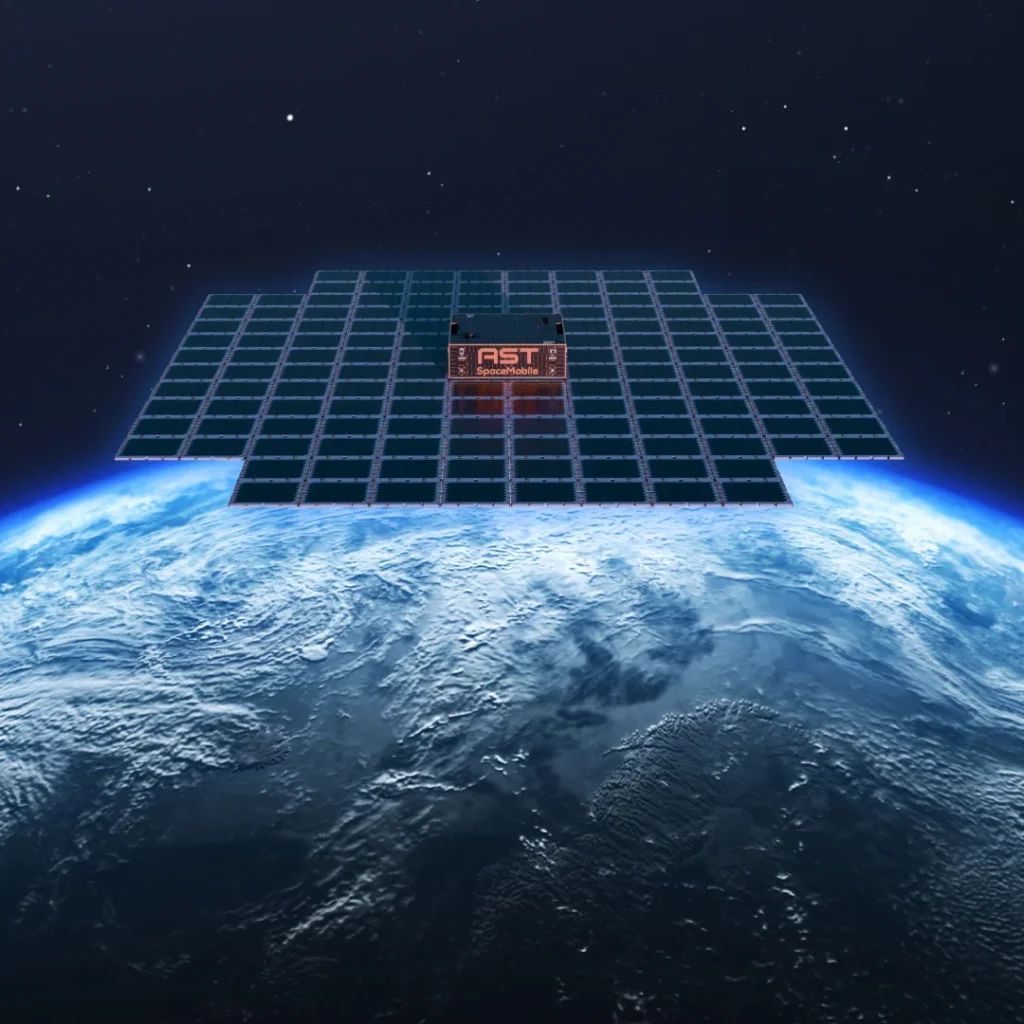
AST SpaceMobile BlueBird is a family of low Earth orbit communications satellites developed to provide cellular broadband directly to standard, unmodified mobile phones. The spacecraft form the operational SpaceMobile constellation and are intended to work with terrestrial mobile networks using standard 4G and 5G devices.
The first five BlueBird satellites established the initial commercial constellation in 2024. A larger Block 2 generation followed from late 2025, with substantially larger communications arrays, greater processing capacity, and higher planned data rates.
AST SpaceMobile assembles, integrates, and tests BlueBird satellites at its facilities in Midland, Texas. The company has described the program as a vertically integrated U.S. manufacturing effort and is expanding production as additional spacecraft enter the launch campaign.
Initial BlueBird deployment
BlueBird 1 through BlueBird 5 were developed as the first five operational SpaceMobile satellites. They were closely based on the BlueWalker 3 prototype, with changes intended to accelerate deployment of the operational constellation. All five were launched together from Cape Canaveral Space Force Station on 12 September 2024 aboard a SpaceX Falcon 9. The AST SpaceMobile BlueBird 1-5 page identifies them as the company's first five commercial satellites and states that they provide non-continuous coverage across the United States and selected other markets while later spacecraft are added.
Independent spacecraft records list the five satellites at about 1,500 kg each and describe a deployable phased-array communications antenna about 10 m in diameter with an area of 64.38 m². The same records identify AST & Science as both operator and contractor. Launch and configuration details are summarized by Gunter's Space Page.
Block 2 development and launches
The second-generation BlueBird Block 2 design was introduced as a larger and more capable successor to the initial five spacecraft. BlueBird 6, the first Block 2 satellite, was launched on 24 December 2025 by an Indian LVM3 from Satish Dhawan Space Centre. A contemporary PCMag report described its deployed communications array as almost 2,400 ft², approximately 223 m², and reported that the design was intended to support more than 2,000 cells per satellite.
BlueBird 7 followed on 19 April 2026 aboard a New Glenn launch. According to Gunter's Space Page, a second-stage issue left the satellite in an unrecoverable orbit. BlueBirds 8, 9, and 10 were then launched together on a Falcon 9 from Cape Canaveral on 17 June 2026.
BlueBirds 11, 12, and 13 were launched on another Falcon 9 from Cape Canaveral at 3:42 a.m. EDT on 5 August 2026. AST SpaceMobile stated that these spacecraft carried communications arrays more than three times the size of those on the five initial Block 1 satellites and were expected to support peak data rates approaching 200 Mbps directly to standard smartphones. The company's launch announcement, republished by Nasdaq, also said that BlueBirds 14, 15, and 16 were being prepared for the next mission and that production work had advanced through BlueBird 42.
Design
BlueBird satellites use large deployable phased arrays as the principal communications element. A phased array combines many antenna elements whose signals are electronically controlled to form and steer radio beams without mechanically pointing the entire antenna. This architecture allows the spacecraft to direct cellular coverage toward selected areas while managing interference and capacity.
BlueBird Block 1
The five initial Block 1 satellites use a communications array measuring 64.38 m², equivalent to 693 ft². Gunter's Space Page describes the deployed antenna as approximately 10 m in diameter and made from numerous repeated sub-antenna modules. AST SpaceMobile states that the Block 1 array supports 40 MHz of bandwidth and peak transmission speeds above 150 Mbps per cell. The company also states that Block 1 provides ten times the processing bandwidth of the earlier BlueWalker 3 demonstrator.
Each Block 1 spacecraft had a cylindrical payload adapter for launch, which was discarded after deployment. The satellites are powered by solar cells and batteries. Published spacecraft data give a mass of approximately 1,500 kg for each of the first five satellites and an operating orbit of about 507 by 523 km at 53.0 degrees inclination.
BlueBird Block 2
Block 2 increased the size and capability of the BlueBird platform. The first Block 2 spacecraft, BlueBird 6, was reported at 6,100 kg, while later Block 2 spacecraft are listed at about 5,830 kg. Published spacecraft data describe two separate and independent electric xenon-thruster propulsion modules, solar-cell and battery power, and a design lifetime of seven years.
BlueBird 6's communications array was described as almost 223 m², or 2,400 ft², considerably larger than the Block 1 array. PCMag reported a design target of more than 2,000 cells per satellite and 120 Mbps of bandwidth per cell for messaging, voice, and data. For BlueBirds 11, 12, and 13, AST SpaceMobile later stated that the next-generation design was expected to support peak data rates approaching 200 Mbps. These figures describe different aspects and stages of the Block 2 system and should not be treated as directly interchangeable measures.
The enlarged aperture and advanced beamforming system are intended to provide more targeted coverage, reduce interference, and increase network capacity. AST SpaceMobile states that the satellites are designed to integrate with terrestrial mobile networks and to use partner spectrum as well as AST SpaceMobile spectrum while connecting to standard 4G and 5G devices.
Operational history
After the 2024 deployment of BlueBirds 1-5, AST SpaceMobile used the initial satellites for a series of direct-to-phone demonstrations. The company records a first video call in Europe in January 2025, additional video calls in the United States in February, and a first video call in Japan in April.
In June 2025 the company reported the first activation for government defense use cases. In July it reported first VoLTE calls using AT&T and Verizon core networks. In October 2025 AST SpaceMobile reported a VoLTE voice call, broadband data connection, and video streaming in Canada.
By August 2026 the constellation included the initial Block 1 satellites and multiple Block 2 spacecraft. AST SpaceMobile stated that the growing system was progressing toward initial service activation and continuous coverage in key markets including the United States, Canada, Europe, Saudi Arabia, and Japan. Beta services later in 2026 were described as a planned program step rather than an already completed operational milestone.
Variants
- BlueBird Block 1 — Initial operational configuration represented by BlueBirds 1-5. Each spacecraft has a 64.38 m² phased-array communications antenna and a mass of about 1,500 kg.
- BlueBird Block 2 — Larger next-generation configuration beginning with BlueBird 6. Published data describe a much larger communications array, increased processing and network capacity, electric xenon propulsion, and a seven-year design lifetime.
Operators
- AST SpaceMobile — Developer and operator of the SpaceMobile constellation. The company operates BlueBird satellites for direct-to-cell commercial and government communications applications.
Specifications (BlueBird Block 1)
General characteristics
- Type: Direct-to-cell communications satellite
- Mass: Approximately 1,500 kg
- Communications array area: 64.38 m² (693 ft²)
- Array diameter: Approximately 10 m
- Power: Solar cells and batteries
- Orbit: Approximately 507 × 523 km, 53.0° inclination
Communications performance
- Bandwidth: 40 MHz
- Peak transmission speed: More than 150 Mbps per cell, according to AST SpaceMobile
Specifications (BlueBird Block 2)
General characteristics
- Type: Direct-to-cell communications satellite
- Mass: 6,100 kg for BlueBird 6; later spacecraft listed at about 5,830 kg
- Propulsion: Two independent electric xenon-thruster propulsion modules
- Power: Solar cells and batteries
- Design lifetime: 7 years
Communications system
- BlueBird 6 array area: Approximately 223 m² (almost 2,400 ft²)
- Cells: More than 2,000 per satellite was reported as a design capability for BlueBird 6
- Per-cell bandwidth: 120 Mbps was reported for the BlueBird 6 design
- Peak data rate: Approaching 200 Mbps was expected for BlueBirds 11-13, according to AST SpaceMobile
Related equipment
- BlueWalker 3 — Technology demonstrator and direct predecessor to the initial BlueBird Block 1 satellites. BlueBirds 1-5 were closely based on its design with improvements intended for operational constellation deployment.
 Argentina
 Armenia
 Australia
 Austria
 Austria-Hungary
 Belgium
 Brazil
 United Kingdom
 Brunei
 Bulgaria
 Canada
 Chile
Chile China
China Colonial America
 Colombia
 Confederate States
 Croatia
 Czech
Czech Denmark
 Egypt
Egypt Finland
 France
 Georgia
 Germany
 German Imperial
 Greece
 Holland
 Hungary
 India
India Indonesia
 Iran
Iran Iraq
Iraq Ireland
 Israel
 Italy
Italy Japan
Japan Japan (1940)
 Jordan
 Kingdom of Italy
 Malaysia
 Mexico
 Myanmar
 Nazi Germany
 Netherlands
 New Zealand
 North Korea
 Norway
 Pakistan
 Peru
Peru Philippines
 Poland
 Portugal
 Prussia
 Romania
 Russia
 Saudi Arabia
 Serbia
 Singapore
 Slovakia
 Slovenia
 South Africa
 South Korea
 Soviet Union
 Spain
Spain Sweden
 Switzerland
 Syria
Syria Taiwan
 Thailand
 Turkey
 UAE
UAE Ukraine
 Vietnam
 Yugoslavia