
History
Rosetta was a European Space Agency deep-space spacecraft developed to rendezvous with, orbit and study Comet 67P/Churyumov-Gerasimenko. It carried the Philae lander and was designed for long-duration observation of a comet nucleus, its coma and the changes caused as the comet approached and passed the Sun.
Launched on 2 March 2004, Rosetta used three Earth gravity assists and one Mars gravity assist during a ten-year interplanetary journey. It also encountered the main-belt asteroids 2867 Šteins and 21 Lutetia before reaching Comet 67P on 6 August 2014.
Rosetta accompanied the comet through perihelion, deployed Philae for the first landing on a comet nucleus, and continued scientific observations until 30 September 2016. The mission ended with a controlled descent of the orbiter onto Comet 67P.
Development and mission planning
ESA approved Rosetta in November 1993 as a cornerstone mission of its long-term space science programme. The original mission plan targeted Comet 46P/Wirtanen and called for launch in January 2003. Following the failure of the first Ariane ECA rocket in December 2002, ESA and Arianespace did not launch Rosetta during that window, and the Wirtanen mission plan was abandoned.
In May 2003, ESA selected Comet 67P/Churyumov-Gerasimenko as the new target and established a revised launch opportunity for 2004. According to the ESA Rosetta factsheet, the mission was intended to make a prolonged close-range study of a comet and to investigate material regarded as representative of the early Solar System.
Rosetta was an international European programme involving more than 50 contractors from 14 European countries and the United States. Astrium Germany was the prime spacecraft contractor. Astrium UK supplied the spacecraft platform, Astrium France was responsible for spacecraft avionics, and Alenia Spazio performed assembly, integration and verification.
Launch and interplanetary cruise
Rosetta was launched from the Guiana Space Centre at Kourou, French Guiana, on 2 March 2004 aboard an Ariane 5. After an initial period in Earth parking orbit, the launch vehicle upper stage placed Rosetta on its interplanetary trajectory.
The spacecraft could not fly directly to Comet 67P with the required energy. It therefore followed a complex trajectory using planetary gravity assists. Rosetta passed Earth on 4 March 2005, flew about 250 km above Mars on 25 February 2007, returned to Earth on 13 November 2007 and made its third Earth gravity assist on 13 November 2009.
During the cruise, Rosetta also carried out two asteroid encounters. It passed 2867 Šteins on 5 September 2008 at about 803 km and 21 Lutetia on 10 July 2010 at about 3,162 km. The encounters provided additional scientific observations and exercised the spacecraft's navigation and imaging systems.
Rosetta entered deep-space hibernation on 8 June 2011 because available solar power had fallen too low for normal spacecraft operations. Most electrical systems were shut down while essential thermal, command, computer and power functions remained active. During this phase the spacecraft reached roughly 780 million km from the Sun and 880 million km from Earth.
On 20 January 2014, an onboard timer initiated the wake-up sequence. Rosetta warmed its navigation equipment, stopped its stabilising spin, oriented its high-gain antenna toward Earth and transmitted a signal received by ground stations later that day.
Arrival at Comet 67P
Between May and August 2014, Rosetta performed a sequence of trajectory-correction manoeuvres to reduce its velocity relative to Comet 67P and approach the nucleus. On 6 August 2014, at approximately 100 km from the comet, the spacecraft executed the manoeuvre marking its arrival. It subsequently followed increasingly close trajectories while mapping the nucleus and characterising its environment.
Rosetta became the first spacecraft to remain with and conduct sustained close-range operations around a comet nucleus as the comet travelled toward the inner Solar System. The spacecraft's instruments examined the nucleus, surrounding gas and dust, thermal properties and the interaction of the comet with the solar wind.
Philae deployment
On 12 November 2014, Rosetta released the approximately 100 kg Philae lander toward Comet 67P. Philae achieved the first landing of a spacecraft on a comet nucleus, but its anchoring harpoons did not fire. The lander therefore rebounded after its initial touchdown and made additional contacts with the surface before coming to rest in a poorly illuminated location.
Philae operated from its primary battery for about 60 hours and transmitted scientific data through Rosetta. Solar illumination at its final location was insufficient for sustained operation. Communications were briefly restored in June and July 2015 before contact was lost again.
Rosetta continued imaging the comet while searching for the lander. An image obtained on 2 September 2016 revealed Philae lying on its side in a dark rocky area. The discovery established the lander's final location almost two years after its descent.
Mission completion
Rosetta observed Comet 67P through its perihelion passage in August 2015 and continued accompanying it as the comet moved outward from the Sun. As solar power declined and the mission approached its planned conclusion, ESA prepared the orbiter for a final descent.
On 30 September 2016, Rosetta ended operations by descending toward the Ma'at region on the smaller lobe of Comet 67P. The controlled impact allowed observations to continue at progressively smaller distances until communication ceased. The ESA operations record documents the twelve-year flight from launch through the final descent.
Design
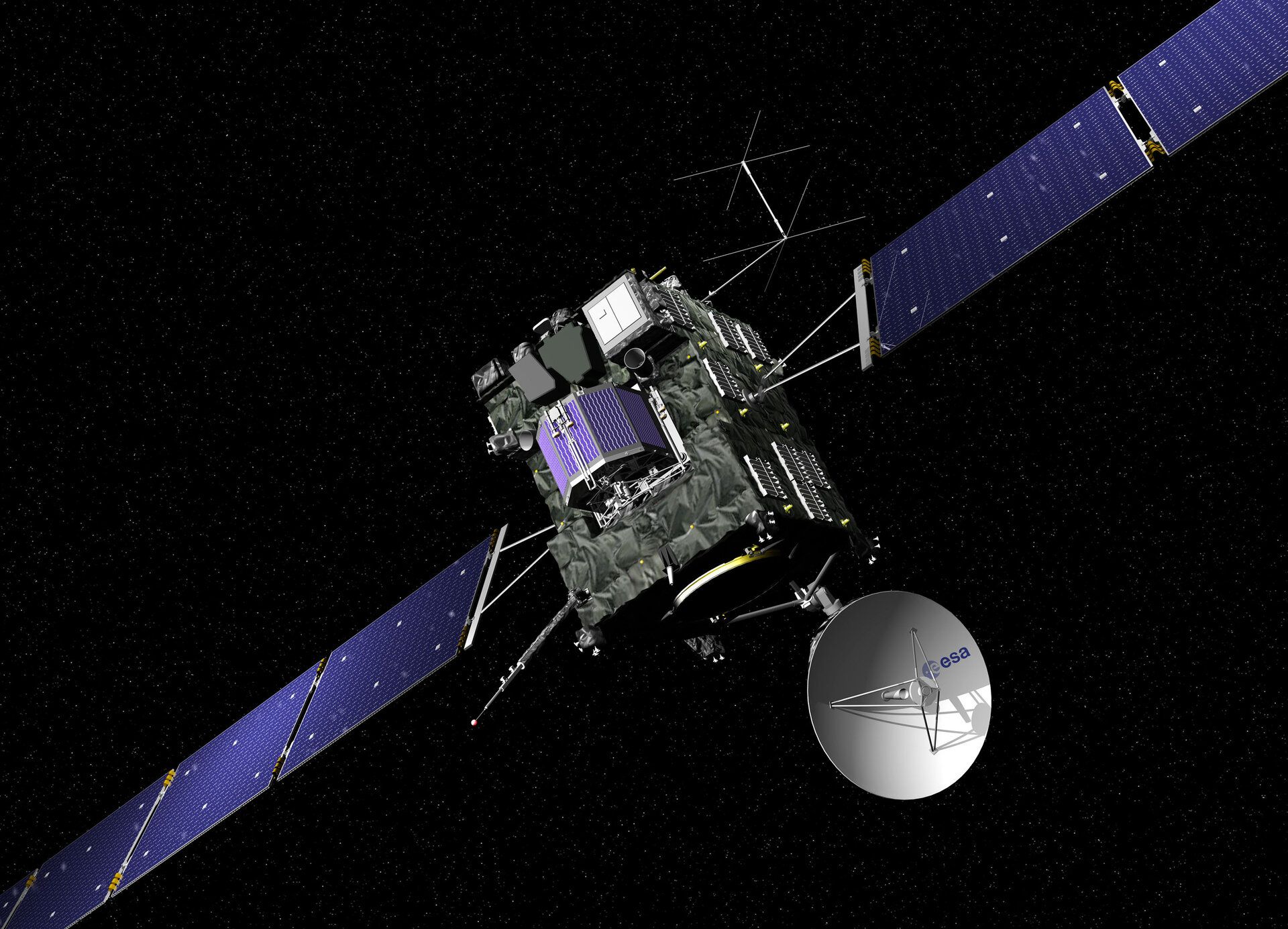
Rosetta was built around a rectangular aluminium spacecraft bus measuring 2.8 m by 2.1 m by 2.0 m. The scientific instruments were mounted on the Payload Support Module at the top of the spacecraft, while the Bus Support Module at the base housed supporting spacecraft systems. Philae was attached to one side of the orbiter during the interplanetary cruise.
The spacecraft was three-axis stabilised. Attitude determination and control used reaction wheels together with star trackers, Sun sensors, navigation cameras and laser gyro packages. Its design had to support more than a decade of cruise, repeated planetary encounters, deep-space hibernation and prolonged operations around an active comet.
Solar power and thermal control
Two large solar-array wings extended from opposite sides of the spacecraft. Each wing had an area of 32 m² and consisted of five panels, giving a combined area of 64 m² and a deployed span of approximately 32 m. The arrays could rotate through ±180 degrees to maintain suitable Sun illumination while the payload faced the comet.
Rosetta used silicon solar cells developed for low-intensity and low-temperature operation. ESA lists an electrical output of approximately 850 W at 3.4 AU from the Sun and 395 W at 5.25 AU. This allowed the spacecraft to conduct deep-space operations without a radioisotope power source.
Thermal control was particularly important because Rosetta operated over a wide range of distances from the Sun. Heaters protected equipment in cold conditions. Radiators and passive thermal louvers controlled heat rejection, with the louvers opening in warmer conditions and closing when heat needed to be retained. The spacecraft's shaded side and rear surfaces were used for radiators and louvers and also faced away from much of the cometary dust environment.
Propulsion and attitude control
The main propulsion system was arranged around a central vertical thrust tube. Separate tanks held fuel and oxidiser, and more than half of Rosetta's launch mass consisted of propellant.
The spacecraft had 24 bipropellant thrusters, each rated at 10 N. They were used for trajectory changes and attitude-control functions. ESA gives the approximate propellant load as 1,670 kg, while another detailed mission description gives a launch propellant mass near 1,720 kg; the difference reflects differing published spacecraft parameter sets.
Communications
Rosetta's primary communications antenna was a steerable 2.2 m high-gain dish. It was supplemented by a fixed 0.8 m medium-gain antenna and two omnidirectional low-gain antennas. The spacecraft used S-band for telecommand and S- and X-band for telemetry and science-data transmission.
Operations at large interplanetary distances imposed long signal travel times and low available data rates. ESA's ground segment therefore combined careful pre-planned command sequences with tracking and communication support from European stations and NASA's Deep Space Network.
Scientific payload
The Rosetta orbiter carried 11 science experiments according to ESA's mission factsheet, while Philae carried 10 additional instruments. The orbital payload combined imaging, spectroscopy, microwave observations, mass spectrometry, dust and plasma measurements, and radio-science investigations.
OSIRIS used narrow-angle and wide-angle cameras for high-resolution imaging of the nucleus, coma and dust environment. ALICE performed ultraviolet spectroscopy between approximately 70 and 205 nm. VIRTIS combined visible and infrared imaging spectroscopy over wavelengths extending from about 0.25 to 5 µm, allowing studies of surface composition, temperature and cometary gases.
MIRO combined millimetre and submillimetre radiometry and spectroscopy to investigate subsurface temperature, volatile species and the physical conditions of the inner coma. Other instruments investigated the composition of neutral and ionised material, dust particles, plasma processes and the internal structure and environment of the comet.
Operational history
Rosetta's flight combined interplanetary navigation with long-duration scientific operations. The spacecraft's Earth and Mars gravity assists supplied the orbital energy required to reach 67P, while the Šteins and Lutetia flybys provided additional opportunities for scientific observations.
At Comet 67P, Rosetta performed remote-sensing and in-situ measurements over an extended part of the comet's orbit around the Sun. This allowed investigators to observe changes in the nucleus, gas production, dust activity and plasma environment as solar heating increased toward perihelion and later declined.
Rosetta also functioned as the communications relay for Philae. After the lander's unplanned rebounds and its loss of sustained solar power, the orbiter continued searching for its final location. Rosetta's identification of Philae in September 2016 allowed data from the landing to be interpreted with a known final position and orientation.
Specifications (Rosetta orbiter)
General characteristics
- Operator: European Space Agency
- Role: Deep-space comet orbiter and scientific spacecraft
- Main structure: 2.8 m × 2.1 m × 2.0 m aluminium spacecraft bus
- Solar-array span: Approximately 32 m
- Total solar-array area: 64 m²
- Launch mass: Approximately 3,000 kg
- Propellant: Approximately 1,670 kg according to ESA spacecraft data
- Science payload mass: 165 kg
- Philae lander mass: Approximately 100 kg
- Operational mission duration: Approximately 12 years
Power and propulsion
- Solar-array output: Approximately 850 W at 3.4 AU and 395 W at 5.25 AU
- Propulsion: 24 bipropellant thrusters
- Thruster rating: 10 N each
Communications
- High-gain antenna: 2.2 m steerable parabolic dish
- Medium-gain antenna: 0.8 m fixed antenna
- Low-gain antennas: Two omnidirectional antennas
- Radio bands: S-band telecommand; S- and X-band telemetry and science-data downlink
Mission milestones
- Launch: 2 March 2004
- First Earth gravity assist: 4 March 2005
- Mars gravity assist: 25 February 2007
- Second Earth gravity assist: 13 November 2007
- 2867 Šteins flyby: 5 September 2008
- Third Earth gravity assist: 13 November 2009
- 21 Lutetia flyby: 10 July 2010
- Deep-space hibernation: 8 June 2011 to 20 January 2014
- Arrival at Comet 67P: 6 August 2014
- Philae landing: 12 November 2014
- Philae located by Rosetta: 2 September 2016
- End of mission: 30 September 2016
Related equipment
- Philae: The approximately 100 kg comet lander carried to Comet 67P by Rosetta and deployed on 12 November 2014.
 Argentina
 Armenia
 Australia
 Austria
 Austria-Hungary
 Belgium
 Brazil
 United Kingdom
 United States
 Brunei
 Bulgaria
 Canada
 Chile
Chile China
China Colonial America
 Colombia
 Confederate States
 Croatia
 Czech
Czech Denmark
 Egypt
Egypt Finland
 France
 Georgia
 German Imperial
 Greece
 Holland
 Hungary
 India
India Indonesia
 Iran
Iran Iraq
Iraq Ireland
 Israel
 Italy
Italy Japan
Japan Japan (1940)
 Jordan
 Kingdom of Italy
 Malaysia
 Mexico
 Myanmar
 Nazi Germany
 Netherlands
 New Zealand
 North Korea
 Norway
 Pakistan
 Peru
Peru Philippines
 Poland
 Portugal
 Prussia
 Romania
 Russia
 Saudi Arabia
 Serbia
 Singapore
 Slovakia
 Slovenia
 South Africa
 South Korea
 Soviet Union
 Spain
Spain Sweden
 Switzerland
 Syria
Syria Taiwan
 Thailand
 Turkey
 UAE
UAE Ukraine
 Vietnam
 Yugoslavia