
History
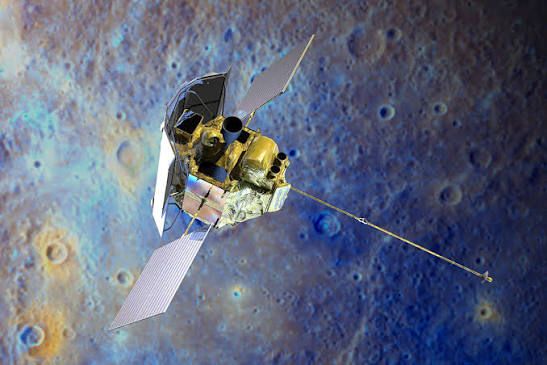
MESSENGER, short for MErcury Surface, Space ENvironment, GEochemistry, and Ranging, was a NASA robotic spacecraft designed, built, and operated by the Johns Hopkins University Applied Physics Laboratory (APL). It was the seventh mission in NASA's Discovery Program and the first spacecraft to enter orbit around Mercury. Its principal science goals were to investigate Mercury's surface composition, geological history, magnetic field, internal structure, polar volatile deposits, and exosphere.
The spacecraft was launched from Cape Canaveral, Florida, on 3 August 2004 aboard a Delta II 7925H rocket. Reaching Mercury required a long gravity-assist trajectory because a spacecraft falling toward the Sun gains substantial speed. MESSENGER therefore used one Earth flyby, two Venus flybys, and three Mercury flybys to reduce its velocity relative to Mercury while conserving propellant.
MESSENGER entered Mercury orbit on 18 March 2011 and began its primary science campaign on 4 April. Its original one-year orbital mission was extended twice, allowing more than four years of observations from Mercury orbit. The mission ended on 30 April 2015 when depleted maneuvering propellant allowed the spacecraft's orbit to decay into an intentional impact with Mercury.
Development
Mariner 10 had made the first close-range observations of Mercury during three flybys in 1974 and 1975, but much of the planet remained unobserved at high resolution. NASA selected MESSENGER for flight in 1999 as a Discovery-class mission led by principal investigator Sean C. Solomon. APL was responsible for spacecraft design, construction, and mission operations for NASA. NASA's historical account notes that the project had to solve two central engineering problems: reaching Mercury without carrying an impractically large propellant load, and operating near the Sun in a severe thermal environment. The mission solution combined repeated gravity assists with a large protective sunshade and spacecraft radiators. A detailed mission overview is available from NASA History.
The mission was originally prepared for a 2004 launch opportunity. After additional spacecraft testing, the launch plan was shifted to the later 2004 window, which required a revised interplanetary trajectory. The final route included an Earth flyby on 2 August 2005, Venus flybys on 24 October 2006 and 5 June 2007, and Mercury flybys on 14 January 2008, 6 October 2008, and 29 September 2009.
Cruise to Mercury
MESSENGER launched at 06:15:57 UTC on 3 August 2004 from Space Launch Complex 17B at Cape Canaveral. After its Earth parking orbit, an upper-stage burn placed the spacecraft on a heliocentric trajectory. The subsequent gravity assists progressively changed its solar orbit and reduced the velocity difference that had to be removed for Mercury orbit insertion.
The Earth encounter also provided an opportunity to calibrate the spacecraft's instruments and image the Earth-Moon system. During the second Venus flyby, MESSENGER passed about 338 km from the planet and collected visible, near-infrared, particle, and field data. The three Mercury encounters returned close-range observations and also prepared the spacecraft dynamically for final orbital insertion. During the third Mercury flyby in September 2009, the spacecraft entered safe mode and lost planned science observations from part of the encounter, but recovered several hours later without losing the trajectory required for the orbital mission.
Mercury orbit insertion
On 18 March 2011, MESSENGER fired its main engine for roughly 15 minutes and became the first spacecraft to orbit Mercury. Its initial orbit was highly elliptical and near-polar, bringing it to about 200 km above the surface at closest approach while carrying it to roughly 15,000 km at the high point, with an orbital period of about 12 hours. The elongated orbit reduced the time spent close to Mercury's hot surface and also enabled observations of the planet's magnetospheric environment over a wide range of distances.
Design
MESSENGER was a compact, thermally protected deep-space spacecraft optimized for prolonged operations close to the Sun. The main spacecraft bus measured approximately 1.85 m high, 1.42 m wide, and 1.27 m deep. Its structure used graphite-fiber composite panels that supported the propellant tanks, propulsion hardware, antennas, instruments, attitude-control equipment, and thermal-control hardware. A ceramic-cloth sunshade approximately 2.5 m high and 2 m wide protected the spacecraft body from direct solar heating.
Propulsion and attitude control
Main propulsion was provided by a LEROS 1b bipropellant engine rated at about 645 N of thrust and using hydrazine and nitrogen tetroxide. The spacecraft carried about 607.8 kg of propellant and helium pressurant for its main propulsion system. Four 22 N monopropellant thrusters supported steering during major burns, while twelve 4.4 N thrusters were used for attitude control. Reaction wheels provided precision pointing between thruster operations.
Power, avionics, and communications
Electrical power came from two rotatable solar-array wings using gallium-arsenide/germanium solar cells and optical reflectors to control array temperature. The system supplied an average of about 450 W in Mercury orbit and stored energy in a 23 Ah nickel-hydrogen battery. MESSENGER used redundant integrated electronics modules with radiation-hardened RAD6000 processors and two solid-state recorders capable of storing up to 1 GB each for science and engineering data.
Communications used NASA's Deep Space Network. The spacecraft carried high-, medium-, and low-gain antenna systems, including electronically steered phased-array high-gain antennas. This arrangement avoided the need for a large mechanically pointed dish while supporting communications despite the spacecraft's thermal and pointing constraints.
Scientific payload
MESSENGER carried seven science instrument packages plus a radio-science experiment. The Mercury Dual Imaging System (MDIS) combined narrow-angle and wide-angle cameras for geological and multispectral mapping. The Gamma-Ray and Neutron Spectrometer (GRNS) measured elemental composition and hydrogen abundance. The X-Ray Spectrometer (XRS) measured surface elemental composition through solar-induced X-ray fluorescence.
The Magnetometer (MAG), mounted on a boom away from the spacecraft body, characterized Mercury's magnetic field and its interaction with the solar wind. The Mercury Laser Altimeter (MLA) measured topography and surface reflectivity. The Mercury Atmospheric and Surface Composition Spectrometer (MASCS) studied Mercury's exosphere and surface mineralogy. The Energetic Particle and Plasma Spectrometer (EPPS) measured charged particles and plasma around the planet. The Radio Science (RS) investigation used precise spacecraft tracking to study Mercury's gravity field and interior. NASA provides the mission's official instrument list and mission chronology on its MESSENGER mission page.
Operational history
Formal science operations began on 4 April 2011 after an orbital commissioning period. During the primary mission, MESSENGER acquired nearly 100,000 images and established the first global orbital perspective of Mercury. Early findings included unexpectedly high magnesium and calcium abundances, evidence of past volcanic activity, a magnetic field offset northward from the planet's center, and observations of water in Mercury's exosphere.
NASA approved a first one-year mission extension beginning in March 2012. During this period, several engine burns reduced the orbital period from 12 hours to 8 hours, allowing a different observing cadence. MESSENGER completed global high-resolution monochrome and color mapping and produced evidence that radar-bright deposits in permanently shadowed polar craters contained water ice. NASA's astrobiology mission record notes that the polar thermal environment permits water ice to remain stable either at the surface or beneath shallow cover; it also records measurements that constrained Mercury's unusually large core and verified that the outer core is molten. Further mission findings are summarized by NASA Astrobiology.
A second extension carried the mission into 2015. MESSENGER passed its 200,000th orbital image in February 2014 and later operated from progressively lower altitudes, producing increasingly detailed observations of the surface and polar regions. It also observed Comet 2P/Encke and Comet C/2012 S1 (ISON). Controllers periodically raised the orbit as propellant reserves diminished.
By early 2015, the spacecraft had nearly exhausted the propellant required for orbital maintenance. Mission controllers used the remaining helium pressurant as reaction mass to prolong operations for several additional weeks. On 30 April 2015 at 19:26 UTC, MESSENGER struck Mercury at about 14,080 km/h, creating a new impact crater and ending a mission that had operated for more than ten years after launch and more than four years in Mercury orbit.
NASA later reported that MESSENGER returned nearly 300,000 photographs and more than 10 TB of formatted scientific data. Major results included confirmation of water ice in permanently shadowed polar regions, evidence for organic compounds near the north pole, extensive evidence of volcanism, improved understanding of Mercury's magnetic field and interior, and the finding that the planet's surface materials are more volatile-rich and chemically reduced than had been expected before the mission. A concise independent spacecraft summary, including the launch mass, propulsion type, instrument arrangement, and nominal orbit, is available from Gunter's Space Page.
Operators
- NASA: Mission operator and program authority for MESSENGER. Spacecraft design, construction, and day-to-day mission operations were carried out by the Johns Hopkins University Applied Physics Laboratory for NASA.
Specifications (MESSENGER spacecraft)
General characteristics
- Type: Robotic Mercury orbiter
- Manufacturer: Johns Hopkins University Applied Physics Laboratory
- Operator: NASA
- Launch mass: 1,107.9 kg
- Spacecraft bus dimensions: approximately 1.85 m high, 1.42 m wide, and 1.27 m deep
- Sunshade: approximately 2.5 m high and 2 m wide
- Launch vehicle: Delta II 7925H
- Launch site: Cape Canaveral, Florida, Space Launch Complex 17B
Propulsion and power
- Main engine: LEROS 1b bipropellant thruster
- Main-engine thrust: approximately 645 N
- Propellants: hydrazine and nitrogen tetroxide
- Propellant and pressurant load: approximately 607.8 kg
- Steering thrusters: four 22 N monopropellant thrusters
- Attitude-control thrusters: twelve 4.4 N monopropellant thrusters
- Electrical power: two rotatable solar-array wings; approximately 450 W average in Mercury orbit
- Energy storage: 23 Ah nickel-hydrogen battery
Scientific equipment
- MDIS: Mercury Dual Imaging System
- GRNS: Gamma-Ray and Neutron Spectrometer
- XRS: X-Ray Spectrometer
- MAG: Magnetometer
- MLA: Mercury Laser Altimeter
- MASCS: Mercury Atmospheric and Surface Composition Spectrometer
- EPPS: Energetic Particle and Plasma Spectrometer
- RS: Radio Science experiment
Mercury orbital parameters
- Orbit insertion: 18 March 2011
- Initial orbital period: approximately 12 hours
- Initial closest approach: approximately 200 km above Mercury
- Initial high point: approximately 15,000 km above Mercury
- Orbit type: highly elliptical, near-polar Mercury orbit
Related equipment
- Mariner 10: NASA spacecraft that made three Mercury flybys in 1974 and 1975 and provided the first close-range observations of the planet before MESSENGER.
- BepiColombo: European Space Agency and Japan Aerospace Exploration Agency mission launched in 2018 to continue orbital exploration of Mercury with two spacecraft.
 Argentina
 Armenia
 Australia
 Austria
 Austria-Hungary
 Belgium
 Brazil
 United Kingdom
 Brunei
 Bulgaria
 Canada
 Chile
Chile China
China Colonial America
 Colombia
 Confederate States
 Croatia
 Czech
Czech Denmark
 Egypt
Egypt Finland
 France
 Georgia
 Germany
 German Imperial
 Greece
 Holland
 Hungary
 India
India Indonesia
 Iran
Iran Iraq
Iraq Ireland
 Israel
 Italy
Italy Japan
Japan Japan (1940)
 Jordan
 Kingdom of Italy
 Malaysia
 Mexico
 Myanmar
 Nazi Germany
 Netherlands
 New Zealand
 North Korea
 Norway
 Pakistan
 Peru
Peru Philippines
 Poland
 Portugal
 Prussia
 Romania
 Russia
 Saudi Arabia
 Serbia
 Singapore
 Slovakia
 Slovenia
 South Africa
 South Korea
 Soviet Union
 Spain
Spain Sweden
 Switzerland
 Syria
Syria Taiwan
 Thailand
 Turkey
 UAE
UAE Ukraine
 Vietnam
 Yugoslavia